
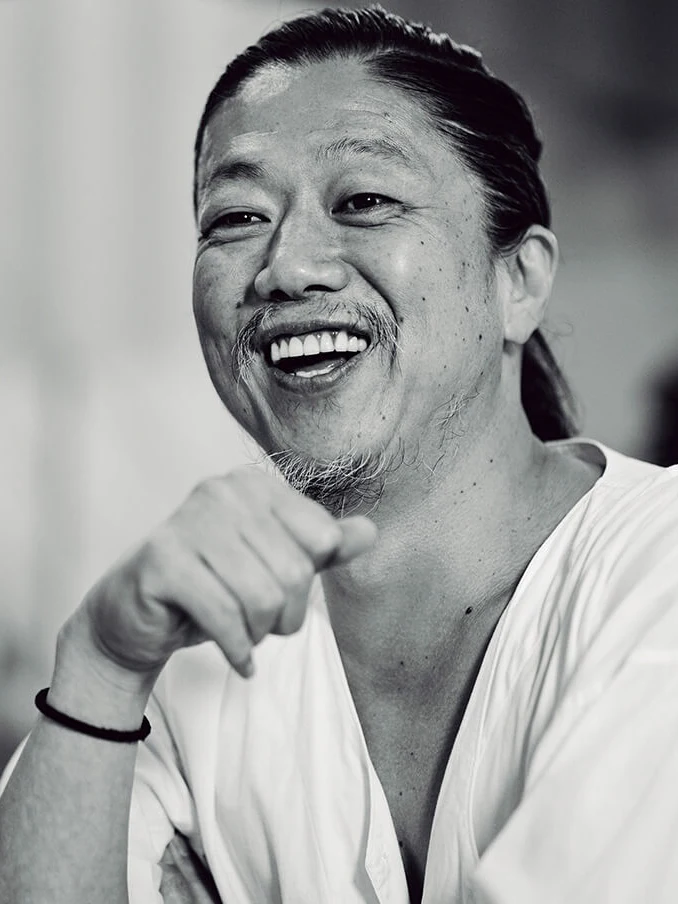
Atsuhiko Mori
Former professional footballer turned designer; co-founded Tokyo label WACKO MARIA in 2005 and has led it alone since 2012.
Atsuhiko Mori designs WACKO MARIA, the Tokyo menswear label known for open-collar shirts, tiger prints and a long series of projects drawn from film and music. His route into fashion was unusual: before he had designed a collection, he had played professional football as a goalkeeper, retired at twenty-five and opened a record bar. Music and cinema became his education, and they still provide the label with its imagery, collaborators and atmosphere. (note; Whiteboard Journal)
A second correction matters for anyone reading a WACKO MARIA label: the brand is often still described as a two-man project. It was, for its first seven years. Mori founded it with fellow former footballer Keiji Ishizuka in 2005, but Ishizuka left the company in 2012, and Mori has been its sole designer and director since. (RINKAN)
From the goal line to Rock Steady
Mori was born in Hyōgo Prefecture in 1972. In 1991 he joined the All Nippon Airways Yokohama Soccer Club, which became Yokohama Flügels when the J.League launched in 1993, and played as a goalkeeper. His dreadlocks and bandana made him a recognisable figure on the pitch, and supporters nicknamed him "Reggae-kun" (レゲエ君). He retired from professional football at twenty-five, after roughly six years in the game. (note; Whiteboard Journal)
Music had preceded football as an obsession — Mori has said he first discovered it through a television programme he watched as a nine-year-old third-grader, and later attended Takikawa Daini High School before turning professional. After he stopped playing, that interest became the business. He opened Rock Steady, a Tokyo bar built around a carefully chosen sound system and a record collection spanning reggae, rocksteady, ska, soul, funk, rockabilly and Latin music. It was this bar, not a fashion apprenticeship, that put him in the position to start a clothing label at all. (note)
Mori has stayed a working DJ and record collector alongside running the label, hosting KILLER TUNES BROADCAST, a sound crew and broadcast project through which he shares music spanning multiple genres and eras. The habit matters for reading the brand: WACKO MARIA's prints, collaborators and even its store fixtures tend to trace back to something Mori was listening to first. (Silver Magazine)
Founding WACKO MARIA and "Guilty Parties"
Mori and Ishizuka started WACKO MARIA in 2005. The name is a Latin-inflected coinage roughly meaning "eccentric Maria," and the two men built the label around a loosely stated concept — women, music, alcohol and hats — rather than a seasonal theme. Mori has said his own design test is simpler than any of that: whether a thing is "interesting or not interesting," and his conviction that "if a person is uncool, the clothes they make won't be cool" shapes who he works with as much as what he draws. (note)
The brand's mark, Guilty Parties, names the community the label claims rather than a product line. WACKO MARIA's own description of the term is "companions who do both good and bad things together" — the collaborators, musicians and friends whose tastes the label treats as source material. (WACKO MARIA) The label gave that idea a physical form early on: in September 2011 it published The Americans Guilty Parties, an 80-page black-and-white photobook shot in Los Angeles by the photographer Taro Mizuguchi, using documentary photography rather than a lookbook to set out who the brand considered its people. (RINKAN)
Mori's own account of his reference points runs wider than the reggae and rocksteady that built Rock Steady. He has named Italian cinema and architecture among his enduring interests, along with directors including Luchino Visconti, Federico Fellini, Bernardo Bertolucci and Jean-Luc Godard, and has described what he is chasing across every medium — music, clothes, photography, architecture, film — as something "imaginable, delusive." (Whiteboard Journal)
Ishizuka left in 2012, although no exact departure date or account of the split has been published; Mori has held both the design and director roles since. The brand's founding year also appears as 2003 in some summaries, but its 2015 flagship was presented as a tenth-anniversary opening and a 2020 project marked its fifteenth anniversary. Those milestones place the launch in 2005. (RINKAN; Hypebeast Japan)
Paradise Tokyo: the record bar as flagship
WACKO MARIA opened its first standalone store, Paradise Tokyo, in Meguro in 2015 to mark the label's tenth anniversary. It is not a conventional flagship: alongside the clothing floor there is a roughly twenty-seat bar and café, and a sound system built on vintage Western Electric and Altec Lansing components chosen for tones Mori has said modern equipment cannot reproduce. The store holds an extensive collection of vinyl, much of it Mori's own. (RINKAN)
Mori has been direct about the order of operations behind that choice. "Music is the trigger of imaginations," he said discussing a 2021 sneaker project, adding that listening to music "makes me feel like I've traveled to different worlds" and that he designs clothes and objects the same way regardless of category — "I just make whatever feels stylish, so it's basically the same whether it's clothes or sneakers." Paradise Tokyo is the physical version of that claim: a shop built to be listened in first. (Hypebeast)
Collaboration as a design language
Collaboration is not a marketing add-on at WACKO MARIA; it is close to the label's main working method. Mori has said he approaches partners himself and picks them on artistic and musical grounds rather than commercial ones, which is consistent with a list that runs from filmmakers to tattoo artists to sportswear houses rather than staying inside one category. (Whiteboard Journal)
The independent filmmaker Jim Jarmusch is one of the longest-running of these partnerships, with prints and Hawaiian shirts drawing on his films, including The Dead Don't Die. (Silver Magazine) The San Francisco tattoo artist Tim Lehi supplies the all-over tiger and dragon artwork behind some of WACKO MARIA's best-known Hawaiian shirts, a partnership that has recurred across multiple seasons since at least 2022. (Fashionsnap)
On the footwear side, WACKO MARIA showed its first sneaker collaboration with Converse in July 2016, and in 2021 worked with Vault by Vans on an Authentic LX sneaker whose print reworked a decade-old WACKO MARIA vinyl-record graphic and paired the shoe with a limited seven-inch record — collaboration treated as a two-way exchange between object and music rather than a logo swap. (RINKAN; Hypebeast) The illustrator Neckface contributed painted artwork to a 2016 collection, one of the earliest of the artist tie-ins that later became a running feature of the brand, and WACKO MARIA has run repeat workwear collaborations with Wrangler — cowboy jackets, western shirts and jeans reworked through the label's own cut — and a long-running partnership with the Tokyo stud and leather specialist Wolf's Head on aloha and Cuban shirts carrying monster and animal motifs. (RINKAN) More recent seasons have added licensed graphics drawn from film, among them The Silence of the Lambs and Mulholland Drive, alongside the recurring Tim Lehi and Jim Jarmusch projects. (note)
Labels, dating and how to read the work
WACKO MARIA does not run a lettered line system the way, for example, Comme des Garçons does. A garment is either part of a numbered seasonal collection or a named collaboration, and the collaborator's name is usually printed directly on the piece — on a woven label, a hem tag or as part of the graphic itself — rather than encoded. That makes the collaborator credit the first and most reliable thing to check on an unfamiliar piece. (WACKO MARIA)
The tiger print is the case to be careful with. It is not exclusive to any one partnership: Tim Lehi's tiger artwork, WACKO MARIA's own house tiger patterns and other collaborators' animal prints (Wolf's Head among them) have all appeared on the same open-collar Hawaiian shirt silhouette across different years. A tiger-print aloha shirt with a WACKO MARIA label is not, by itself, identifiable as a specific season or collaborator — the artwork, the printed credit and the retailer's own season listing all need to agree before a piece can be dated with confidence. (Fashionsnap)
The 2012 split with Ishizuka is a useful rough marker rather than a precise cut-off: pieces from 2005–12 come from the two-founder period, while everything from 2012 onward was directed by Mori alone. Retail delivery can lag a season's presentation, so a resale listing should still be checked against WACKO MARIA's collection archive rather than dated from styling. (RINKAN; WACKO MARIA)
References
- Fashion Tomo. "ワコマリア(WACKO MARIA)完全解説." note. Accessed September 2026.
- Whiteboard Journal. "Wacko Maria: Atsuhiko Mori's Pursuit of Passion." Whiteboard Journal.
- RINKAN. "ワコマリアの歴史." RINKAN Column.
- RINKAN. "ワコマリアの旗艦店 PARADISE TOKYO." RINKAN Column.
- RINKAN. "ワコマリアのコラボレーション." RINKAN Column.
- WACKO MARIA. "About." wackomaria.co.jp. Accessed September 2026.
- Silver Magazine. "Interview with Atsuhiko Mori (WACKO MARIA Designer) about Fashion needs Music." Silver Magazine.
- Hypebeast. "Wacko Maria's Atsuhiko Mori Shares the Musical Influences in Vault by Vans Collaboration." Hypebeast, 6 May 2021.
- Fashionsnap. "「ワコマリア」がタトゥーアーティストのティム・リーハイとコラボ、虎柄のハワイアンシャツとショーツ3型発売." Fashionsnap, 30 June 2022.
- Hypebeast Japan. "WACKO MARIA がブランドのダブルアニバーサリーを記念し舐達麻とコラボレーション." Hypebeast Japan, September 2020.
- 生年
- 1972年5月31日
- 原語表記
- 森敦彦