Keizo Shimizu
Japanese retailer and designer who founded Nepenthes and built NEEDLES from idiosyncratic American dress, film and music.
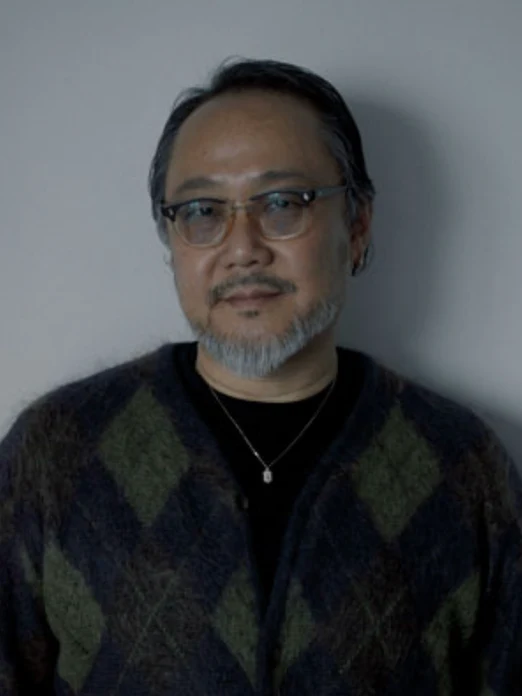
Keizo Shimizu is the founder of Nepenthes and the designer of NEEDLES. He has spent his career looking at American clothing from Japan without treating “Americana” as a fixed, tasteful canon. In his hands, track suits meet Western tailoring, military surplus becomes one-off patchwork and a conservative sack jacket may arrive in purple velour. The pleasure comes from the collision: familiar clothes retain enough of their history to be recognised, then colour, proportion and styling pull them somewhere stranger. (NEEDLES; SSENSE Japan)
Shimizu was born in Yamanashi Prefecture in 1958. His father managed a cinema and returned from buying trips to Tokyo with made-to-measure clothes and a Burberry coat; twice-yearly family visits to Shinjuku made the city's department stores and menswear shops part of Shimizu's childhood calendar. As a teenager he moved from Ivy style towards 1950s clothing and American casual dress under the influence of American Graffiti and the Japanese Made in U.S.A. catalog. Cinema, records and clothes were already one field of information. (Nepenthes)
After a very brief first attempt at fashion school, he worked to pay his own way into Bunka Fashion College. On graduating in 1980 he joined the Shibuya shop Union Square, which reopened as Redwood two years later with Shimizu as manager. Redwood became known for imports that sat outside Japan's most obvious channels. Retail was his real apprenticeship: not simply learning what an American garment looked like, but finding makers, judging stock and discovering how an object changed when placed beside something from another subculture. (Nepenthes; Dig-it)
Building Nepenthes
Shimizu established Nepenthes in 1988. The company began as an importer and wholesaler, with Daiki Suzuki buying in the United States, and gradually became a network of shops, labels and printed matter. Its importance cannot be reduced to NEEDLES alone. Nepenthes created a context in which obscure American manufacturers, Japanese-made originals, vintage clothing, outdoor equipment and eccentric styling could support one another. Engineered Garments, South2 West8 and NEEDLES developed distinct authors rather than becoming one anonymous house style. (NEEDLES; Fashion Press)
NEEDLES began in 1995. Some contemporary accounts give 1996, but the label's own profile specifies 1995; for catalogue purposes, the official date is the sounder one. Shimizu had already spent fifteen years selecting other people's products. His label allowed him to supply garments that he could imagine but could not find: clothes grounded in American work, sports, military, Ivy and countercultural dress, yet freed from the obligation to reproduce any one of those worlds correctly. (NEEDLES; GQ Japan)
That freedom is visible in the label's recurring characters. There is the louche musician in narrow trousers, the cowboy in piped synthetic cloth, the sportsman in a glossy track suit and the outdoorsman in mismatched surplus. Shimizu does not smooth them into a neutral wardrobe. Peacock colours, animal patterns and awkwardly seductive fabrics preserve their theatricality, while relaxed construction keeps the pieces wearable. Film and music supply attitudes rather than costume briefs. (SSENSE Japan; Mastered)
The track pant that took its time
The NEEDLES track pant first appeared in 2008 and attracted little attention. Shimizu continued making it because he wanted to wear it himself. Its basic language is direct—polyester jersey, contrasting side tape and a drawstring waist—but the cut turns ordinary sportswear into a highly legible silhouette. Narrow, straight, boot-cut, H.D. and later skirt forms let the same stripe move differently around the body. (Hypebeast Japan; HOUYHNHNM)
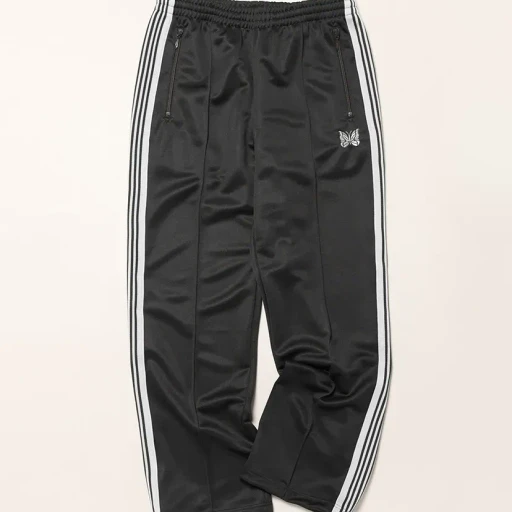
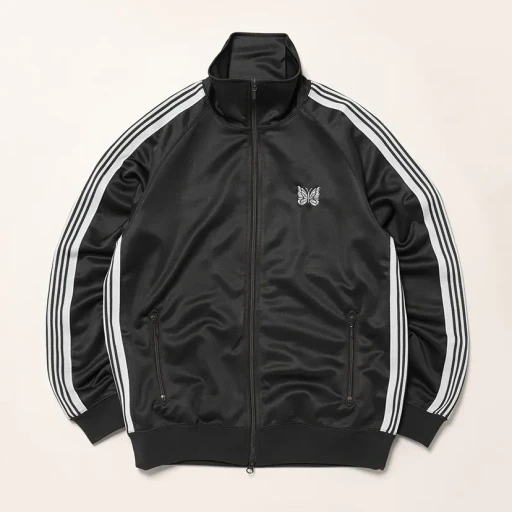
The butterfly emblem made the growing family recognisable, its delicate swallowtail form an elegant counterpoint to a garment inherited from athletics. The track pant's international breakthrough came much later, helped by A$AP Rocky wearing NEEDLES. Shimizu stresses that the relationship was not a planned celebrity-placement campaign. Musicians adopted the clothes and the image travelled organically; an initially ignored piece became the label's global identifier. (Hypebeast Japan; HOUYHNHNM)
This history is worth remembering because ubiquity can make the track series look like a logo product designed for social media. It predates its hype by years and belongs to Shimizu's longer habit of placing supposedly low or unfashionable materials in newly persuasive combinations. The versions also matter: Poly Smooth, velour and jacquard do not hang alike, and H.D., narrow and boot-cut patterns are substantially different trousers rather than colours of one model. (Hypebeast Japan; NEEDLES)
Rebuild, not imitation
Shimizu formally launched Rebuild by NEEDLES in 2010. The project starts with American deadstock and used garments that may have excellent pockets, cloth or fading but little usefulness in their existing form. Japanese factories dismantle and combine them into new garments. A 7 Cuts flannel shirt, for example, splices sections of several shirts so that checks, hems and wear patterns refuse perfect symmetry. No two examples can be exactly the same. (NEEDLES; HOUYHNHNM)
Shimizu prefers “rebuild” to casual “remake” because the work uses industrial sewing skill and a designed pattern rather than a few domestic alterations. The Spring/Summer 2012 theme Rebuild to the Last also carried the post-earthquake sense of rebuilding Japan. This did not make the collection a literal charity message; it gave the physical act of rescuing unusable clothes a wider emotional pressure. (Mastered; GQ Japan)
There is an ecological argument here, though Shimizu makes it through garments rather than abstract virtue. Mass-produced clothes already exist, and some contain qualities no new imitation will reproduce. Rebuild preserves those useful fragments while changing fit and function for the present. The labour is conspicuous: mismatched seams and panels make the reconstruction readable rather than disguising old material as a pristine new commodity. (GQ Japan; HOUYHNHNM)
A retailer's authorship
Shimizu's contribution to Japanese fashion lies as much in editing as in drawing. Nepenthes' shops, catalogues and editorial projects teach a way of looking across hierarchies: an inexpensive synthetic jersey can be as evocative as leather; an unfashionable shoe may become desirable in the right company; a Japanese reconstruction can reveal something neglected in American clothing. His role as retailer keeps the design practice connected to what people actually discover, buy, wear down and return for. (HOUYHNHNM; SSENSE Japan)
In 2023 he also began Hana, Taiyo, Ame—“flowers, sun, rain”—in Biei, Hokkaido. The project extends Nepenthes' curiosity into a specific rural setting rather than proposing a replacement for NEEDLES. It is consistent with a career built through places: Yamanashi, Shinjuku and Shibuya shaped the early eye; repeated American buying trips produced a trans-Pacific business; Hokkaido opened another local field of work. (Nepenthes)
Reading NEEDLES in the catalogue
The main NEEDLES label, Rebuild by NEEDLES and collaborations should be recorded distinctly. Rebuild pieces ought to show variation and evidence of multiple source garments; apparent irregularity is not by itself a flaw. On main-line track garments, note the product name, silhouette, fabrication, season code and colour. The butterfly confirms the brand family, not the year, and it appears on far more than the original track trouser. (NEEDLES; HOUYHNHNM)
Recurring forms make visual dating unreliable. Track pants and jackets are issued season after season in different tapes and bodies; piping cowboy jackets and mohair cardigans also return. Record the complete style code from the care label and distinguish collaborative branding from ordinary retail styling. A celebrity photograph can establish that a type was worn by a certain date, but it cannot date every later garment with the same butterfly or stripe. (Hypebeast Japan; NEEDLES)
Shimizu's work rewards that specificity. NEEDLES is not one purple trouser but a long experiment in how clothes gather meaning: through the remembered film, the overlooked shop, the old shirt cut apart, the wearer onstage and the customer who keeps returning after fashion has moved on. (SSENSE Japan; NEEDLES)
References
- NEEDLES. “Profile: Keizo Shimizu.” Accessed September 2026.
- NEEDLES. Official website. Accessed September 2026.
- Nepenthes. “A Place to Be My True Self: Keizo Shimizu.” 2024.
- SSENSE Japan. “清水慶三と鈴木大器のアメリカンドリーム.” 2020.
- Mastered. “2012年春のブランド大特集 Vol.01: Needles.” 17 January 2012.
- GQ Japan. “ヴィンテージこそがニューラグジュアリーだ.” 16 August 2016.
- Hypebeast Japan. “NEEDLESデザイナー清水慶三がトラックパンツの歴史について語る.” 3 June 2021.
- HOUYHNHNM. “新しい時代の定番パンツと言ってよいでしょう.” 3 June 2021.
- HOUYHNHNM. “リメイクではなく、リビルド.” 5 December 2014.
- HOUYHNHNM. “ネペンテスのこれまでとこれから.” 17 July 2015.
- Fashion Press. “エンジニアド ガーメンツ デザイナー 鈴木大器.” 9 July 2013.
- Dig-it. “世界的オリジナルブランドでも知られる老舗セレクトショップ『ネペンテス』.” 15 May 2024.
- Native name
- 清水慶三
- Education
- Bunka Fashion College