Maria Grazia Chiuri
Roman designer who led Dior's womenswear as its first female creative director, 2016–2025, and now leads Fendi as chief creative officer.
Maria Grazia Chiuri returned to Fendi as chief creative officer in October 2025, having begun her career in its accessories studio in 1989. Between those appointments she co-directed Valentino with Pierpaolo Piccioli and led Dior womenswear and couture for nine years. Her work is often most legible in a single object: the shared Rockstud, a revived Saddle bag, or Dior’s feminist slogan T-shirt. (LVMH; WWD)
Chiuri has a practical feel for a house’s most recognisable pieces. At Valentino, she and Piccioli made the Rockstud a repeatable accessory language; at Dior, she returned the Saddle bag to shops and gave the Bar jacket new fabrics and proportions. She has also used runway clothes and sets to foreground women’s work and the craft of embroidery, with a directness that has drawn both admiration and criticism. (Business of Fashion)
Rome, Fendi, and an apprenticeship in accessories
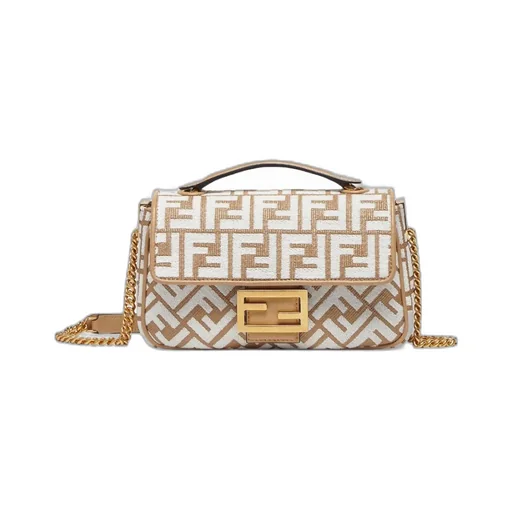
Chiuri was born in Rome on 2 February 1964, the daughter of a dressmaker mother and a father in the military; she has said her mother's workshop, and the five sisters she grew up alongside, shaped her sense of clothing as something made rather than merely designed. She trained in fashion design at the Istituto Europeo di Design in Rome, then joined Fendi in 1989 to work on handbags. There she recruited a colleague, Pierpaolo Piccioli, into the same department, and the two worked together on the house's accessories line through the 1990s, a period that included the development of the Fendi Baguette, the small, arm-hugging shoulder bag that became one of the most copied handbag shapes of the decade. (BoF; The Zoe Report)
Valentino: accessories to the top of the house
Chiuri and Piccioli moved together to Valentino in 1999, again to develop accessories, working in the shadow of Valentino Garavani's couture without yet directing it. When Garavani retired in 2008, the pair were named co-creative directors on 4 October 2008, a partnership documented at length on Pierpaolo Piccioli's own profile. Their most consequential joint object was the Rockstud, a pyramid-stud line introduced in 2010 that both designers have consistently described as a shared invention rather than either one's individual authorship — an important distinction for anyone trying to attribute a specific Valentino piece from that period. (Associated Press; Interview)
The partnership ended on 7 July 2016, when Valentino confirmed Chiuri's exit "to pursue a new professional experience" and named Piccioli sole creative director. In a joint statement, the two said they were choosing, after twenty-five years together, "to continue our artistic paths in an individual way with the reciprocal desire of further great achievements." Chiuri's new position, at Dior, was confirmed the following day. (Fashion Network; LVMH)
Dior and the slogan T-shirt
On 8 July 2016, Christian Dior announced Chiuri as creative director of women's haute couture, ready-to-wear and accessories — the first woman to hold the position in the house's seventy-year history. Bernard Arnault, LVMH's chairman, said she would bring "her elegant and modern vision of the Dior woman, seamlessly attuned to the heritage and the codes defined by Monsieur Dior." (LVMH)
She used her first show, for Spring/Summer 2017 in September 2016, to make the appointment itself the subject. Models opened in a white fencing jacket, and a plain cotton T-shirt printed with "We Should All Be Feminists" — the title of Chimamanda Ngozi Adichie's 2014 essay — became the collection's most photographed piece within hours, amplified when Rihanna posted a picture of herself wearing it. The gesture set the register for Chiuri's Dior: recognisable house codes, redeployed to carry an explicit message about who gets to wear them. (Fashion Network; V&A)
The slogans drew criticism as well as attention. Cathy Horyn, Vanessa Friedman and other reviewers questioned whether a feminist message printed on an expensive T-shirt could carry the weight Chiuri placed on it. She continued to put that language on the runway while building more sustained collaborations with women artists and makers behind the collections. (Grazia; UnHerd)
Reworking the archive: the Saddle, the Book Tote, the Bar jacket
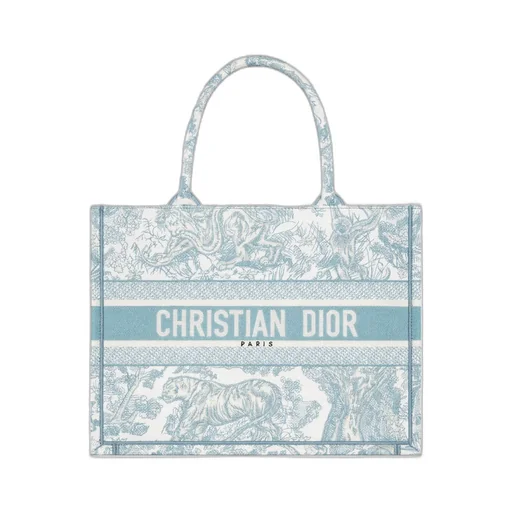
Much of Chiuri's commercial success at Dior came from returning to objects already in the house's history rather than inventing new ones. In 2018 she reissued the Saddle bag, the asymmetrical, equestrian-shaped bag John Galliano had introduced for Spring/Summer 2000, timing its comeback to the fiftieth anniversary of the 1968 Paris protests; it became Dior's best-selling accessory of the period. The same year she introduced the Book Tote, a canvas-and-leather shopper drawn from a 1967 archive sketch by Marc Bohan, which became one of the most recognisable logo bags of its decade. (Hypebae; Second Sense)
She treated the Bar jacket — the fitted, peplum-hipped jacket at the centre of Christian Dior's 1947 New Look — the same way, opening her Autumn/Winter 2020 show with a rib-knit version and later a leopard-print take referencing Mizza Bricard, one of Christian Dior's own muses. The point in each case was the same: to keep a garment's silhouette legible while changing its material, its price point or the body it was shown on, rather than starting again from a blank page. (SHOWstudio; Russh)
Craft as collaboration: Chanakya and the ateliers of Mumbai
Chiuri's other consistent method was building shows around named collaborators rather than working alone. She had known Karishma Swali, artistic director of the Mumbai embroidery atelier Chanakya, since her Fendi years; at Dior she commissioned Chanakya for set pieces and embroidery, and in 2014 backed Swali's project to document India's hand-craft traditions, which became the nonprofit Chanakya School of Craft in 2016, training women in embroidery as a route to financial independence. The relationship culminated in The Toran, a 46-foot embroidered installation for Dior's March 2023 show, made with 35,000 hours of handwork across twenty-five techniques. She worked in a similar vein with the American feminist artist Judy Chicago, whose 1979 installation The Dinner Party inspired the set and a woven carpet for Dior's Spring 2020 haute couture show, The Female Divine. (Wallpaper*; AnOther)
Rome, twice over
Chiuri never fully relocated her life to Paris. In 2020 she bought and began restoring the Teatro della Cometa, a mid-century Roman theatre designed by Tomaso Buzzi, working with her husband and children; it reopened in May 2025 under the direction of her daughter, Rachele Regini. Weeks earlier, on 27 May 2025, she staged Dior's Cruise 2026 show in the gardens of the Villa Albani Torlonia in Rome — eighty looks mixing ready-to-wear with haute couture pieces, built around a theme she called bella confusione. Two days later, on 29 May 2025, Dior confirmed she was stepping down, closing a nine-year tenure with a show in her home city rather than in Paris. (WWD; Business of Fashion)
Return to Fendi
LVMH announced Chiuri as Fendi's chief creative officer on 14 October 2025, giving her authority across womenswear, menswear, couture and accessories at the house where she had begun her career. She presented her first collection, Fendi's Fall/Winter 2026–27 show, in Milan on 25 February 2026, built around the phrase "Meno Io, Più Noi" — "Less I, More Us" — spelled out on the runway as a statement that a collection is made by an atelier, not a single name. The Baguette, the bag she had helped shape in the 1990s, returned as the collection's central object, remade in whipstitch leather, beadwork and shearling. (LVMH; Wallpaper*)
Labels, dating and how to read the work
A Valentino piece from 1999 to October 2008 comes from the accessories studio Chiuri co-led rather than from a named creative direction; from October 2008 to July 2016 it is co-authored with Piccioli, and the Rockstud family in particular should be attributed to both designers jointly, not to either alone. A Dior piece needs its season checked against the July 2016–May 2025 window to confirm it as Chiuri's: house classics like the Saddle and the Book Tote were revived by her but originated under earlier creative directors, so a later reissue or colourway can postdate her tenure even though the shape itself is one she made newly popular.
At Fendi, the useful line falls in February 2026. Pieces from her chief creative officer tenure begin with the Fall/Winter 2026–27 collection; anything earlier, including further Baguette variants from the 2010s and 2020s, belongs to Silvia Venturini Fendi's design leadership rather than Chiuri's, even though both women worked on the same bag at different points in the house's history. As with any resale attribution, a season code or a dated collection tag is worth more than a designer's name alone — especially for a designer whose signature has always been to work through a house's existing objects rather than to invent a visibly personal one.
References
- LVMH. "Maria Grazia Chiuri, artistic director of women's collections at Dior." 8 July 2016.
- LVMH. "Maria Grazia Chiuri named Chief Creative Officer at Fendi." 14 October 2025.
- WWD. "Dior Confirms Maria Grazia Chiuri Is Stepping Down." 29 May 2025.
- WWD. "Maria Grazia Chiuri on Her Restored Theater and Rome's Special Locations." 2025.
- Business of Fashion. "Confirmed: Dior Artistic Director Maria Grazia Chiuri Steps Down." 29 May 2025.
- Business of Fashion. "Maria Grazia Chiuri | BoF 500." Profile.
- The Zoe Report. "35 Years After Starting Her Career There, Maria Grazia Chiuri Returns To Fendi As Creative Director." October 2025.
- Associated Press. "Valentino's longtime designer Piccioli announces his departure after 25 years." 22 March 2024.
- Fashion Network. "Valentino nominates Piccioli sole creative director." 7 July 2016.
- Interview. "Studly Valentino." 15 October 2010.
- Fashion Network. "Chiuri raises banner of feminism in first Dior show." September 2016.
- Victoria and Albert Museum. "'We Should All Be Feminists' T-shirt, Chiuri, Maria Grazia." Collection record.
- Grazia. "Calling Bullshit on (Dior's) Feminist Slogan Tees." 2018.
- UnHerd. "Dior's faux feminism." June 2025.
- Hypebae. "The Unique History of Dior's Iconic Saddle Bag." October 2018.
- Second Sense. "The History and Evolution of the Dior Book Tote." 2025.
- SHOWstudio. "Maria Grazia Chiuri Reimagines the Dior Bar Jacket." 2020.
- Russh. "The iconic Dior Bar Jacket reimagined by Maria Grazia Chiuri." 2021.
- Wallpaper*. "Dior celebrates the virtuosity of Indian craft in new exhibitions." 2023.
- AnOther. "Dior Collaborates with Feminist Artist Judy Chicago on Haute Couture Show." January 2020.
- Wallpaper*. "Maria Grazia Chiuri makes her debut at Fendi: 'Less I, more us'." February 2026.
- Born
- February 2, 1964
- Education
- Istituto Europeo di Design, Rome, Fashion design
- Awards
- CFDA International Award, 2015Knight of the Legion of Honour, 2019FIT Couture Council Award for Artistry of Fashion, 2022