
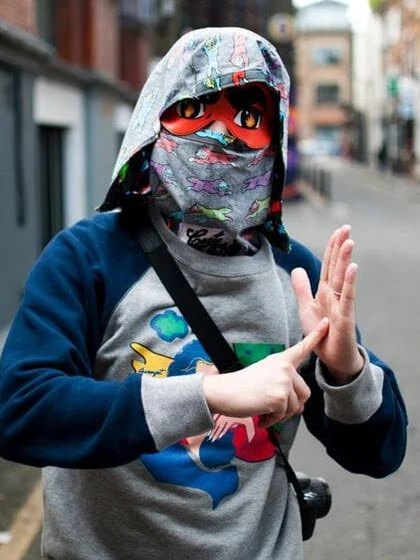
SK8THING
Tokyo graphic designer known as SK8THING, co-founder and designer of Cav Empt and the hand behind much of A Bathing Ape's early graphics.
SK8THING is a graphic designer, not a fashion designer, and for the first two decades of his career he was not the person whose name went on anything. He drew for other people's labels. English-language sources give his real name as Shinichiro Nakamura; Japanese street-skating circles have called him スケシン (Sukeshin) since the 1980s. He almost never gives interviews, keeps no archive of his own work, and has said plainly why: he has always worked for brands that already had a front man, so there was nothing he needed to explain in public. (Interview)
His low public profile has encouraged loose attribution. Resale listings and forum posts often credit him with almost every important graphic to emerge from Ura-Harajuku, the network of small Tokyo labels that formed behind Harajuku's main street in the 1990s. His documented influence is already considerable, but it does not make every anonymous graphic his work. (Interview)
Skateboards before graphics
He came out of skateboarding, not art school. Around 1984, Hiroshi Otaki formed the Tokyo skate team TOKYO SKATES — the group that became T19 — and among the people he skated and made things with were Tatsuya Mino, Shin-chan (SK8THING) and Hiroshi Fujiwara. Otaki's own account is unfussy about the period: they cut their own boards and drew on the decks and on T-shirts, and entered contests on them. (VHSMAG; Fashion Press)
Asked about his art or design education, he answered with one word: none. He drew constantly, learned from friends, and was taught to use a Mac for the first time by Fujiwara. By 2010 he estimated he had been designing T-shirts for about twenty years, without ever having counted the designs. (Interview)
That sequence matters for reading the work. A screen print — ink pushed through a stencilled mesh onto cloth — was the cheapest way a skate crew could put an image into the world, and it stayed his native format long after the tools changed. He works alone in a Tokyo studio, feeding finished files into other people's teams, and does not travel; in 2010 he said he found Tokyo uninteresting and never had found it otherwise, so he looked outward from the desk instead. (Interview)
Goodenough, and a T-shirt that started a scene
GOODENOUGH was established in Tokyo in 1990 and is usually filed as Hiroshi Fujiwara's first streetwear label. The origin story, as the brand directories tell it, puts SK8THING at the start of it: the label came about after he raised with Fujiwara the possibility of making graphic T-shirts. A Japanese account of the Ura-Harajuku chronology tells it the same way, as a friend's remark that Fujiwara acted on immediately. (Hypebeast; Qkaku)
The relationship did not end with the 1990s. When GOODENOUGH returned to the street scene in 2016, Japanese trade coverage described it as the label that Fujiwara and SK8THING run together — present tense, more than twenty-five years after it started. (Hypebeast Japan)
A Bathing Ape and the limits of attribution
A Bathing Ape was founded in 1993 by Nigo. SK8THING was there from the beginning: the 2010 Interview profile calls him the label's lead designer, serving "since the label's inception". (Interview; Hypebeast)
On the APE HEAD — the flat, faceless primate mark — Hypebeast's 2023 history of the brand states that the motif was inspired by the 1968 film Planet of the Apes and "conceptualized by graphic designer Sk8thing (Shinichiro Nakamura), who ultimately shaped the design language of BAPE's early graphics". That is the clearest published attribution available in English. Japanese reference material makes a narrower, differently-shaped claim: that the full brand name, A Bathing Ape in Lukewarm Water, was SK8THING's, that he was involved from the founding, and that the idea is said to trace to an illustration of a monkey in a hot spring in Takashi Nemoto's book Inga Tetsudō no Tabi. Nigo is the person credited there with the Planet of the Apes impulse. (Hypebeast)
SK8THING was therefore BAPE's principal graphic designer from the start and shaped its early visual language; Hypebeast credits him directly with conceptualising the ape head. That is different from claiming that one person created the logo, name and camouflage in a single act. (Interview; Hypebeast)
The 1st CAMO in particular is not his. The same Hypebeast history credits that pattern — the ape head hidden in the camouflage repeat, in production from 1996 onward — to MANKEY, a separate designer. A listing that sells 1st Camo as "SK8THING camo" is repeating an attribution no published source makes. (Hypebeast)
Working inside other people's labels
By 2010 the list of labels he was drawing for was long and almost entirely behind the scenes: BAPE, Pharrell Williams' Billionaire Boys Club and Ice Cream, Neighborhood, WTAPS, Undercover, BOUNTY HUNTER and T-19. He described the arrangement precisely — alone in his studio, feeding into different teams at each brand — and said that working for brands with visible leaders was part of what he enjoyed. (Interview)
He is not only a designer for hire. He has played in The Changes, a band with Misha Hollenbach and Shauna Toohey of the Melbourne label Perks and Mini and the London artist Fergus Purcell, and described the collaboration with characteristic flatness: everyone else spoke English, he was the odd one out, and it was possible the others had been politely confused by everything he made. (Interview)
He also publishes outside clothing. The National Diet Library holds 涙の怪獣パーティー (Namida no Kaijū Party, 2005), credited to スケートシング as author with Tsuburaya Productions as supervisor — a monster book made with the rights-holder of Ultraman. (National Diet Library)
SK8THING is also widely described online as a 1993 co-founder of FORTY PERCENT AGAINST RIGHTS with Tetsu Nishiyama. FPAR's published history presents it as Nishiyama's first brand, while the biographical note accompanying their 2011 HOUYHNHNM interview credits SK8THING only as a graphic designer for various labels. Nishiyama conducted the interview, but their friendship alone does not establish a founding credit. (Hypebeast; HOUYHNHNM)
Cav Empt: the first label with his name on the decision
In 2011 he started a brand of his own, with Toby Feltwell and Yutaka Hishiyama — three people who had been working together on Billionaire Boys Club and Ice Cream. The first collection, Spring/Summer 2012, was presented in London in August 2011 at the Jacket Required trade show, with the grime MC D Double E fronting the lookbook; a Tokyo showing followed in September. (Fashion Press; FASHIONSNAP)
The name came from Philip K. Dick. In Ubik, a woman wears a Latin tattoo — caveat emptor, buyer beware. He liked the phrase, shortened it to CAV EMPT, then shortened that to C.E. Both forms are correct: C.E is the name generally used in Japan, CAV EMPT the one used abroad. Asked at the end of that interview what fashion was to him, he gave a one-word answer: a tool. (HOUYHNHNM)
The label's visual world — early-internet textures, degraded type, science-fiction fragments — was legible to his peers as a continuation rather than a departure. In the same interview he talked about GIF files and hand-edited HTML with real affection, and about the web having become convenient at the cost of being customisable; he described Tokyo as a peculiar city in which the real and networked societies are mixed together, having noticed on trips to London and Sydney that nobody looked at a phone on the train. When HOUYHNHNM collected reactions to the launch from people who had worked alongside him, the writer Kunichi Nomura called him one of Tokyo's intangible cultural properties, and the BEDWIN director Masashi Watanabe called him a graphic artist who represents Japan. (HOUYHNHNM, Vol. 2; HOUYHNHNM, Extra)
As of September 2026 he remains Cav Empt's designer, and the label still sells through selected stockists rather than its own retail network. (Hypebeast)
Reading and dating the work
Nothing he designed before 2011 carries his name, so attribution has to be made through the brand rather than the designer. A BAPE, GOODENOUGH or BOUNTY HUNTER garment is dated by its own labelling and season; a seller's “designed by SK8THING” is an interpretation, not a credit printed on the piece. (Interview)
Three traps are worth knowing. The ape head and 1st Camo have different documented authors, so the camouflage should not be attributed to him. He keeps no archive and has never counted his output, making the absence of an individual credit normal rather than suspicious. Finally, C.E and CAV EMPT are two forms of one label's name, not a mainline and diffusion line. (Interview; Hypebeast; HOUYHNHNM)
For Cav Empt itself, season is the reliable axis. The label uses numbered drops within each season, and the code on the garment label, checked against its release archive, places a piece more reliably than the style of its graphic. (Fashion Press)
References
- Harsh Patel. "Tonight I Make Graphics: Sk8thing." Interview, 23 August 2010.
- Tetsu Nishiyama (interviewer). "SK8THING Interview Vol. 1." HOUYHNHNM, 21 December 2011.
- Tetsu Nishiyama (interviewer). "SK8THING Interview Vol. 2." HOUYHNHNM, 28 December 2011.
- "SK8THING Interview Extra." HOUYHNHNM, 13 January 2012.
- "Behind the Hype: How BAPE's Camo Became a Streetwear Staple." Hypebeast, November 2023.
- "Cav Empt." Hypebeast brand directory. Accessed 11 September 2026.
- "GOODENOUGH." Hypebeast brand directory. Accessed 11 September 2026.
- "BAPE." Hypebeast brand directory. Accessed 11 September 2026.
- "Goodenough kara 'Karl Marx on Acid' to daisareta T-shirt ga tōjō." Hypebeast Japan, July 2017.
- "FPAR x Nike SB Dunk High release date." Hypebeast, October 2019.
- "Shī Ī: C.E." Fashion Press brand profile. Accessed 11 September 2026.
- "Tī Naintīn: T19." Fashion Press brand profile. Accessed 11 September 2026.
- "SKATETHING tegakeru hatsu brand 'C.E' kōkai." FASHIONSNAP, 22 September 2011.
- Hiroyuki Wakabayashi (interviewer). "Setsuritsu 30-shūnen no fushime o mukaeta T19 to iu lifestyle — Hiroshi Otaki × Akira Ozawa." VHSMAG, 30 December 2014.
- Skate Thing. Namida no Kaijū Party. Asuka Shinsha, 2005. National Diet Library record.
- "Urahara-kei nenpyō." Qkaku. Accessed 11 September 2026.
- Also known as
- SKATE THINGSKATETHINGSk8thingShinichiro Nakamuraスケシン