
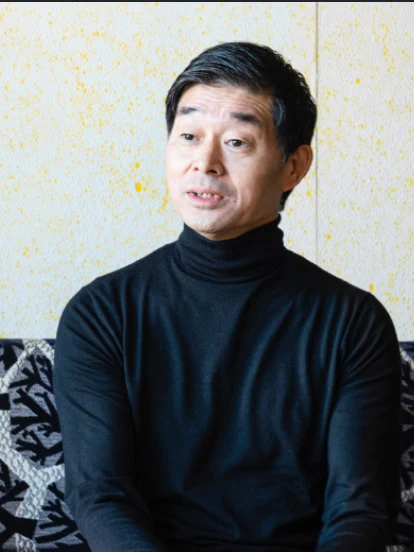
Akira Minagawa
Japanese textile and fashion designer who founded minä perhonen and remains its chief designer after handing over the company presidency in 2021.
Akira Minagawa founded minä in 1995 and remains the founder and chief designer of the company now called minä perhonen. He is not, however, its current chief executive. On 1 July 2021, textile designer Keiko Tanaka succeeded him as representative director; Minagawa stepped away from management to concentrate on design and new creative direction. As of September 2026, the pair describe that transition as a relay rather than a clean break: Tanaka leads the company while Minagawa continues to work inside its design team. (Senken Shimbun; minä perhonen)
That distinction suits a practice organised around continuation. Minagawa did not build the label on a recognisable seasonal silhouette or a designer monogram. He built an archive of named textiles, garments intended to be repaired, and objects that return in new colours and materials years after their first appearance. The familiar circles of tambourine are only the most visible part of a much larger argument: a design need not become obsolete simply because a selling season ends. (minä perhonen, “History”; Bunshun, Hon no Hanashi)
A long route into clothing
Minagawa was born in Tokyo in 1967. Until late adolescence he devoted himself to middle- and long-distance running, but an injury ended his competitive ambitions. At eighteen he travelled through Europe. While in Paris he found work helping backstage at a fashion show; struggling with the handwork made clothing seem less like an effortless talent than a field he could spend a lifetime learning. Back in Japan, he entered the evening course at Bunka Fashion College and graduated before establishing his own label. (Bunshun, Hon no Hanashi; Ginza)
The beginning was deliberately small. In 1995 he started minä in an atelier in Hachiōji, Tokyo. For its first two years he supported the work with early-morning shifts at a fish market; the brand's own chronology records that he finally left the job in 1997. This period produced two lasting objects from an immediate material problem: the mini bag in 1996 and the egg-shaped egg bag in 1997 used remnants left after cutting clothes. They were not later sustainability exercises applied to an established business. They grew out of the economics and waste of the first collections. (minä perhonen, “History”; WWDJAPAN)
The atelier moved to Asagaya in 1998 and to Shirokanedai in 2000, where Minagawa opened the first shop alongside the workroom. In 2002 the company began reissuing earlier designs in changed colours and materials. A year later he extended the name to minä perhonen—the Finnish words for “I” and “butterfly”—and adopted the butterfly mark. The change acknowledged an affinity with Finnish daily life and design, but the clothes continued to be developed through relationships with Japanese textile regions and factories. (minä perhonen, “About”; minä perhonen, “History”)
Drawing cloth before cutting clothes
Minagawa's usual starting point is not a purchased fabric. He and the studio draw a motif, then work with mills, embroiderers and printers to determine how that image can become material. Weaving constructs the cloth by crossing threads; embroidery adds thread to an existing ground; printing places colour on its surface. Each method changes more than appearance. Dense stitches can contract a base fabric, a jacquard weave can build its pattern into the structure, and irregular hand-drawn lines retain a trace of the person who made them. (Kyoto Costume Institute; SPUR)
The best-known result, tambourine, first appeared in Autumn/Winter 2000–01. Uneven embroidered dots make linked circles across the cloth. Its slight irregularity matters: the pattern is repetitive without looking mechanically perfect. Minagawa has called its continued production an experiment in whether one design can remain desirable beyond a single season. It has since changed scale, ground fabric and colour and has generated related designs, but it has never been treated as a one-year print to be replaced by the next. (minä perhonen, “tambourine”; Isetan Mitsukoshi)
Nature supplies many of the studio's nouns—birds, flowers, forests, rain and seeds—but the work is not botanical documentation. A sketch records movement, memory or the rhythm of repeated marks, then the manufacturing process introduces another intelligence. Minagawa visits production sites and asks what a machine or a craftsperson can do that a drawing alone cannot. At a moment when Japanese apparel production was contracting, he defined the label's purpose partly as keeping careful, ambitious making economically alive. (Ginza; SPUR)
That cloth is then cut into what Minagawa calls special everyday wear rather than runway fantasy. Dresses, coats, skirts and knitwear often use uncomplicated volumes so that texture can carry the narrative and the garment can survive repeated use. The company accepts repairs even for old clothes. It also keeps earlier patterns available for revival and operates archive and remnant projects, making duration part of the service around an object rather than only a theme printed on it. (Bunshun, Hon no Hanashi; minä perhonen, “History”)
From fashion season to living environment
minä perhonen joined London Fashion Week in 2003, participated in Paris in 2004 and began presenting each new season there as well as in Japan in 2005. Minagawa resisted the standard runway ritual: for the first Paris presentation, dancers and the sounds of Japanese street musicians and festival music displaced the usual model procession. International presentation widened the audience, but it did not redirect the brand towards a conventional Paris-house structure. (minä perhonen, “History”; Audio-Technica)
His field was already expanding beyond dress. The first chair appeared in 1999, followed by the puu interior series in 2003 and the sale of interior fabrics in 2006. The double-faced furnishing textile dop, released in 2014, was designed so wear would reveal a contrasting inner layer rather than simply register as damage. Furniture projects with Artek, Maruni and other manufacturers let the same textile acquire a different scale and lifespan; collaborations with Kvadrat, Liberty and Klippan placed Minagawa's drawings inside other companies' production knowledge. (minä perhonen, “History”; Artek)
Other commissions made the breadth concrete. Minagawa designed uniforms for the Aomori Museum of Art in 2009, Tokyo Skytree in 2012 and the 21st Century Museum of Contemporary Art, Kanazawa in 2014. Projects with Diptyque, Repetto, Richard Ginori, The North Face and Karhu moved between scent, footwear, tableware and outdoor clothing. These are important not as a tally of famous partners but because the same hand-drawn memory had to negotiate different materials, safety requirements and patterns of daily use. (minä perhonen, “History”)
Recognition followed without changing that long horizon. Minagawa received the Mainichi Fashion Grand Prix in 2006, the 2015 Mainichi Design Prize and the 2015 Agency for Cultural Affairs Art Encouragement Prize for New Artists. The large exhibition minä perhonen / minagawa akira: TSUZUKU, held at the Museum of Contemporary Art Tokyo from November 2019 to February 2020, examined drawings, manufacturing processes, repaired garments, users' stories and a prototype lodging space. Its title, tsuzuku—“to continue”—described both the archive and the social relationships required to keep it usable. (minä perhonen, “History”; Museum of Contemporary Art Tokyo)
The company's thirtieth year brought another handover-minded exhibition, tsugu minä perhonen, to the Setagaya Art Museum in late 2025 and the Matsumoto City Museum of Art in 2026. Tsugu can mean to inherit, join, mend or pour. It framed the archive not as a closed retrospective around one author but as material passed among designers, makers and wearers. That emphasis also made Tanaka's presidency legible as part of the design rather than an administrative footnote. (minä perhonen, “Exhibition History”; “tsugu minä perhonen”)
Reading and dating minä perhonen
First separate the name eras. A garment labelled minä can belong to the period from 1995 through the 2003 change; minä perhonen is the later name. That boundary is useful, but it is not an authentication test by itself, and old textile designs regularly return after 2003. Seller phrases such as “vintage mina” often blur original production, later archive issues and garments made from an earlier pattern. (minä perhonen, “History”)
The textile name is often more informative than the motif alone. The official textile archive gives the first collection in a notation such as 2000-01 → a/w for tambourine, while exhibition lists identify the designer, technique and date. “First designed in” does not mean “this garment was made in”: tambourine, choucho and other standards recur across decades. Match the care label and product number to the exact garment shape, fabric composition and a seasonal catalogue or official shop record. (minä perhonen, “tambourine”; Setagaya Art Museum, exhibition list)
Line and object names add a second layer. laundry, begun in 2008, identifies home-washable clothing; arkistot, opened in 2009, is an archive project; piece, develops products from remnants; and dop is a durable double-faced furnishing cloth that appears on furniture as well as objects. None is a substitute for reading the internal tag. When evidence is incomplete, describe the label, textile and likely period separately rather than turning a recurring flower or butterfly into an exact season. (minä perhonen, “History”)
References
- minä perhonen. “About.” Accessed 10 September 2026.
- minä perhonen. “History: Brand.” Accessed 10 September 2026.
- minä perhonen. “History: Exhibition.” Accessed 10 September 2026.
- minä perhonen. “tambourine.” Accessed 10 September 2026.
- Yoko Hiramatsu and Akira Minagawa. “トレンドを超越するテキスタイル・デザインの力.” 本の話, 21 March 2014.
- Mariko Asabuki. “皆川明さんが明かす、ブランドを100年続けるための思考と行動.” Ginza, 13 June 2019.
- Imai Eiichi. “空に星降り、野に花咲く.” Audio-Technica, accessed 10 September 2026.
- Senken Shimbun. “「ミナ・ペルホネン」運営のミナ 田中景子氏が代表に.” 29 July 2021.
- SPUR. “皆川明さんにインタビュー「丁寧で情熱のあるものづくりの現場を日本に残す」.” 6 June 2025.
- Kyoko Masunari. “「ミナ ペルホネン」30周年 皆川明に聞く100年続くブランドの作り方.” WWDJAPAN, 24 March 2025.
- Kyoto Costume Institute. “JAPANESE TEXTILE: TRADITION, INNOVATION.” Accessed 10 September 2026.
- Museum of Contemporary Art Tokyo. “ミナ ペルホネン/皆川明 つづく.” 2020年度年報.
- Artek. “皆川 明.” Accessed 10 September 2026.
- Isetan Mitsukoshi. “生地に残る誰かの痕跡.” Accessed 10 September 2026.
- Setagaya Art Museum. “つぐ minä perhonen: 作品リスト.” 2025.
- Chris Peppler. “皆川 明・田中景子トークイベント.” つぐ minä perhonen, 14 December 2025.
- 原語表記
- 皆川明
- 学歴
- Bunka Fashion College
- 受賞
- Mainichi Fashion Grand Prix, 2006Mainichi Design Prize, 2015Art Encouragement Prize for New Artists, 2015
主な作品
該当する結果が見つかりませんでした
キーワードやフィルター条件を変更して再度お試しください。