
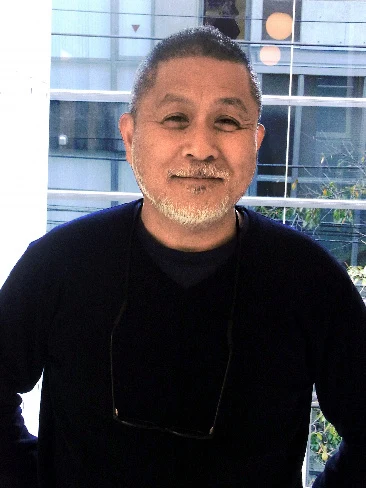
Akira Onozuka
Japanese designer who founded ZUCCa in 1988, led it to 2011, and now designs the workwear brand HAKUÏ.
Akira Onozuka founded ZUCCa in 1988 and designed it through Spring/Summer 2011, when he stepped back from the label to concentrate on HAKUÏ, the workwear brand he still designs. ZUCCa's own retrospective divides the house into three design periods since then — his own tenure, an unnamed in-house team, and Kengo Baba's from Spring/Summer 2026 — and those periods, not shifts in ZUCCa's familiar everyday wardrobe, remain the most dependable framework for attributing a garment. (ZUCCa)
From Niigata to the Miyake studio
Onozuka was born in Niigata Prefecture in 1950. He trained at the Sugino Dress Maker Academy, a Tokyo fashion school founded in 1926 and, alongside Bunka Fashion College, one of Japan's major institutions for training designers, graduating in 1973. He joined Miyake Design Office, the company behind Issey Miyake's own label, the following year. Within the group he designed corporate uniforms for clients including NTT, Shiseido and the Seibu department store chain, and later led Odds-On, a menswear line shown as part of the group's Tokyo collection presentations. He joined the Tokyo Designers Council in 1987, a year before he left to establish his own house. (Fashion Press; Seven Press; Dressmaker Gakuin)
Founding ZUCCa: "basic but detail-focused"
Onozuka founded ZUCCa in 1988 and began showing in Paris around the same period, presenting under the label's own name rather than his. "ZUCCa" reads as a nickname built from "Onozuka"; the brand kept the joke rather than adopting a conventional eponym. In 1990 he won the 8th Mainichi Fashion Grand Prix and the 34th Fashion Editors' Club of Japan Award, prizes that established the label within its first two years. The Mainichi prize, created by the newspaper's own publisher in the early 1980s, had already become one of Japan's largest fashion awards by the time Onozuka received it; a fashion-history account of the prize records that his Paris Collection debut with ZUCCa and his Grand Prix win fell in the same year, an unusually fast route to international recognition. (Fashion Press; Fashion Guide)
ZUCCa's own retrospective description of the Onozuka years is brief but specific: clothing that was "basic yet detail-focused," built around "comfortable" wear rather than spectacle (ZUCCa). The label's current "About" page still uses the same register to describe itself: "there is a calming feeling and a sense of delight surrounding those who wear ZUCCa. ZUCCa delivers a little spice into our daily lives." The Japanese original describes the clothes as 日常着 (nichijōgi) — literally, everyday wear, clothing for ordinary days rather than occasions — with the ambition of adding "a new spice" to that everyday register rather than replacing it with something more dramatic (ZUCCa). That continuity of language, stretching from a description of Onozuka's own design years into the brand's current self-description, suggests the everyday-wear brief he set has outlasted his own time at the label.
The last interview
In February 2011, the Tokyo art monthly Geijutsu Shinchō published a first-person interview with Onozuka in its recurring "speak low" column. Titled "I have always entrusted myself to 'Let It Be'," it looked back at ZUCCa and asked what would follow. The timing places the interview in the same season as his departure from the label. (Geijutsu Shinchō; ZUCCa)
A 2008 Kurashi no Techō feature had already presented him outside the trade press under the title "A Life of Walking." Together with the 2011 interview, it shows that his work drew coverage beyond seasonal fashion reporting even before he left ZUCCa. (Kurashi no Techō)
HAKUÏ and the years after ZUCCa
Onozuka's departure from ZUCCa did not end his design career; it redirected attention to work he had begun years earlier alongside the fashion label. In 1992, while still at ZUCCa, he partnered with the uniform manufacturer Hakuyōsha (白洋社) — a company founded in 1952 that renamed itself Seven Uniform Co. in 2011, the same year Onozuka stepped back from ZUCCa — to launch HAKUÏ, a workwear brand built from plain white cotton. He has described the aim as making "clothing like jazz" — simple working garments that absorb the smell of coffee or whisky and the daily life of the people who wear them, the way work songs became blues and blues became jazz. Trade coverage of the brand frames it more plainly, as "work clothes as tools": fashion-literate design applied to uniforms rather than uniforms treated as a lesser category of clothing. (HAKUÏ; Fashion Press, HAKUÏ)
The uniform side of his practice expanded through the 1990s and 2000s. Onozuka designed uniforms for the United Nations Office at Geneva in 1995, incorporated ZUCCa Design Office Inc. in 2003, and in 2004 saw ZUCCa TRAVAIL — a workwear line manufactured in France — awarded the 1er Trophée Élan by the Fédération Française du Prêt-à-Porter for its contribution to French manufacturing. ZUCCa also produced a womenswear collaboration with Puma in 2007. (HAKUÏ; Fashion Press)
In November 2012, the year after his departure from ZUCCa, he illustrated Neige, a picture book published by the city of Tokamachi — a return, in a sense, to Niigata Prefecture, where he was born. The title is the French word for snow, the defining feature of Tokamachi's climate. (Tokamachi City Office)
HAKUÏ has remained Onozuka's main line of work since, and since 2011 his only one. The brand has released 34 numbered collections to date; the first thirteen, from its 1992 launch onward, are now retrospectively grouped together as HAKUÏ BASIC. (HAKUÏ)
The later, individually themed collections show the same working method that ran through his ZUCCa years, applied to uniforms rather than ready-to-wear. HAKUÏ 31, released in January 2023, argued that "uniforms should feel the era and be much more free," and built that argument through gender-free, borderless silhouettes: a coat that combined a samurai-inspired wrap with tailored-jacket construction, an apron hybridising chef's and front-of-house service wear, and trousers cut from a proprietary antimicrobial cotton the brand calls "stierely cotton." HAKUÏ 32, in July 2024, took up a narrower problem — that counter service and open kitchens now put staff on view from behind as often as from the front — with a decorative striped front for customer-facing hospitality and a plain, stretch-knit back for the kitchen side of the same job. Both collections keep the same brief he set for ZUCCa's clothes: garments built from how a job is actually done rather than from how a uniform is expected to look. (Seven Press, HAKUÏ 31; Seven Press, HAKUÏ 32; AXIS)
ZUCCa after Onozuka
ZUCCa's design-team period, which followed Onozuka's 2011 departure, ended with the announcement, on 8 August 2025, that Kengo Baba would design the brand's Spring/Summer 2026 collection onward, with a first public showing planned for autumn 2025. Baba, born in Tokyo in 1979, studied at ESMOD Japon's Tokyo school, moved to France in 2008 after working with domestic collection brands, then built a career as a freelance designer across brands in Japan and abroad before founding his own design office, Caravel LLC, in Tokyo in 2020. ZUCCa's announcement frames his brief in almost the same terms used for Onozuka's original one: functional, universal working and everyday clothing, adapted to how people actually use it. (ZUCCa; A-net)
ZUCCa belongs to the A-net group alongside Plantation and other labels. CABANE de ZUCCa appears as a distinct retail name in A-net's shop directory, sometimes beside a separate ZUCCa storefront in the same building. Resale listings should therefore preserve whichever name appears on the garment rather than treating CABANE and the main line as interchangeable. (A-net)
Reading and dating a ZUCCa garment
ZUCCa publishes no equivalent of a season-by-season date-code table. Its design history nevertheless gives three useful attribution periods:
- 1988–Spring/Summer 2011: Akira Onozuka.
- Autumn/Winter 2011–Autumn/Winter 2025: an unnamed design team.
- Spring/Summer 2026 onward: Kengo Baba. (ZUCCa)
The care label does not announce those periods. Match any season code, fabric and construction details against dated lookbooks or retail records before assigning a specific designer. ZUCCa TRAVAIL, the workwear line manufactured in France during the Onozuka years, is a further complication: it carries French manufacturing markings rather than the Japanese production associated with the mainline, so a "Made in France" label on a ZUCCa garment points to that line specifically rather than to a different designer or period. HAKUÏ, Onozuka's uniform label, belongs to a different company altogether and does not appear on ZUCCa garments at all; the two should not be confused when a listing credits him as designer. The A-net directory can confirm the current ZUCCa and CABANE de ZUCCa names, but a present-day stockist listing cannot date a vintage garment. (A-net; HAKUÏ)
References
- "ブランド新体制のお知らせ" (Notice: a new structure for the brand). ZUCCa, 8 August 2025.
- ZUCCa. "About." Accessed September 2026.
- Fashion Press. "ズッカ: ZUCCa (CABANE de ZUCCa)." Accessed September 2026.
- Sugino Gakuen. "学院紹介 (About the Academy)." Dressmaker Gakuin. Accessed September 2026.
- Fashion Guide. "毎日ファッション大賞(グランプリ/新人賞)の歴代受賞者一覧." Accessed September 2026.
- HAKUÏ. "デザイナー 小野塚秋良 (Designer Akira Onozuka)." Accessed September 2026.
- HAKUÏ. "HAKUÏ: WORKING EQUIPMENT." Accessed September 2026.
- Fashion Press. "ハクイ: HAKUÏ." Accessed September 2026.
- Seven Uniform. "小野塚秋良のデザインする新作「HAKUÏ 31」は自由を体感するユニフォーム。" Seven Press, 13 January 2023.
- Seven Uniform. "前と後ろがちがったデザイン!? 小野塚秋良の最新作「HAKUÏ 32」は"現代"をカタチにした仕事着。" Seven Press, 10 July 2024.
- AXIS. "小野塚秋良." AXIS Web, tag archive. Accessed September 2026.
- A-net Inc. "ZUCCaブランド新体制のお知らせ." 8 August 2025.
- A-net Inc. "Brands: ZUCCA." Accessed September 2026.
- A-net Inc. "Concept." Accessed September 2026.
- 林央子 (Hayashi Nakako). "暮らしの風景(第4回)小野塚秋良 散歩人生." 暮しの手帖, 第4世紀37号, 2008, pp. 56–61.
- "speak low 小野塚秋良「いつも"Let It Be"で身をゆだねてきた」zuccaのこれまでと、ぼくのこれから." 芸術新潮, vol. 62, no. 2 (issue 734), February 2011, pp. 80–83.
- 小野塚秋良 (illus.). Neige. Tokamachi City Office, November 2012.
- 原語表記
- 小野塚秋良
- 別名
- Onozuka Akira
- 学歴
- Sugino Dress Maker Academy (1973)
- 受賞
- 8th Mainichi Fashion Grand Prix, 199034th Fashion Editors' Club of Japan Award, 1990