
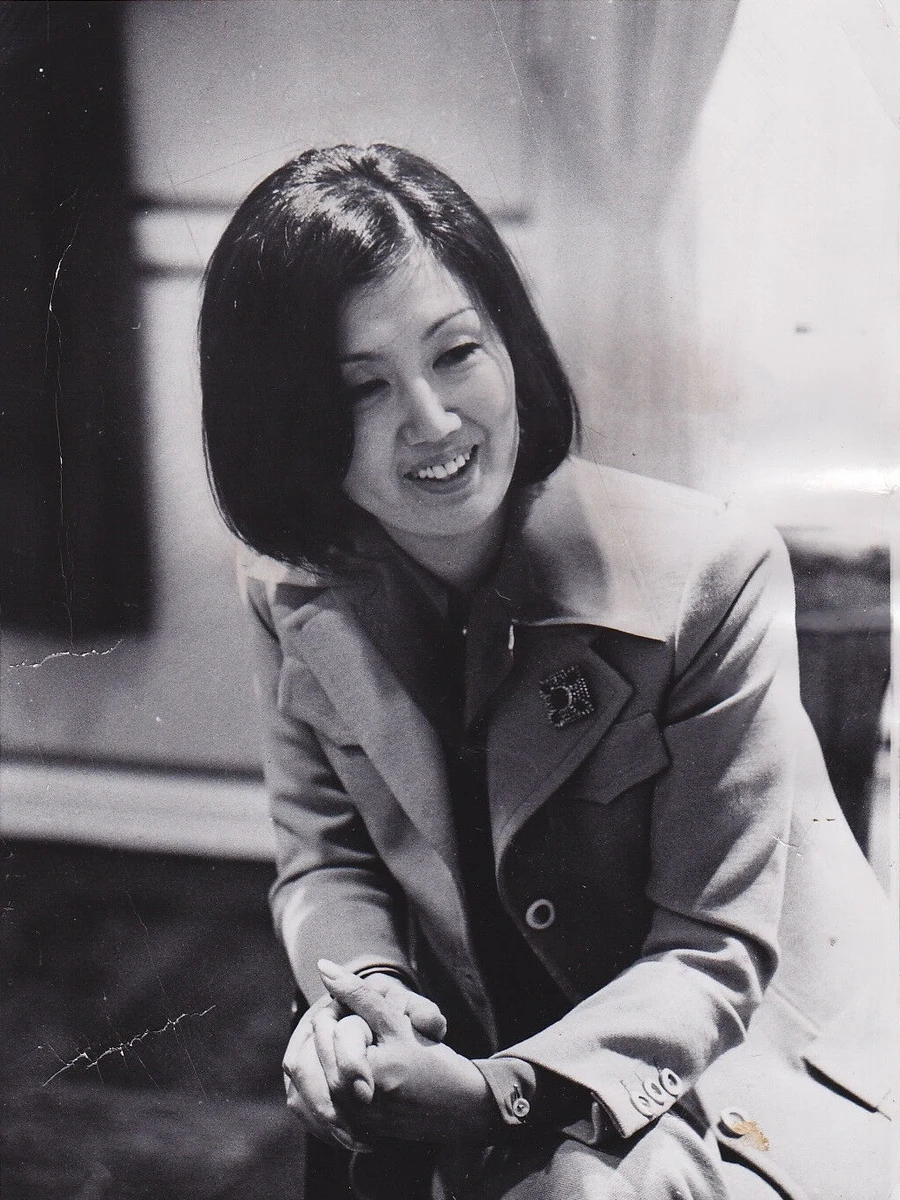
Hanae Mori
Japanese couturier, founder of the Hanae Mori house in 1951 and the first Asian woman admitted to the Paris haute couture syndicate in 1977.
Hanae Mori was the first Asian designer admitted as a member of the Paris haute couture syndicate, the Chambre Syndicale de la Couture Parisienne, in 1977, and she showed on its calendar for twenty-seven years. She died at home in Tokyo on 11 August 2022, aged 96. (WWDJAPAN; HANAE MORI)
The correction worth making first is one of sequence. The standard account of Japanese fashion in Paris begins in 1981, with the Comme des Garçons and Yohji Yamamoto shows that European critics received as a rupture. Mori had opened a couture house on Avenue Montaigne four years before that, and had been showing overseas since 1965. She arrived by the opposite route — not as an outsider set against Paris couture but as a member of its own institution, working inside its rules of made-to-measure production and its seasonal calendar. Reading her as a precursor to the 1981 generation misstates what she was doing; the two were different projects that happened to share a nationality. (nippon.com; HANAE MORI)
Shimane, literature, and a room above a soba shop
Mori was born on 8 January 1926 in what is now Yoshika, Shimane Prefecture, the daughter of a physician. She graduated from Tokyo Woman's Christian University in 1947, having read Japanese literature, and married the following year. Only after marrying did she train in dressmaking — at the Dressmaker school in Tokyo, which contemporary Japanese accounts name variously as ドレスメーカー女学院 and ドレスメーカー服装学院. She had no fashion-college background of the kind that later defined the Japanese industry. (Weekly Economist; Kyoto University, Women Pioneers in Japanese Cinema)
In 1951 she opened a studio called ひよしや (Hiyoshiya) on the first floor above a soba restaurant near Shinjuku Station. It was an ōdā dressmaking shop: a place where a customer was measured and a garment cut for her individually, the standard way middle-class Japanese women acquired Western clothes in a period when ready-to-wear barely existed. A boutique and salon followed in Ginza in 1954. (HANAE MORI; Weekly Economist)
Several hundred films
The shop's location decided the next decade. Staff from the film studios found it, and in 1954 Nikkatsu asked Mori to dress the lead of Kakute yume ari, the first picture the company produced after resuming production. Over roughly ten years she worked across every major studio — Nikkatsu, Shōchiku, Tōhō, Tōei and Daiei — on what Japanese film scholarship counts as several hundred titles, including work for Ozu Yasujirō, Suzuki Seijun, Ōshima Nagisa and Nakahira Kō. (Kyoto University, Women Pioneers in Japanese Cinema; HANAE MORI)
This was not a decorative apprenticeship. Costume for a studio picture is a production problem: many garments, fixed budgets, a shooting schedule, and clothes that must read at a distance and survive repeated takes. It taught her volume and deadline discipline before she designed a single collection, and it gave her an unusually direct education in how Japanese women of the period actually dressed, because the films were contemporary and the audience would notice a false note. By the early 1960s television had shrunk the studios' costume budgets and the work dried up; the studios began borrowing clothes rather than commissioning them. (Kyoto University, Women Pioneers in Japanese Cinema)
East meets West
A trip to the United States in 1961 supplied the argument the rest of her career answered. Watching an American staging of an opera about a Japanese woman, Mori recorded her reaction bluntly — Japanese women were not that wretched, and she would not be patronised. The collection she took to New York in 1965 was the reply. (nippon.com)
It used domestic textiles at couture weight: coats cut from obi fabric — the stiff, figured silk of a kimono sash, woven for a use that has nothing to do with tailoring — alongside crêpe. American buyers from the better department stores and specialist shops responded, and Vogue described the show as the meeting of East and West, a phrase the house adopted as EAST MEETS WEST. (Kateigaho; HANAE MORI)
The butterfly followed from the same logic. Beaded and embroidered butterflies became the house's recurring motif and earned Mori the nickname Madame Butterfly, which she used rather than resisted: an image the West had attached to Japanese femininity, rebuilt in her own materials and on her own terms. (WWDJAPAN)
New York became an operating base rather than a visit. She opened a boutique in the Waldorf Astoria in 1970, a Seventh Avenue showroom in 1973 and a fashion house on 79th Street in 1976, and had already begun the licensing that would later define — and endanger — the business, contracting textile and uniform work from 1967, including six successive generations of Japan Air Lines cabin-crew uniforms. (HANAE MORI)
Paris, and the industry she built around herself
Mori showed in London in 1972, in Monaco at Princess Grace's invitation in 1975, and in Paris for the first time that same year. In 1977 she opened a couture maison on Avenue Montaigne and was admitted to the Chambre Syndicale — the body that controls which houses may call their work haute couture, a legally protected term in France with requirements covering atelier staff, made-to-measure fitting and the number of looks shown each season. She remained its only Japanese member and presented there until 2004. (HANAE MORI; WWDJAPAN)
Her influence on the Japanese industry ran wider than her own clothes. She founded the magazine 流行通信 (Ryūkō Tsūshin) in 1966, スタジオ・ボイス (Studio Voice) in 1976 and the Japanese edition of WWD in 1979 — so the trade press that later covered Kawakubo, Yamamoto and Miyake was in part her own infrastructure. Commissions accumulated: the Japanese team's uniforms for the Barcelona Olympics in 1992, the robe décolletée worn by the then Crown Princess Masako at her wedding in 1993, opera and ballet costumes for La Scala and the Paris Opera Ballet. She received the Order of Culture in 1996 and was made an Officier de la Légion d'honneur in 2002. (WWDJAPAN; HANAE MORI)
Bankruptcy and the end of the couture house
The business did not survive her reputation. Hanae Mori Inc. peaked at roughly ¥11.7 billion in revenue in the year to February 1991. Her husband, who had run the commercial side of the company throughout, died in 1996. Sales fell to about ¥8.7 billion by the 2001 financial year, while borrowing taken on for diversification — including a move into restaurants — remained. A restructuring attempt supported by Mitsui & Co. transferred core operations to new entities, but the funding could not be completed. On 30 May 2002 the company applied to the Tokyo District Court for civil rehabilitation, Japan's principal reorganisation procedure, with debts of about ¥10.1 billion. (Teikoku Databank; Imidas)
Mitsui & Co. acquired the worldwide HANAE MORI trademark rights in 2002, and the ready-to-wear and licensing operations passed out of family control. Mori kept the couture house going for two more years on a separate footing and closed it herself: her final Paris haute couture collection was shown on 7 July 2004, her granddaughter Izumi Mori walking in a wedding dress, to a standing ovation. She was 78. She continued to take individual commissions afterwards, designing for an NHK programme as late as 2019, at 93. (MN Inter-Fashion; Kateigaho; WWDJAPAN)
The collapse is worth stating plainly because it was commercial rather than creative. A couture house is an expensive, low-volume operation funded by the licences its name supports; when the licence income weakened and the person who had managed the business was gone, the couture went with it. Nothing about the clothes themselves had failed. (Teikoku Databank; Imidas)
Reading a HANAE MORI label
Haute couture, 1977 to 2004, is made-to-measure work from the Paris maison and is rare. Before it, and separately, Mori ran a Japanese ready-to-wear business through VIVID, established in 1963; garments from the 1960s to the 1990s bearing HANAE MORI most often come from this domestic operation, not from Paris. (HANAE MORI; Fashion Press)
Third are the licensed goods — bedding, towels, scarves, neckwear, uniforms, fragrance — which the house produced in quantity from 1967 onward and which Mitsui & Co. has controlled since 2002. A butterfly on a scarf or a tie is normal licensed product and proves nothing about the atelier. Fourth is everything after the failure: HANAE MORI manuscrit, launched in 2015 and designed by others, and a 2026 licensing agreement under which Sanyo Shōkai will plan and sell HANAE MORI womenswear from the Autumn/Winter 2027 season with Satoshi Ōtsuki as creative director. Mori designed none of it. (MN Inter-Fashion; Fashionsnap; Fashionsnap)
The practical consequences are straightforward. The butterfly motif appears across couture, ready-to-wear and licensed goods, so it dates nothing on its own. A Paris address points towards the couture period; a Japanese manufacturer's tag more often indicates VIVID-era ready-to-wear or a licence. Mori's name also continues on garments designed after her death, meaning that a new HANAE MORI piece cannot be attributed to her. Wardatrobe records the label under HANAE. (HANAE MORI; Fashionsnap)
Her centenary is being marked by Vital Type, an exhibition of some 400 garments and documents, at the Iwami Art Museum in Shimane from 20 September to 1 December 2025 and at the National Art Center, Tokyo, from 15 April to 6 July 2026. (WWDJAPAN)
References
- Chizuru Muko. "ファッションデザイナーの森英恵が逝去、96歳 アジア人初の仏オートクチュール組合正会員." WWDJAPAN, 18 August 2022.
- HANAE MORI. "History." Official site. Accessed 11 September 2026.
- Tatsumi Tomohiro. "森英恵." Women Pioneers in Japanese Cinema, Kyoto University (JSPS Grant-in-Aid 20H01200), 22 February 2022.
- Teikoku Databank. "株式会社ハナヱモリ|倒産速報." 30 May 2002.
- Imidas. "世界的デザイナー率いるファッションブランド、「ハナヱモリ」倒産." Imidas, 2002.
- "デザイナー・森英恵." Weekly Economist, Mainichi Shimbun, 24 October 2022.
- Chikako Shimizu. "「日本の美意識で勝負する」と決意しアメリカからパリへ." Kateigaho, July 2026 issue, published 23 June 2026.
- "森英恵—東と西を結んだデザイナー." nippon.com, 13 April 2026.
- Chieko Kimoto. "森英恵の言葉が今を生きる人たちに生き生きと響く 生誕100周年を記念した展覧会開催." WWDJAPAN, 28 October 2025.
- MN Inter-Fashion. "HANAE MORI、Pierre Cardin両ブランドのライセンス事業を三井物産アイ・ファッションに集約." PR TIMES, 1 October 2020.
- "若返りを図る新ライン「ハナエモリ マニュスクリ」." Fashionsnap, 26 May 2015.
- "三陽商会が「ハナエモリ」の展開を27年秋冬から開始." Fashionsnap, 14 April 2026.
- Fashion Press. "HANAE MORI(ハナエモリ)." Accessed 11 September 2026.
- 生年
- 1926年1月8日
- 没年
- 2022年8月11日
- 原語表記
- 森英恵
- 学歴
- Tokyo Woman's Christian University, Japanese literature (1947)
- 受賞
- Order of Culture, 1996Officier de la Légion d'honneur, 2002
主な作品
該当する結果が見つかりませんでした
キーワードやフィルター条件を変更して再度お試しください。