Hideaki Shikama
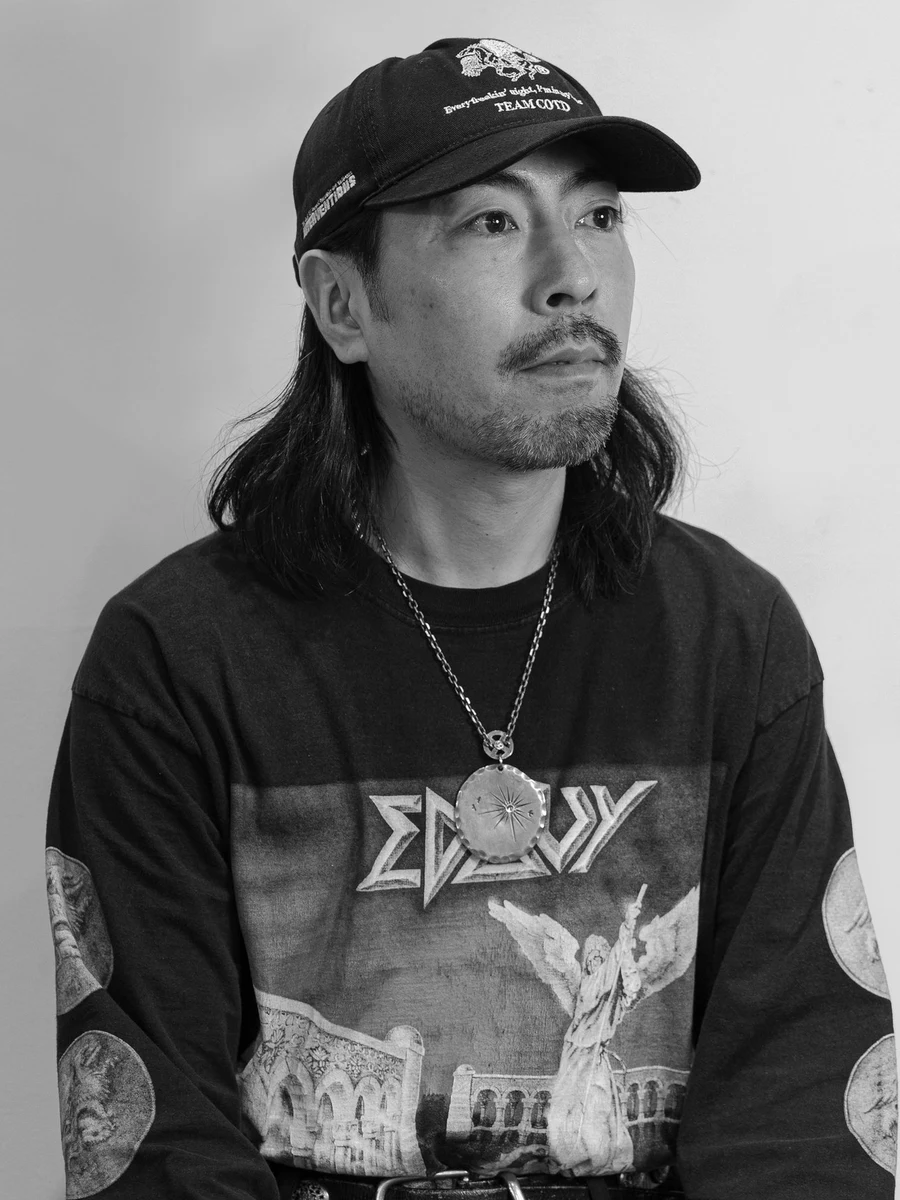
Japanese designer, co-founder of Children of the Discordance in 2011 and its sole designer since 2013, rebuilding vintage textiles into one-off garments.
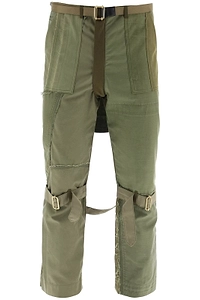
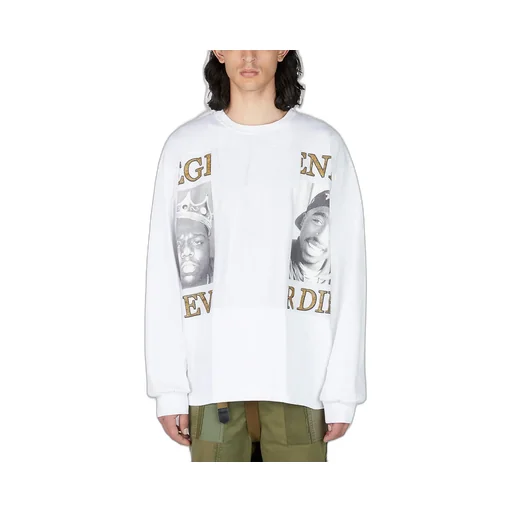
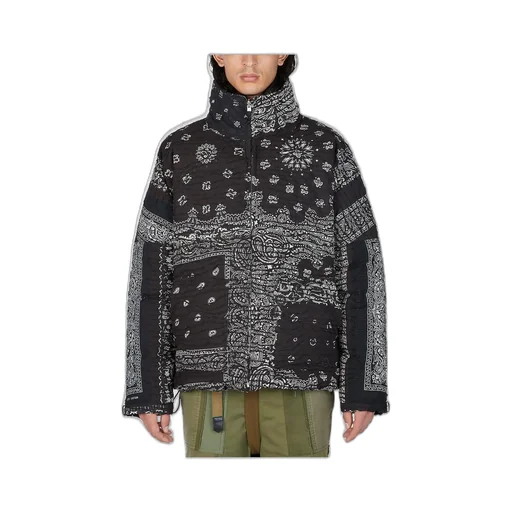
Hideaki Shikama is the sole designer of Children of the Discordance, the Tokyo menswear label he founded in 2011 with two collaborators and has run alone since 2013. The label is usually filed under Japanese streetwear, which is accurate about its references and misleading about its production. A large part of every collection is built by hand from vintage cloth Shikama has bought on his travels — bandanas above all, but also band and rap T-shirts, workwear and found garments — unpicked and reassembled in quantities small enough that most pieces exist only once. (Children of the discordance; Rakuten Fashion Week Tokyo)
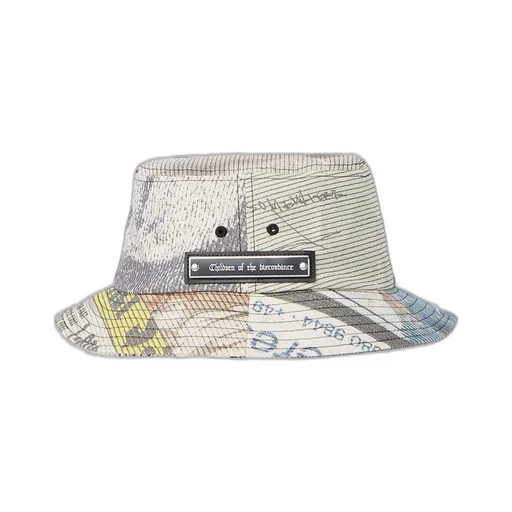
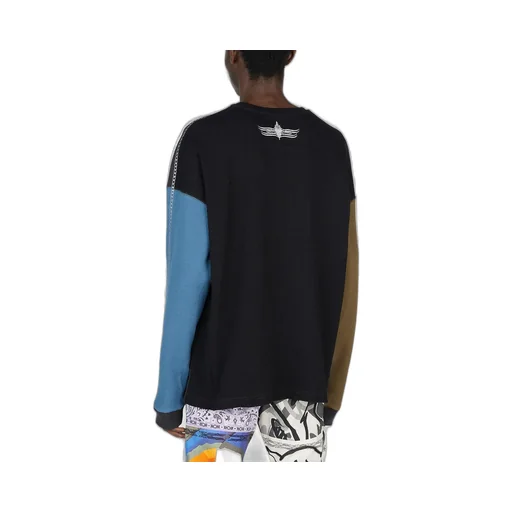
That is the first thing to understand about the clothes, and it has practical consequences. Where most brands can be identified by matching a garment to a lookbook image, a Children of the Discordance patchwork piece is one of a run in which no two are alike: the same style number in the same season may carry entirely different textiles. Shikama has said he completes roughly 300 such garments a year himself, with one outside contractor. The label is therefore closer to a small workshop practice than to a production line, and it should be catalogued as one. (honeyee)
Yokohama, Stüssy, and a fashion career entered sideways
Shikama was born in 1980 and grew up in Yokohama, a port city he has described as one where standing out required real nerve. He dates his interest in clothes to primary school, when a friend wore a Stüssy T-shirt; skateboarding, hip-hop, motorcycle culture and graffiti all reached him at once in the same neighbourhood. As a teenager in the mid-1990s he spent time in New York, arriving in the years of Nas's Illmatic and the Notorious B.I.G.'s Ready to Die, and around the opening of Supreme's first store. He has been explicit that the trip reset his expectations rather than merely supplying references. (TOKION; OR NOT, part 2)
He did not arrive at design through a conventional route. After a fashion vocational course in the late 1990s and a period modelling for the magazine Boon, he worked in retail, including at mont-bell and then at the Japanese chain SHIPS, where he had begun as a part-timer. His own wardrobe — full Raf Simons looks on the shop floor, at a point when that was read as provocation — drew attention inside the company. He was made buyer and director of Acycle, a Harajuku select shop opened under the SHIPS umbrella in 2005, and designed its in-house label despite no formal training, teaching himself from specification sheets. He spent about six and a half years there. (Hypebeast Japan; OR NOT, part 1; Rakuten Fashion Week Tokyo)
A label named after not fitting in
Children of the Discordance began in 2011, when Acycle closed. Shikama started it with Toru Kido and Takayuki Inokawa, and the name states the shared position plainly: discordance means disagreement or incompatibility, and the three of them, by Shikama's account, had in common a refusal to wear what everyone else was wearing. He has described the label's origin as wanting to make, with friends, clothes he would actually wear off duty — the work he had not been able to prioritise as a buyer. The debut exhibition took place in the months after the March 2011 Tōhoku earthquake and secured three wholesale accounts. Shikama became the sole designer in 2013. (Hypebeast Japan; Rakuten Fashion Week Tokyo; honeyee)
Sole is meant literally. Shikama handles the graphics, the textile printing, the embroidery briefs and the visual direction himself, working with a staff he has said can be counted on one hand, and he has explained the insistence in terms of authorship rather than economy: doing all of it himself is how the result contains, in his phrase, no lie. Production is split between Tokyo and Vietnam, with small runs made by neighbouring factories in Nippori, Tokyo's textile district. (Hypebeast Japan)
Twenty bandanas, unpicked
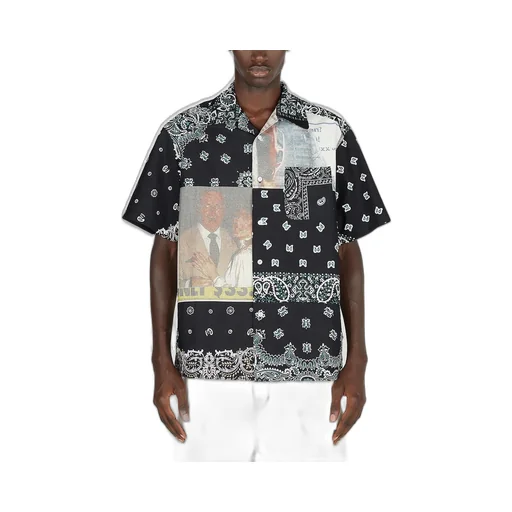
The signature is the bandana patchwork shirt, introduced for Spring/Summer 2016. Shikama's interest in the object is domestic in origin: his parents wrapped his packed lunches in American-made bandanas. He now buys them abroad in bulk — in one account from five countries, the United States, the Netherlands, France, Pakistan and Thailand — and holds ten to fifteen thousand at a time, sorted by colour and by where they were made, since American and European printing and cloth differ. A single garment consumes around twenty of them. (Hypebeast Japan; honeyee)
The method matters as much as the material. Shikama does not cut vintage garments apart; he unpicks the stitching — 糸をほどいて解体する (ito o hodoite kaitai suru), to unthread and dismantle — so the original panels survive intact and can be re-seamed. He has compared the pace to bespoke tailoring: roughly a day of work per garment. The wider practice, which he calls 解体再構築 (kaitai saikōchiku), deconstruction and reconstruction, extends to rare-graphic T-shirts, which he buys in small sizes because the market undervalues them, then rebuilds at a larger scale. One project used about seventy Joy Division shirts carrying Peter Saville's artwork, collected over two years. (Rakuten Fashion Week Tokyo; TOKION; OR NOT, part 1)
Shikama has been careful to separate this practice from sustainability as a marketing frame. The upcycling grew out of what he already collected and how he shopped, not from a later positioning exercise. The brand instead emphasises respect for the craftspeople, makers and producers involved, describing those relationships as going beyond ordinary fair trade, though it publishes few details about the individual overseas workshops. (TOKION; Children of the discordance; Fashion Press)
Paris, Pitti, and leaving Tokyo
The turn came through a failure abroad. Exhibiting during Paris fashion week, Shikama watched the crowd around doublet's booth while almost nobody came to his, and concluded that he had not staked his life on making clothes. He returned and rebuilt the business around that judgement; at Pitti Immagine Uomo the following June, wearing one of his own bandana patchwork shirts, he was photographed repeatedly by street-style press, and the orders followed, along with stockists including Maxfield in Los Angeles. Sources disagree on the year: Hypebeast Japan places the Paris exhibition in January 2017 and the Pitti breakthrough that June, while honeyee places Paris in 2017 and Pitti in June 2018. Both agree on the sequence and on the Tokyo Fashion Award, which the label received as a 2018 awardee, announced in 2017. (Hypebeast Japan; honeyee; QUI)
Runway shows followed in Tokyo from Autumn/Winter 2018, including a Spring/Summer 2021 presentation through Milan Digital Fashion Week in July 2020 and an Autumn/Winter 2021 show staged on a sixty-metre runway at the Hyōkeikan in Ueno, an Important Cultural Property, which Shikama described as preparation for showing abroad. In June 2024 he announced that the collection would move its base to Italy from June 2025. The last Japanese show, for Autumn/Winter 2025–26, was held on 20 December 2024 at Todoroki Arena in Kawasaki, with 38 looks. The brand then showed at Pitti Immagine Uomo in Florence in June 2025 for Spring/Summer 2026, mixing its street and punk register with patchworked suiting cloth. As of September 2026, Spring/Summer 2026 is the most recent collection covered by the Japanese trade press. (Fashion Press; Hypebeast Japan; WWDJAPAN; WWDJAPAN)
Reading, dating and identifying the work
Start with what cannot date a piece. The textiles are vintage and frequently much older than the garment: a 1970s American bandana or a 1980s tour shirt tells you when the cloth was printed, not when Shikama sewed it. Nor does wear help, since the cloth arrived worn. A patchwork garment's composition varies within a single production run, so a listing photograph showing a different arrangement of bandanas is normal rather than evidence of a fake or of a different season. Treat almost every reconstructed piece as unique, and describe the actual object rather than the style. (honeyee; Hypebeast Japan)
What does place a piece is the base garment and the season's fixed elements — the body pattern, the original knit or shirting, the printed graphics and the collaborators. Autumn/Winter 2025–26, for instance, carried named partnerships with Penalty, OOFOS, John Doe, West Coast Choppers, Dickies and Regal, and original fabric development including needle-punch and bio-ageing treatments; those are season markers a patchwork panel is not. Earlier seasons carry their own: a Yokohama graffiti knit made with the writer SUI and bandana pieces worked with the artist Jun Inagawa for Spring/Summer 2023. (WWDJAPAN; TOKION)
Three names are commonly confused with the mainline. Second Edition is a separate label launched on 1 November 2024, sold exclusively through B'2ND, and intentionally more wearable and more functional than the main collection. Peroxside is a second brand on the same company's site, built around fade — its name comes from hydrogen peroxide — using Japanese fabrics and 1990s T-shirt manufacturing methods. Dover Street Market Ginza has also carried exclusive pieces made by a Nippori factory. The operating company, 株式会社DISCORDANCE, was registered on 31 October 2023, which means paperwork and packaging bearing that entity postdate the brand by twelve years. (WWDJAPAN; Children of the discordance; Children of the discordance; Hypebeast Japan)
The brand has not published a chronology of its neck-label or care-label variants, so label design alone is not enough to assign a year. A credible season attribution should instead lead back to a lookbook match, a named collaboration or another feature documented for that collection. (Children of the discordance)
References
- Children of the discordance. "ABOUT." Accessed 11 September 2026.
- Children of the discordance. "PEROXSIDE ABOUT." Accessed 11 September 2026.
- Children of the discordance. "会社概要." Accessed 11 September 2026.
- "Studio Visits: 志鎌英明 | Children of the discordance デザイナー." Hypebeast Japan, July 2021.
- "Children of the discordance." honeyee, 24 December 2021.
- "志鎌英明 Hideaki Shikama." Rakuten Fashion Week Tokyo. Accessed 11 September 2026.
- "「チルドレン オブ ザ ディスコーダンス」デザイナー、志鎌英明." TOKION, 12 September 2022.
- Shuhei Hasegawa. "Children of the discordance デザイナー志鎌英明インタビュー 01." OR NOT.
- Shuhei Hasegawa. "Children of the discordance デザイナー志鎌英明が語るアーカイブ 02." OR NOT.
- "CHILDREN OF THE DISCORDANCE 志鎌英明." QUI.
- "「チルドレン オブ ザ ディスコーダンス」のニューレーベルが誕生 「ビーセカンド」のみで展開." WWDJAPAN, 31 October 2024.
- "「チルドレン オブ ザ ディスコーダンス」が日本最後のショー 世界を見据えたコラボや生地開発で「これまでにない服を」." WWDJAPAN, 25 December 2024.
- "ピッティ26年春夏は〝自転車〟にフォーカス 「チルドレン オブ ザ ディスコーダンス」がショーで新基軸を披露." WWDJAPAN, 19 June 2025.
- "「チルドレン オブ ザ ディスコーダンス」2026年春夏メンズ・コレクション." WWDJAPAN, 22 June 2025.
- "チルドレン・オブ・ザ・ディスコーダンス." Fashion Press. Accessed 11 September 2026.
- 原語表記
- 志鎌英明
- 受賞
- Tokyo Fashion Award 2018
主な作品