Hidehiko Yamane
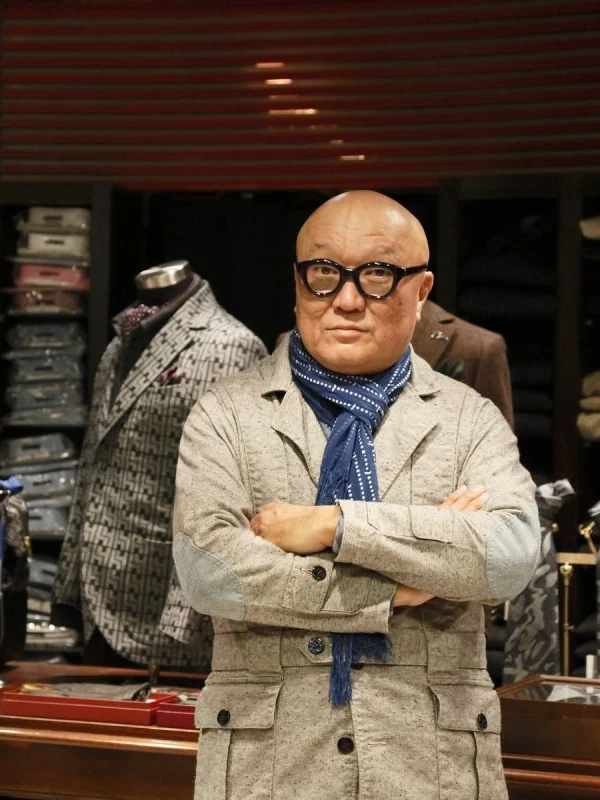
Osaka tailor who founded Evisu in 1991, originating hand-painted seagull replica denim; independent of the company since 2022.
Hidehiko Yamane founded Evisu in Osaka and, by hand-painting a seagull onto the back pocket of a pair of jeans in 1988, supplied the founding gesture of Japan's replica-denim movement. He is not, however, Evisu's designer today. Yamane stepped down as the Japanese company's representative director in September 2021 and left the business altogether in 2022, by which point a separate, Hong Kong-based ownership group had already taken over the Evisu trademark everywhere outside Japan. (Digital Zasshi; Jing Daily)
That corporate split is not a footnote. A garment carrying an Evisu seagull may come from Yamane's original Osaka company or from the international group that controls the name outside Japan; for some periods, where the piece was sold matters as much as when. A single hand-painted mark ultimately came to identify two separate businesses. (Wallpaper*; Jing Daily)
From a Levi's counter to a paintbrush
Yamane was born on 31 December 1959. He did not train at a fashion school; his education in denim came from managing Lapine, an Osaka shop that dealt in deadstock vintage Levi's and stocked Studio D'Artisan, one of the earliest Japanese replica-denim labels. Working around genuine 1940s and 1950s Levi's taught him to read construction rather than branding — the weight of the cloth, the shape of a pocket, the irregularities that came from wartime American production. (Heddels; nss magazine)
In 1988 he made his own jeans and, as a joke as much as a design decision, painted a white seagull across the back pocket in place of Levi's stitched double-arch — a decoration known in the trade as the arcuate. Yamane later said the paint was "half joke," and that he never expected anyone to buy the result. (Heddels) The response from friends persuaded him otherwise, and in 1991 he formalised the label, opening Evisu's first store, "Old Hampshire Bond," in Osaka. (Fashion Press; Kopenguin)
His early partner in the project was Mikiharu Tsujita, who supported the venture until a disagreement over how strictly to reproduce vintage construction pushed him to leave and found his own label, Fullcount, instead — one of several splits that shaped the small circle of Osaka denim makers Yamane belonged to. (Heddels)
A name built from a joke and a god of fortune
The label's original name, Evis, combined the initial letters of Levi's with Ebisu (恵比寿), the Japanese folk god of fishermen and commercial prosperity, usually shown holding a fishing rod — a fitting patron for Yamane, an enthusiastic angler. Legal pressure from Levi's over the similarity to its own name pushed Yamane to add a final "u," settling on Evisu. (Denimhunters; Heddels)
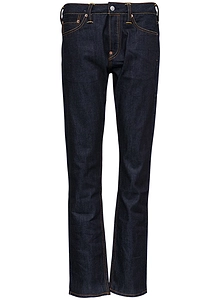
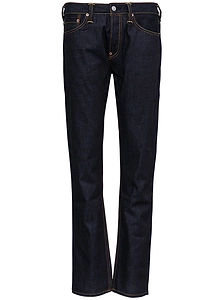
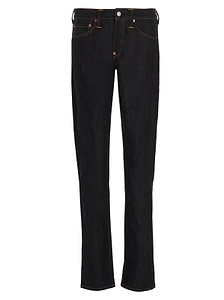
Production stayed deliberately small at first: about fourteen pairs a day, each with its seagull painted by hand, Yamane's own, using water-based paint worked into the denim rather than printed or embroidered onto it. (Fashion Press) That scarcity later became a sorting mechanism for the range itself. Evisu split its core cut into two numbered fits: No.1, left unsanforized — sanforization is the mechanical pre-shrinking process most modern denim goes through before sale — so the fabric shrinks and twists unpredictably in its first washes in exchange for a more individual fade; and No.2, sanforized at the mill, which holds close to its original measurements and was marketed as the easier entry point for a first-time buyer. (Ideal Vinci) The distinction still governs how a resale buyer should read an older pair — a No.1 that has never been washed will look nothing like the size on its tag suggests it should, where a No.2 in the same nominal size should sit close to true.
Yamane never fully handed the paintbrush over. Decades after Evisu had grown well beyond fourteen pairs a day, Japanese press still described him occasionally painting seagulls himself in-store, with fans travelling on weekends specifically to have their pair marked by the founder's own hand rather than a member of his painting staff. (Dig-it)
The Osaka Five and the shuttle loom
Evisu belonged to a loose grouping later nicknamed the Osaka Five, alongside Studio D'Artisan, Denime, Fullcount and Warehouse — small Kansai-region labels that rebuilt vintage American denim construction from scratch rather than distressing modern fabric to look old. Like the others, Evisu wove its denim on Toyoda shuttle looms restored from Japan's prewar textile industry, machines that run narrower bolts of cloth at far lower speed than the modern projectile looms most jeans are made on, producing the self-finished selvedge edge collectors look for. (Denimhunters) Yamane established Evisu's own mill in Kurashiki, Okayama — a historic centre of Japanese textile production — in 1994, giving the company direct control over fabric rather than relying on outside weavers. (Fashion Press; Ideal Vinci)
Within that group, Evisu was the outlier in temperament rather than technique. Where some peers approached reproduction like archival restoration, Yamane was comfortable altering proportions and finishes. The split with Tsujita marked that difference, and Evisu leaned into the seagull as a large graphic rather than a quiet construction detail, making the brand recognisable at a distance. (Heddels; Denimhunters)
Going global, and losing the room
Evisu's international break came through a 1994 partnership with Peter Caplowe, the Hong Kong-based founder of the London retailer The Hub, who began importing Evisu into Britain. (Fashion Press; nss magazine) The brand found an audience in London's clubbing scene through the mid-1990s, then broke into American celebrity culture at the turn of the 2000s: David Beckham commissioned an 18-karat-gold-buttoned pair, and the label was namechecked and worn by Jay-Z and Beyoncé, with the costume designer June Ambrose credited with introducing it to hip-hop wardrobes via the 1998 film Belly. Yamane expanded the collection accordingly, launching the womenswear line Evisu Donna in 1999 and showing at London Collections in 2000 and in Florence and Milan from 2002. (nss magazine; Fashion Press)
That visibility came at a cost. Scott Morrison, who was later brought in to run the brand, described the Evisu of the mid-2000s as having "got overly colorful, got cartoonish," turning up in Hype Williams music videos as a logo-driven streetwear label rather than the quiet reproduction house Yamane had started. (Wallpaper*) Counterfeiting compounded the dilution: a South Korean manufacturer, Wolbi Trading, produced large volumes of fake Evisu jeans, and when the company sued, Korean courts initially sided with Wolbi on the basis of a prior local trademark registration. (nss magazine) Morrison was installed as CEO and creative director around 2009 to strip the brand back toward its denim-first origins. (Hypebeast; Wallpaper*)
Two companies called Evisu: reading and dating the work
By the mid-2010s, ownership of the international business had moved again, to David Pun, a private-equity executive who bought the company after it had run up roughly $50 million in debt, cut its operating costs sharply and refocused the label on Asian retail rather than the American and European stores it had chased in the 2000s. (Complex) According to Wallpaper\, that ownership group formalised the arrangement around 2019 — roughly three years before the magazine's 2022 report — by buying the Evisu trademark for the entire world outside Japan, leaving the international company "completely disassociated with Evisu Japan." ([Wallpaper](https://www.wallpaper.com/fashion/evisu-comeback-interview-with-ceo-scott-morrison)) Yamane continued to lead the separate Japanese company, under its original name and his own design direction, for roughly two more years before stepping back.
For a resale reader, the practical consequence is that "Evisu" now names two unconnected supply chains rather than one. A tag or care label giving a Japan-only retail address, or a Made in Japan denim panel, points toward the company Yamane built and ran until 2021; product sold through the international group's 200-plus stores worldwide is more likely China-made and governed by a different design office entirely. (Jing Daily) Neither fact alone dates a garment — both companies have used the seagull continuously — but the split explains why two pairs bought the same year, on different continents, can differ sharply in fabric, fit and finishing. Within that, the No.1/No.2 fit code on the tag remains the most reliable read on how a pair was meant to be worn: unwashed, unsanforized No.1 stock will have shrunk and twisted from its stated size by the time it reaches resale, where treated No.2 stock should still measure close to true. A hand-painted seagull, rather than a printed or embroidered one, points toward earlier production or a small-batch run, since hand-painting was the founding method but became harder to sustain at volume as the brand scaled internationally in the 2000s. (Fashion Press; Ideal Vinci)
Yamane himself has not stopped working. In 2024, Jing Daily reported that he had begun a new venture under his own name, marking its London launch alongside his original overseas partner, Peter Caplowe — a reunion of the two men who first took Evisu abroad thirty years earlier, now working together outside the company that bears the seagull he invented. (Jing Daily)
References
- Fashion Press. "エヴィス(エビスジーンズ):EVISU." Accessed September 2026.
- Digital Zasshi. "山根英彦(EVISU創業者/デザイナー)さんの経歴/プロフィール." Accessed September 2026.
- Ideal Vinci. "EVISUの歴史と特徴【ブランドリリース】." Accessed September 2026.
- Kopenguin. "日本のデニムブランド「エヴィス(EVISU)」の歴史." Accessed September 2026.
- Dig-it. "【世界が認める日本の先駆者たち①】「EVISU」山根英彦|日本で生まれたカモメマークは どこよりも早く世界へと羽ばたいた。" Accessed September 2026.
- Heddels. "Evisu, Behind the Outsider of the Osaka 5." February 2019.
- Denimhunters. "How the Osaka Five Pioneered Japanese and Heritage Denim." Accessed September 2026.
- nss magazine. "Evisu and the story of how Japanese denim conquered the world." Accessed September 2026.
- Jack Moss. "Evisu comeback: Interview with CEO Scott Morrison." Wallpaper\*, 15 July 2022.
- Hypebeast. "Interview with Scott Morrison of Evisu." 30 March 2010.
- Maria Mora. "How Evisu Became Lil Uzi Vert and Travis Scott's Favorite Premium Denim Brand." Complex, 17 August 2020.
- Jing Zhang. "Why Evisu founder Hidehiko Yamane is having a comeback." Jing Daily, 3 July 2024.
- 生年
- 1959年12月31日
- 原語表記
- 山根英彦