
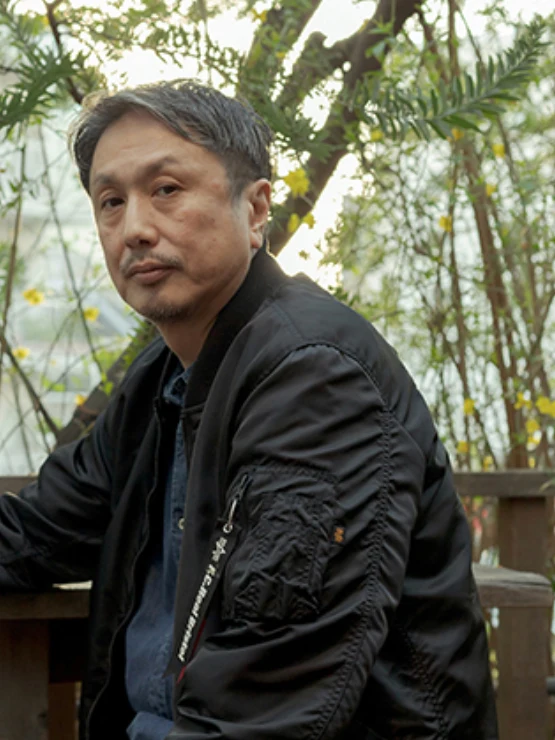
Hirofumi Kiyonaga
Japanese designer who founded SOPHNET. in 1998 and stepped down from the company he built around it in 2022.
Hirofumi Kiyonaga founded SOPH. in 1998, renamed it SOPHNET. in 2002 and built F.C.Real Bristol and uniform experiment alongside it. He left the company on 30 June 2022; its labels and collaborations have continued without him. A brand name can therefore establish a product family, but only a season date can place a garment inside Kiyonaga's tenure. (WWDJAPAN)
The three labels began with different rule-bound wardrobes. SOPHNET. drew from military and outdoor clothing, F.C.Real Bristol from football kit, and uniform experiment from the uniform itself. Kiyonaga's method was to preserve the function of those categories while changing their fabric, finish and cultural setting. (SOPH.)
Oita to Tokyo
Kiyonaga was born in 1967 in Oita Prefecture, on the island of Kyushu. (WWDJAPAN) In 1998, at 31, he founded the company that would become SOPHNET.
From SOPH. to SOPHNET.
In 1998 Kiyonaga established SOPH., a brand built around minimal design applied to refined daily wear. (WWDJAPAN) In 2002 the brand was renamed SOPHNET., the name it has carried since. (SOPH.; WWDJAPAN) The company's own account of the label describes it as drawing on outdoor functionality and surplus wear — secondhand military-issue clothing, sold off once a garment's service life with an army or navy ends, and a long-standing raw material for Japanese workwear-influenced design — built around "the functionality and comfort of superior fabrics, engineered for modern urbanites," with art and cultural collaboration treated as part of the brand's foundation rather than an add-on — the company cites past work with artists including Tatsuo Miyajima, Julian Opie and Jack Pearson. (SOPH.) The result sits recognisably inside Tokyo's military- and outdoor-influenced menswear lineage, but pitched toward a cleaner, more minimal silhouette than the workwear-heavy labels around it.
SOPHNET. operates under the corporate name SOPH. CO., LTD., which groups it with the other labels Kiyonaga built alongside it and continues to run physical shops in Tokyo, Fukuoka, Seoul and Hong Kong. (SOPH.)
A group built around a fictional football club
Kiyonaga did not stop at one label. In 1999 he founded F.C.Real Bristol, an original football-wear brand built around an imagined club rather than a real one — the company describes it as a culture of "unity and loyalty to one's popular sport under a fictitious team," built on the belief that fashion and football, done properly, share the same design discipline. (SOPH.; WWDJAPAN) The concept was credible enough that Nike signed on as F.C.Real Bristol's official supplier for sportswear and lifestyle product from 2000 to 2015, a fifteen-year partnership the brand's own history credits to Nike recognising its "pioneering spirit and sophisticated design concept." (SOPH.) That arrangement ended in 2015; the label has operated independently of Nike since, while continuing to describe its purpose in the same terms it used before the partnership, as work that enriches "a cohesion of sports and lifestyle as a common ground." (SOPH.) Football recurred as a personal interest as much as a design theme: in 2015, EDIFICE exclusively sold a collection of hoodies, sweatpants, bandanas and tote bags directed by Kiyonaga in collaboration with the French club Paris Saint-Germain. (WWDJAPAN)
In 2008 Kiyonaga co-founded a second label, uniform experiment, with Hiroshi Fujiwara of fragment design. Where F.C.Real Bristol worked from sport, uniform experiment worked from the uniform as a category: the brand's own description frames it as "a collection which experiments with men's uniform attire," drawing on "cultural heritage that reflects the history [and] identity of many diverse eras" to build original pieces rather than straight reproductions. (SOPH.; WWDJAPAN) The two men's long-running partnership produced further joint projects, including the Luna Grand Zip Wing Boots, a January 2015 collaboration between uniform experiment and Cole Haan: a wingtip boot in grain and smooth leather, "U.E NAVY" lettered on the collar, both labels' logos embossed inside, and an interior zip added to a shoe shape that would otherwise need to be laced. (WWDJAPAN)
Collaboration as a working method
Long before collaboration became a default marketing tool across menswear, Kiyonaga's brands treated it as routine practice. The relationship with the British outerwear house Belstaff began when its newly appointed Japan CEO met Kiyonaga in October 2015, and led to a six-piece capsule collection built around the brand's Road Master and 1970s-era Level biker jackets, launched in January 2017 through a pop-up at Isetan Shinjuku Men's and sold across SOPHNET.'s Japanese stores and its stockists in Europe, the Americas, Hong Kong and South Korea. (WWDJAPAN) Kiyonaga described the aim as trying "to maximise BELSTAFF's philosophy while blending the unique culture we've cultivated in Japan, creating something that resonates with both brands' existing audiences and new fans" — a fair statement of how most of his brands' collaborations work, translating an established house's archive through SOPHNET.'s own design language rather than simply relabelling it. (WWDJAPAN) That same year, Kiyonaga opened a personal shop, KIYONAGA&CO., in Fukuoka — on Kyushu, the island where he was born, rather than in Tokyo, where the rest of the group is based; it closed as a physical store in 2019 and has continued to trade online since. (WWDJAPAN) In May 2018 Fujiwara marked the Fukuoka shop's first anniversary with a joint pop-up under the name "Fujiwara&Co.," selling limited items including records produced by Fujiwara and phone cases carrying both men's names — a small-scale, friendship-driven event rather than a conventional trade tie-up. (WWDJAPAN)
Stepping back, 2022
On his personal Instagram account in January 2022, Kiyonaga announced that he would leave the company he had founded, effective 30 June that year. He described the move, in his own words, as his "last tactic" (最後の戦術), writing that he wanted "once again, in a place without power, in a place to think freely, to reconsider fashion" (もう一度、力を持たない場所で、自由に思考する場所で、ファッションを見つめ直す), and framed the search ahead in terms borrowed from his own football theme: finding what "total fashion" might mean, the way Total Football once emerged in that sport (トータルフットボールが生まれたようにトータルファッションとは何かを見つける). The report was explicit that this remained open: "後任については発表していない" (no successor has been announced), and none had been named by the time it was published. (WWDJAPAN)
What Kiyonaga leaves behind
Twenty-four years passed between Kiyonaga founding SOPH. in 1998 and his announced exit in 2022 — long enough that SOPHNET. is now discussed as an established name in Japanese menswear rather than a newer label finding its footing, and long enough that F.C.Real Bristol outlasted its own founding premise, running for fifteen years as a Nike-backed sportswear line before spending the years since as an independent one. (SOPH.; SOPH.) What connects the three labels is less a house silhouette than a working method: take an existing, rule-bound category of dress — military surplus, a football strip, a uniform — and use its established logic as the constraint a new collection has to answer to, rather than starting from a blank sketch. Kiyonaga's own explanation for leaving, borrowed from football, points at the same instinct turned on his own career: having spent two decades asking what a settled category of clothing could still become, he framed his departure as a search for what "total fashion" might mean in the same way Total Football once remade what a settled sport could become. (WWDJAPAN)
Reading and dating the work
The wordmark establishes only the broadest period. SOPH. belongs to 1998–2002; SOPHNET. follows the 2002 rename. F.C.Real Bristol begins in 1999 and uniform experiment in 2008, but neither name encodes a season. (SOPH.; SOPH.; SOPH.)
Authorship requires a second boundary: Kiyonaga left on 30 June 2022. SOPHNET. and F.C.Real Bristol continued to release collections and collaborations afterwards, including projects with UGG, Vans, Camper, Salomon, Kvadrat and fragment design. Their continued activity confirms why a brand label alone cannot establish Kiyonaga's involvement. Match the item to a season or release dated no later than his departure; allow for later retail delivery of already-designed stock. (WWDJAPAN; WWDJAPAN; WWDJAPAN; WWDJAPAN; WWDJAPAN; Hypebeast Japan)
References
- WWDJAPAN. "「ソフ」創業者の清永浩文が退任を発表 「もう一度、ファッションを見つめ直す」." 5 January 2022.
- WWDJAPAN. "藤原ヒロシが「ソフネット」の清永浩文と協業したポップアップを開催 限定アイテムも." 17 May 2018.
- WWDJAPAN. "「ベルスタッフ」×「ソフネット」カプセルコレクション発売." 7 January 2017.
- WWDJAPAN. "「エディフィス」がフランスのフットボールクラブと清永浩文のコラボ商品を独占販売." 22 October 2015.
- WWDJAPAN. "「コール ハーン」から清永浩文と藤原ヒロシの「ユニフォーム・エクスペリメント」とのコラボブーツが登場." 25 January 2015.
- WWDJAPAN. "「ソフネット」と"グレゴリー"が2年ぶりにコラボ." 3 June 2025.
- WWDJAPAN. "「アグ」×「ソフネット」新作コラボシューズが発売 躍動感のあるモノトーンルック." 29 July 2022.
- WWDJAPAN. "「ソフネット」が米発「スクリーンスターズ」とコラボ." 8 December 2022.
- WWDJAPAN. "「ソフネット」×「ヴァンズ」新作スニーカー." 11 May 2023.
- WWDJAPAN. "「カンペール」が「ソフネット」とコラボ." 26 January 2024.
- WWDJAPAN. "「ソフネット」がデンマーク発テキスタイルメーカーのクヴァドラとコラボ." 19 November 2025.
- WWDJAPAN. "「ソフネット」と「金子眼鏡」がコラボ." 19 June 2025.
- WWDJAPAN. "「ソフネット」が金子眼鏡との協業によるリムレスアイウエア2型を発売." 18 June 2026.
- WWDJAPAN. "「ソフネット」が"サロモン"との限定スニーカーを発売." 15 April 2025.
- Hypebeast Japan. "F.C.Real Bristol x fragment design 最新コラボカプセルが発売." 13 May 2026.
- SOPH. "ABOUT SOPHNET." Accessed September 2026.
- SOPH. "ABOUT F.C.Real Bristol." Accessed September 2026.
- SOPH. "ABOUT uniform experiment." Accessed September 2026.
- SOPH. "Company site." Accessed September 2026.
- 原語表記
- 清永浩文
主な作品
該当する結果が見つかりませんでした
キーワードやフィルター条件を変更して再度お試しください。