
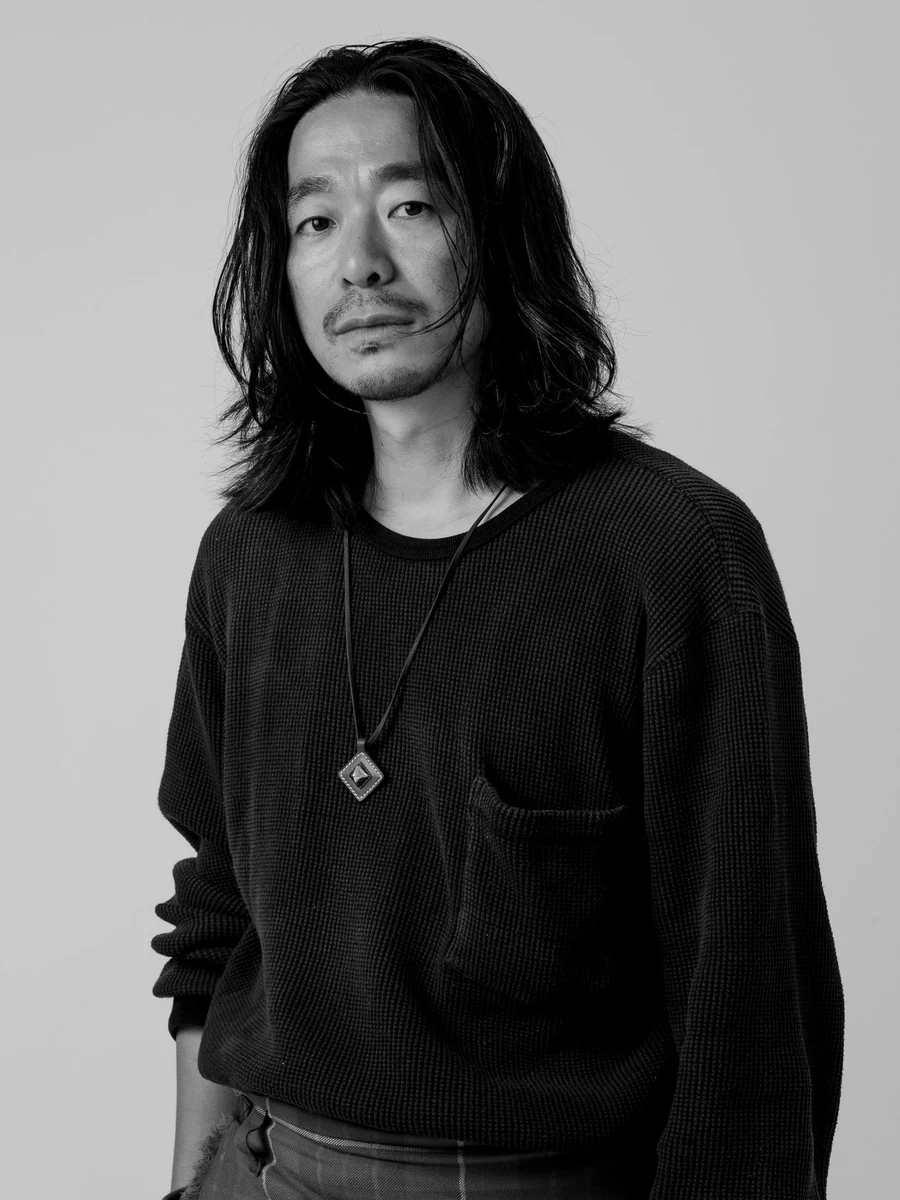
Hiromichi Ochiai
Tokyo designer behind FACETASM and FamilyMart's Convenience Wear, known for generous volume, textile clashes and a many-sided view of dress.
Hiromichi Ochiai is the Tokyo-born founder and designer of FACETASM. Since 2021 he has also directed FamilyMart's Convenience Wear, and in January 2025 he became chief design officer of the shipbuilding and maritime company Tsuneishi Group. FACETASM itself paused after its Spring/Summer 2026 collection; Ochiai called the interval preparation for a new beginning, not a closure. (Ochiai Design Studio; WWDJAPAN)
FACETASM is built on multiplicity. Its name extends “facet”, one face of a many-sided form, into a word of its own. Ochiai does not use that idea to avoid having a position. It lets apparently incompatible clothes—school uniform and club wear, couture volume and a football scarf, perfect Japanese cloth and deliberately awkward styling—remain in the same picture. (Ochiai Design Studio; G-Star Japan)
Tokyo, textiles and eight years inside production
Ochiai was born in Tokyo in 1977 and graduated from Bunka Fashion College's menswear course in 1999. As a teenager he absorbed American clothing, Ralph Lauren and used clothes alongside the emerging Harajuku labels, while European designers such as the Antwerp Six supplied a different idea of fashion authorship. That mixture matters more than assigning him to “streetwear”: Tokyo taught him to hold several imported and local languages at once. (Vogue Japan; G-Star Japan)
After Bunka, Ochiai spent eight years at textile company Guildwork, which supplied labels including Comme des Garçons, Zucca and Undercover. He also assisted the artist NGAP. The job gave him a network among Japanese mills and factories and a practical understanding of how weave, finish, minimum quantities and delivery shape a collection. FACETASM could therefore use unusual fabrics without treating manufacturing as somebody else's problem. (Fashion Press; Vogue Japan)
Ochiai started FACETASM in 2007 and initially presented it in exhibition form. Accounts sometimes confuse that date with its runway debut: the first Tokyo runway was in October 2011, for Spring/Summer 2012. Early growth came through local shops and a community rather than an instant international launch. Ochiai has recalled the importance of buyers who found the label before it had entered Tokyo Fashion Week. (Rakuten Fashion Week Tokyo; GQ Japan; Barneys New York Japan)
Clothes assembled like a city
FACETASM's garments often begin with something legible—a varsity jacket, MA-1, tracksuit, plaid shirt or pair of jeans—then disturb its expected proportion. Sleeves swell, a body is spliced from two categories, and zips allow one garment to join another. A wide silhouette is not simply an oversized size: seams and fastening points redistribute the volume so that it collapses, stands out or moves around the wearer. (FamilyMart; Isetan Mitsukoshi)
The recurring zip series makes that method unusually clear. A zip set into the edge of an MA-1, shirt or other piece is both a graphic line and an invitation to alter the garment, opening a layer or connecting compatible pieces. Collectors sometimes treat every large bomber as the same signature model; it is better to check the exact zip layout, fabric and season. The system has returned in different materials, including bandana-pattern versions, so the idea alone cannot date an item. (Isetan Mitsukoshi)
Colour and texture stop the construction from becoming an academic exercise. Ochiai can put tulle beside a heavy sweatshirt, technical nylon beside a traditional check, or a tender pastel against hardware. His old textile-company relationships made this breadth producible. He has described Japanese materials and sewing technique not as a patriotic slogan but as the label's concrete advantage when competing internationally. (Vogue Japan; G-Star Japan)
The label's phrase HUMOR OF POP is useful when understood as an effect, not a motif. Humour may come from a familiar object made too large, a solemn material placed on a casual garment, or a styling collision that changes how both pieces read. Ochiai wants clothes to move people and to retain the pleasure of getting dressed; the work can be technically complex without demanding a severe face from its wearer. (Shinsaibashi PARCO; Chemical Conbination)
Milan, Paris and the Olympic handover
The Fashion Prize of Tokyo supported FACETASM's first Paris showroom presentations. In June 2015 Giorgio Armani selected the label—the programme's first Asian participant—to show Spring/Summer 2016 at Armani/Teatro in Milan. That was FACETASM's first overseas runway, not its first overseas sales activity. Ochiai then entered the Paris men's calendar, while continuing to use both women and men in a single proposition. (OPENERS; Rakuten Fashion Week Tokyo)
In 2016 he became the first Japanese designer selected as a finalist for the LVMH Prize and won the 34th Mainichi Fashion Grand Prix, three years after receiving its newcomer award. That year he also helped make the costumes for Tokyo's flag-handover sequence at the Rio Olympic closing ceremony. The commission placed his sense of Tokyo—mixed, kinetic and pop—inside an image intended for a global mass audience. (Ochiai Design Studio; Vogue Japan)
Collaborations became another way to show FACETASM from a new side. Work with Nike Air Jordan, Coca-Cola, Levi's, Woolmark, G-Star, Avirex and ASICS moved between footwear, uniforms, denim and industrial textiles. The best examples are not surface-logo swaps. For G-Star's DENIM DEPOT UNIVERSE, Ochiai researched the company's Amsterdam archive and drew on NASA suits, military dress and a diver's garment, using denim as a construction problem. (Ochiai Design Studio; G-Star Japan)
Design outside the fashion boutique
FamilyMart launched Convenience Wear in March 2021 with Ochiai as creative director. Socks, T-shirts, underwear and towels sold through a convenience-store network gave him a different problem from runway fashion: the product had to be immediately understandable, affordable, replenishable and useful to people who had not gone shopping for a designer garment. Its green-and-blue line uses FamilyMart's existing visual identity, turning the store itself into part of the design. (FamilyMart; Ochiai Design Studio)
The line grew far beyond emergency basics and staged Fami-FEST in 2023, described as the convenience-store industry's first runway show. In 2025 Ochiai added the chief design officer role at Tsuneishi Group, applying design across a company better known for ships and infrastructure. These jobs do not represent a retreat from fashion. They extend FACETASM's premise that design changes when it is viewed from another face. (Ochiai Design Studio; TRILL)
That context is important to the 2026 pause. Spring/Summer 2026 completed FACETASM's first twenty-year cycle, after which the brand suspended collection activity and closed its directly operated shops. Ochiai remained active through Convenience Wear and other design work. Describing him as having “left fashion” or FACETASM as definitively ended goes beyond the announcement; “on hiatus after SS2026” is the accurate status. (WWDJAPAN; WWDJAPAN)
Reading and dating FACETASM
Start with the care label's style code and compare the garment with the official collection archive, which currently runs from 2018 through 2026. A collaboration should carry the relevant partner's branding and match its release documentation. Oversizing, clashing fabric or an MA-1 base are long-running vocabulary, not season codes; seller phrases such as “archive zip bomber” are descriptions, not provenance. (FACETASM; FASHIONSNAP)
Three dates provide useful boundaries. The label begins in 2007, the runway record begins with SS2012 in October 2011, and regular collection activity pauses after SS2026. RIOT FACETASM, launched for Autumn/Winter 2020, and projects such as FMAM are separate line or project names rather than automatic dates for every FACETASM garment. Where the official archive does not reach an early piece, contemporary Tokyo Fashion Week coverage and retailer records are safer than trying to infer a year from label typography alone. (GQ Japan; Fashion Press)
References
- Mitsuko Watanabe. “FACETASM / Ochiai Hiromichi—henshucho × kie designer taidan Part 6.” Vogue Japan, 8 June 2016.
- “Ochiai Hiromichi—Profile.” Ochiai Design Studio. Accessed 11 September 2026.
- “Hiromichi Ochiai.” Rakuten Fashion Week Tokyo, 2015.
- “Designer Ochiai Hiromichi ga kataru, hatsu no kaigai collection.” OPENERS, 2015.
- “Designer Ochiai Hiromichi ni omoi o kiku.” GQ Japan, 9 January 2021.
- “Conversation: FACETASM × The Barneys Team.” Barneys New York Japan, 25 August 2016.
- “G-Star × FACETASM: Ochiai Hiromichi interview.” G-Star Japan, 2024.
- “FamilyMart 40-shunen no challenge.” FamilyMart, 1 March 2021.
- WWD Staff. “FACETASM ga 2026-nen harunatsu o saigo ni ichiji kyushi.” WWDJAPAN, 15 January 2026.
- WWD Staff. “FACETASM ga chokuei-ten no heiten o happyo.” WWDJAPAN, 16 January 2026.
- “FACETASM brand profile and history.” Fashion Press. Accessed 11 September 2026.
- 原語表記
- 落合宏理
- 学歴
- Bunka Fashion College, Apparel Design, Menswear (1999)
- 受賞
- Mainichi Fashion Grand Prix New Designer Award and Shiseido Sponsorship Award, 201334th Mainichi Fashion Grand Prix, 2016
主な作品
該当する結果が見つかりませんでした
キーワードやフィルター条件を変更して再度お試しください。