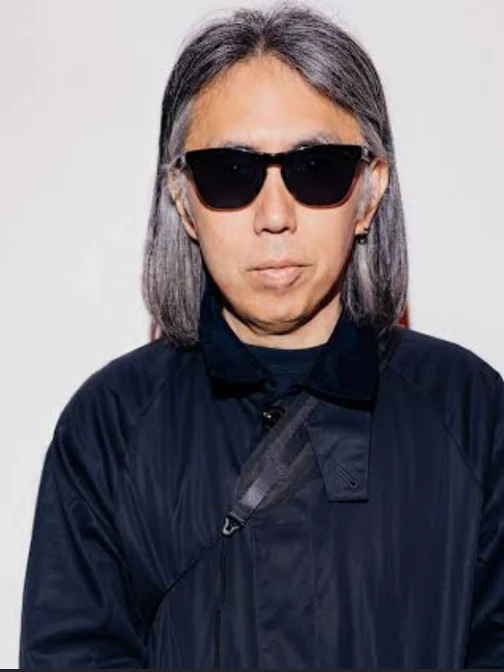
Hiroshi Fujiwara
Japanese DJ, producer and stylist behind fragment design, Goodenough and Nike HTM; GROOVE X chief creative officer since 2022.
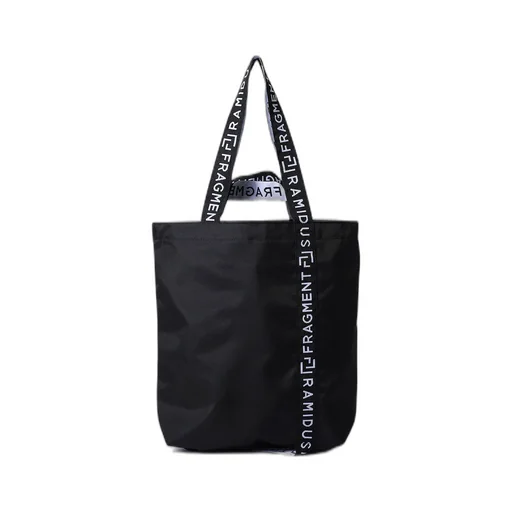
Hiroshi Fujiwara occupies an odd position for someone widely credited as the central figure of Ura-Harajuku street culture: by his own account he is primarily a DJ and record producer who became one of fashion's most consulted people almost by accident. As of September 2026 he directs fragment design, the collaboration practice he has run since 2003, and serves as chief creative officer of the robotics company GROOVE X, overseeing its LOVOT companion-robot line since 26 May 2022 (Fashionsnap). Neither role makes him a garment technician, which is worth reading carefully: Fujiwara works largely as a stylist and curator whose paired-lightning-bolt signature certifies involvement rather than marking manufacture (GO OUT WEB).
His most influential early work was deliberately unsigned. Fujiwara designed GOODENOUGH, one of the labels that defined Ura-Harajuku, without publicly claiming authorship for years because he wanted buyers to judge the clothes rather than his name. The habit of working through other companies' factories continued through fragment and Nike's in-house team on HTM. (Fashion Press; Hypebeast)
Origins
Fujiwara was born on 7 February 1964 in Ise, Mie Prefecture, the youngest of three children; his father was a professional competitive cyclist (Qkaku). He fell into punk during junior high school and, through high school, was a regular at Tsubaki House, a Shinjuku disco hosting London Nite, a club event run by the broadcaster Kenshō Ōnuki. In 1982 he won a London Nite fashion contest judged in part by a designer from the label MILK; the prize was a plane ticket to London (Qkaku). That year he also enrolled at the Setsu Mode Seminar, a Tokyo fashion school, mainly as a pretext his parents would accept for letting him move to Tokyo — he withdrew after three weeks, never having intended to stay (Qkaku).
In London, Fujiwara met Malcolm McLaren, the former Sex Pistols manager and Vivienne Westwood's business partner, who gave him his home address and talked with him about music and culture into the night. McLaren later put him in touch with a New York contact, and in 1983 Fujiwara travelled there and encountered hip-hop's DJ and remix culture directly — pulling a record apart and reconstructing it, with no real equivalent in Japan at the time (Qkaku). He returned to Tokyo still a teenager, carrying reference points almost nobody else in the city had encountered firsthand.
DJ, producer, Major Force
In 1985 Fujiwara formed the hip-hop unit Tiny Punks with Kan Takagi, a name McLaren had coined for him in London (Qkaku). Three years later he co-founded Major Force with Toshio Nakanishi, Masayuki "K.U.D.O." Kudō, Gota Yashiki and Takagi — generally described as Japan's first dedicated club-music label and a formative outlet for hip-hop, house and early sampling culture in Tokyo (Eyescream). He is credited as one of the first DJs to bring hip-hop culture into Japan, and through the 1990s moved into production, working on records for artists including Kyōko Koizumi, Fumiya Fujii and UA (Digital Zasshi). This grounding matters: everything Fujiwara later did in fashion, he approached with a DJ's instinct for sampling existing material, not a patternmaker's training in construction.
GOODENOUGH: the designer who withheld his own name
Around 1990 the skate-culture designer Skate Thing — later founder of C.E — approached Fujiwara about making T-shirts together. The resulting label, GOODENOUGH, launched with four people involved — Fujiwara, Skate Thing, Tetsu Iwai and Minatsugu Mizutsugu — with Fujiwara supplying the name (Fashion Press). Sold through a handful of shops with no flagship of its own, in an era before the internet made scarcity easy to manufacture, Goodenough became one of the defining "phantom brands" of the emerging Ura-Harajuku scene.
Fujiwara did not publicly claim the designer's role for years. In his 2009 memoir Oka no Ue no Panku (丘の上のパンク, "Punk on a Hill"), he explained the choice: if people knew he was behind the clothes, they would judge his name rather than the garments, distorting how both his fans and his critics received the work. Goodenough paused for roughly six months in 1998, resumed in 1999, added the secondary line Resonate Goodenough in 2004 and closed in 2017; the published history identifies the year rather than an exact date. It remains the reference point against which fragment design's very different structure should be read. (Fashion Press)
fragment design: a direction practice, not a label
Fujiwara started fragment design in 2003, and it has never operated as a conventional label: it holds no permanent stores, produces no standing seasonal collection, and exists almost entirely as a credit attached to other companies' products (Fashion Press). Its signature, a paired lightning-bolt mark generally called the thunder mark (サンダーマーク), works less as a logo than a certification: applying it to an existing product signals that Fujiwara has looked at the object and reinterpreted it, in his own aesthetic terms, as currently "cool" — a judgment more than a redesign (GO OUT WEB).
Fujiwara has been explicit this is a deliberate shift, not an evasion. In a 2018 interview he traced fragment's method to Goodenough's own supply chain: the label's first outside collaboration was a DJ bag made with the bag maker Porter in 1995, and once Goodenough stopped manufacturing its own goods around 2000, "everything since then can be called a collaboration" (2000年から自社生産をやめたので、それ以降はすべてコラボといえますね) (Numero TOKYO). He has described the working method itself just as plainly: "I'm good at sampling — when I'm walking down the street and I think a person's shirt looks good, I bring it in straight away," adding that the choices are sensory rather than principled (Silver).
That candour is also the honest answer to the myth-making around him. Asked what he had been trying to achieve across four decades, Fujiwara said he never had much sense of purpose at all: "I don't have much of a purpose, so there's nothing I need to accomplish; I just did what was fun in the moment, and it grew from there" (LEON); asked in 2026 what has kept fragment running so long, he gave an equally modest answer, that the trick is "being conservative, and not overdoing it" (Hypebeast Japan). Read against his own account of sampling other people's shirts, fragment design is best understood not as a design studio but as a decades-long record of one person's taste applied, repeatedly, inside other people's factories.
uniform experiment and the wider network
In 2008 Fujiwara co-founded uniform experiment with Hirofumi Kiyonaga of SOPH. The experimental menswear line, built around a permanent White Line and seasonal Color Chart themes, is produced and retailed through SOPH.'s infrastructure. Fujiwara has no documented departure from the project. As with fragment, his role is creative direction layered onto an established production system rather than ownership of a conventional fashion house. (Fashion Press)
The same pattern runs through his broader role in Ura-Harajuku. He is widely credited with mentoring and giving an early testing ground to designers including Nigo, later of A Bathing Ape, and Jun Takahashi of Undercover, both of whom worked in his orbit before founding their own labels (Reclo); Undercover has since been a recurring outside collaborator of fragment's, dating from 2003 (Numero TOKYO). The throughline is consistent: Fujiwara supplies direction, reputation and a network; someone else supplies the factory.
Nike HTM: nearly a quarter century
Fujiwara's longest-running fashion relationship is with Nike, formalised in 2002 as HTM — his own initials paired with Tinker Hatfield, Nike's vice-president of creative concepts, and Mark Parker, then rising toward the company presidency. Fujiwara has said the name began as an internal code, coined the way earlier collaborations had used acronyms, and that he "never dreamed that would become the official name" (Hypebeast). Fujiwara recalls that when he first met Parker, before Parker became chief executive, Parker asked what he would do with Nike given the chance; he answered that he wanted to help elevate specific existing models, not invent new ones — Parker has since described the arrangement forming "organically" out of repeated conversations on his trips to Japan (Hypebeast).
The division of labour the three describe matches Fujiwara's role elsewhere: Hatfield supplies technical innovation, Parker curates which projects go ahead, and Fujiwara operates as the stylist, choosing materials, colourways and restraint with an eye to wearability rather than engineering a new silhouette (nss magazine). HTM has produced dozens of releases since 2002, generally reworking existing Nike silhouettes — the Air Force 1, the Air Max, the Flyknit Racer — in premium materials and unexpected colours, and remains active as of 2026, one of Nike's longest-running designer collaborations.
Reading the work: how to date a fragment design piece
fragment design does not manufacture products, so it has no factory code, size run or label sequence of its own. A fragment-marked Nike shoe carries Nike's style number; uniform experiment uses SOPH.'s system; a Louis Vuitton collaboration follows Louis Vuitton's. The lightning bolt indicates Fujiwara's approval or direction, not manufacture, and each release must be dated through the partner brand. (Fashion Press; GO OUT WEB)
fragment design is therefore not a “period” in the way a design house has eras. To date any Fujiwara-associated piece, first identify the company that manufactured it and use that company's records; his name and lightning bolt are an attribution layered over its production system. (Fashion Press)
References
- Qkaku. "藤原ヒロ史 音楽編|音楽業界で先頭を走るまで。世界を牽引する事になる藤原少年物語。" Accessed September 2026.
- Digital Zasshi. "藤原ヒロシのプロフィール,経歴(フラグメントデザイン)とは?" Accessed September 2026.
- Eyescream. "伝説のレーベル〈Major Force〉のドキュメンタリーが公開。K.U.D.O、高木完、藤原ヒロシ、Sk8thing、滝沢伸介らが歴史を振り返る." Accessed September 2026.
- Fashion Press. "グッドイナフ : GOODENOUGH." Accessed September 2026.
- Fashion Press. "フラグメント(フラグメントデザイン) : fragment design." Accessed September 2026.
- Fashion Press. "ユニフォームエクスペリメント : uniform experiment." Accessed September 2026.
- GO OUT WEB. "フラグメントデザインとは? 藤原ヒロシが手がける、コラボで価値を生むデザインプロジェクトの魅力." Accessed September 2026.
- Silver Magazine. "Style File 09: fragment design, Hiroshi Fujiwara." Accessed September 2026.
- Hypebeast Japan. "HB20:fragmentで藤原ヒロシが築いてきた持続性とレガシー." January 2026.
- Numero TOKYO. "藤原ヒロシが語る「コラボの歴史は裏原の歴史にあり」." 25 July 2018.
- Reclo. "藤原ヒロシとはどんな人?スト系ファッションのゴッドファーザーについて紐解く。" Accessed September 2026.
- LEON. "藤原ヒロシ「どうしてこんな興味深いものを知らなかったのか不思議です」." Accessed September 2026.
- Hypebeast. "Hiroshi Fujiwara, Tinker Hatfield and Mark Parker Open up on the Origins of the HTM Legacy." March 2016.
- nss magazine. "The oral history of HTM, told by Hiroshi, Tinker and Mark." Accessed September 2026.
- Fashionsnap. "藤原ヒロシがロボットベンチャー GROOVE XのCCOに就任、新モデル「LOVOT 2.0」を発売." 26 May 2022.
- 生年
- 1964年2月7日
- 原語表記
- 藤原ヒロシ
- 学歴
- Setsu Mode Seminar (1982)