
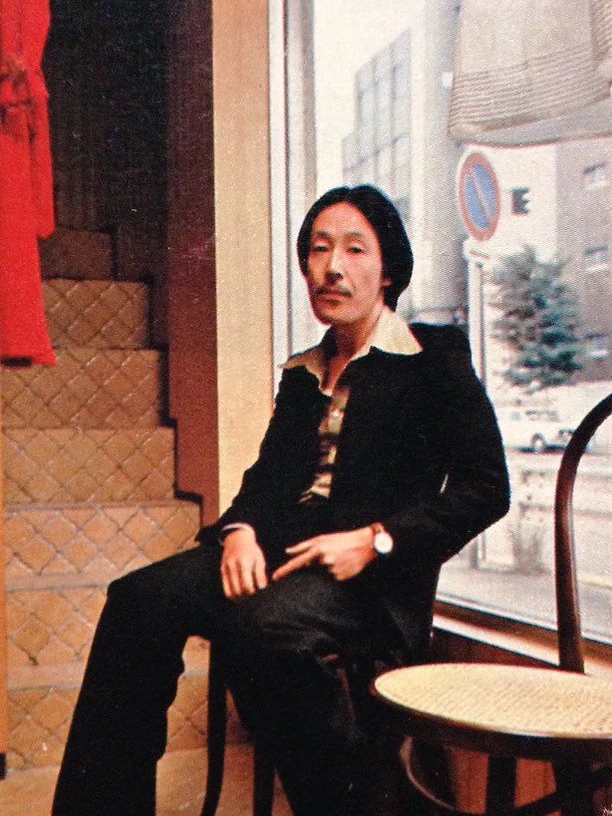
Isao Kaneko
Japanese designer who founded Pink House in 1972, left in 1994 to run his own Kaneko Isao label, and retired from design in 2007.
Isao Kaneko founded Pink House and established its vocabulary of floral prints, ribbons, pintucks, frills and lace. He left the company in 1994 to run his own label full-time, and stopped designing altogether in 2007. Pink House itself kept trading under other hands and was still active in 2026, so a Pink House label identifies the house across a much longer span than the period Kaneko actually designed for it. (Melrose; FASHION HEADLINE; WWDJAPAN; WWDJAPAN)
From Yamaguchi to Harajuku
Kaneko was born in Yamaguchi Prefecture on 15 July 1939. He studied at Bunka Fashion College in Tokyo, in the class its own alumni still call the "flower of the ninth class" (花の9期) — a cohort that also produced Kenzo founder Kenzo Takada, Junko Koshino and Mitsuhiro Matsuda, later the founder of Nicole. After Bunka he trained at Setsu Mode Seminar, a Tokyo school built around fashion illustration rather than patternmaking, and on graduating took a job at the advertising firm Ad Center, working on the production side of ad campaigns rather than on clothing. (FASHION HEADLINE)
That advertising background sat behind the label he built once he left it. Melrose, the company that now owns Pink House and traces the brand's origin to Kaneko's own trips to Parisian flea markets, describes his early collections as a deliberate answer to the plain, dark minimalism then dominant in Japanese fashion — full skirts, ribbons and layered prints set against a prevailing look built from black and grey (Melrose). Pink House was not part of that minimalist wave; it was built to look nothing like it.
Founding Pink House
Melrose's own account dates the label's founding to 1972; FASHION HEADLINE's profile of Kaneko gives 1973 for the same launch (Melrose; FASHION HEADLINE). Whichever year the brand itself began trading, it launched into a cluster of related Harajuku companies still dividing themselves into separate labels. Bigi, built around its own Boutique Bigi flagship, had been founded in 1970; Melrose split off from Bigi's knitwear division in 1972 and launched its own, separate contemporary womenswear line the following year. Pink House's early years sit right at the point where this group of companies was still splitting into the separate labels — Melrose, Pink House, and later several others — that would go on to share ownership and, eventually, a single corporate parent (Melrose). Pink House was incorporated as its own company, separate from Melrose, in 1982 (Melrose).
The Pink House style and the DC-brand boom
Pink House's signature look through the 1980s combined floral-print one-piece dresses and skirts with a fitted military-style blazer, a pairing distinctive enough that the trade press still calls it simply the "Pink House style" (WWDJAPAN). It rose alongside what the Japanese fashion industry calls the DC-brand boom — DC standing for "designers' and characters'," the shorthand for the wave of independent, designer-led Japanese labels that took over department-store floors through the decade, from the austere side of it built by houses such as Comme des Garçons to the decorative side Kaneko was building at Pink House — alongside a related vogue for folk-inflected prints and silhouettes (Melrose; WWDJAPAN).
In September 2022, Melrose marked the brand's fiftieth anniversary with the "Timeless Pink House Exhibition" at the Daikanyama Hillside Forum in Tokyo, running from 30 September to 9 October. The retrospective drew on the archive to show roughly two hundred of the brand's print patterns from the 1980s and 1990s alongside period catalogues and shopping-bag graphics, a film tracing how the brand's signature corsage is made, and a projection installation built around a dress that appears to change (WWDJAPAN). As of that anniversary, Pink House operated around forty-five stores, mostly concessions inside Japanese department stores, both domestically and abroad (WWDJAPAN).
Ingeborg and Karl Helmut, a house of feminine brands
Kaneko did not stop at one label. In 1983 he introduced Ingeborg, a sister brand aimed at an older customer than Pink House and built around what Melrose's own account of the line describes as a combination of dignity and prettiness, its identity organised around a lily motif rather than Pink House's rose-and-ribbon vocabulary (Melrose). Two years later he introduced Karl Helmut, a menswear line built on bold, pop-inflected prints and an unconventional take on masculine dressing (Melrose). Ingeborg outlived Kaneko's own direct involvement much as Pink House did: in November 2025, a new label called B-I relaunched it under the designer Naoya Nakada, reworking Kaneko's original aesthetic with sustainable manufacturing and Bishu wool-region textiles for its debut collection (Fashionsnap).
Leaving Pink House: Kaneko Isao and Wonderful World
In September 1990 Kaneko founded a company under his own name and started the Kaneko Isao label alongside his continuing work at Pink House. In 1994 he left Pink House outright to concentrate on his namesake line, and that same year's autumn/winter season introduced a sister label, Wonderful World. A men's line, Men's Kaneko Isao, followed for spring/summer 1998 (FASHION HEADLINE). Where Pink House had built its identity on ribbons, corsages and a fitted military blazer worn over florals, Kaneko Isao and Wonderful World gave him a smaller, name-carrying business to run without a corporate group's design committee behind it. In autumn 2007 Kaneko stopped working as a designer altogether, closing out the Kaneko Isao line with that season's collection (FASHION HEADLINE).
Pink House after Kaneko
Pink House's corporate life after Kaneko's departure has been more eventful than its design vocabulary. Incorporated separately from Melrose in 1982, the Pink House company merged with Jedix Corporation in 2004; Melrose then absorbed Jedix in 2011, bringing Pink House back inside the Melrose group (Melrose). Through those changes of ownership, the brand's florals, ribbons and corsage motifs have stayed recognisably the ones Kaneko established in the 1970s and 1980s, maintained by the company rather than by Kaneko personally after 1994. The scale the business reached during Pink House's boom years is visible in what it built: Melrose's own headquarters, completed in 1984 at the height of the DC-brand years, was designed by the architect Tadao Ando (Melrose).
In 2023, Melrose introduced Pink House Posh, a line dedicated to reworking pieces from the brand's own archive and vintage stock together with a rotating list of guest creators, rather than to producing new seasonal collections from scratch (WWDJAPAN). It operates alongside Timeless Pink House, the brand's flagship store in Omotesando, which functions as both a retail point and the public face of this archive-facing side of the business (WWDJAPAN).
That continuity is visible in what the brand has done with Kaneko's own words, more than a decade after he stopped designing. In February 2025, Pink House Posh collaborated with the womenswear label RURUMU on a ten-piece capsule called "Bricolage Couture," reworking Pink House archive pieces with embroidery and print and selling them through the Timeless Pink House store. Several of the garments carried lines attributed directly to Kaneko: a lace blouse embroidered with "leave me alone" (我が道を行く、放っておいて — go your own way, and leave me to it), and a crochet cardigan printed with "the basis of all fashion is to wear it with confidence and enjoyment" (全てのおしゃれの基本は、自信を持って楽しんで着ること) (WWDJAPAN).
The brand's most recent collaboration, released 11 September 2026, paired Pink House with the American bag label LeSportsac on two prints built from the house's own vocabulary — "PH Ribbon Berry Fetti," scattering the brand's logo ribbon and berry motifs, and "PH Cake Sweets Rabbit," built around illustrated cakes, rabbits and sweets — across ten bag styles, alongside a small limited run of dresses and cardigans sold through Pink House's own stores and online shop, Takashimaya, ZOZOTOWN, Rakuten Fashion and Marui (WWDJAPAN). More than half a century after Kaneko founded it, the label is still trading on the decorative vocabulary — ribbons, berries, sweets, florals — that he gave it.
Reading and dating a Kaneko-era garment
Do not date Pink House from florals, ribbons, pintucks, lace or corsages alone: the vocabulary has stayed consistent for decades, and the label kept using it long after Kaneko left. Pink House Posh, introduced in 2023, further complicates the picture by reworking archive and vintage garments, so old cloth can appear in a newly assembled piece. Dated exhibition material is a stronger comparison point than a general resemblance to the 1980s (WWDJAPAN; WWDJAPAN).
The manufacturer on the care label gives a firmer range for the company that made the piece, though it does not by itself prove Kaneko's personal authorship, which effectively ends with his 1994 departure:
- Pink House Co., Ltd.: 1982–2004.
- Jedix Corporation: 2004–2011.
- Melrose Co., Ltd.: 2011 onward. (Melrose)
A label reading Kaneko Isao or Wonderful World is not Pink House at all, even though both were designed by the same person: they are his own namesake company's lines, launched in 1990 and 1994 respectively and wound down when he stopped designing in 2007 (FASHION HEADLINE). Keep Ingeborg and Karl Helmut separate as well. They shared a design group and, at points, a corporate parent with Pink House, but used their own labels for different customers: Ingeborg centred a lily motif and an older womenswear customer, while Karl Helmut carried menswear and pop prints (Melrose).
References
- Melrose Co., Ltd. "メルローズの歩み" (Company history). Accessed September 2026.
- FASHION HEADLINE. "7月15日はファッションデザイナー金子功の誕生日です." 15 July 2013.
- WWDJAPAN. "「ピンクハウス」が50周年記念の回顧展 80年代を風靡したコレクションが一堂に." 27 September 2022.
- WWDJAPAN. "「ピンクハウスポッシュ」が「ルルムウ」とコラボ 金子功の名言をあしらった限定アイテム10着." 18 February 2025.
- Fashionsnap.com. "金子功「インゲボルグ」を中田優也が再構築、新レーベル「ビーアイ」が初ポップアップを開催." 3 November 2025.
- WWDJAPAN. "「ピンクハウス」が「レスポートサック」とのコラボバッグを発売 一部店舗でワンピース、カーディガンなど限定アイテムも." 4 September 2026.
- Kotobank / 367日誕生日大事典. "金子功." Accessed September 2026.
- Wikidata. "Isao Kaneko (Q11646721)." Accessed September 2026.
- 生年
- 1939年7月15日
- 原語表記
- 金子功
- 学歴
- Bunka Fashion CollegeSetsu Mode Seminar
主な作品
該当する結果が見つかりませんでした
キーワードやフィルター条件を変更して再度お試しください。