
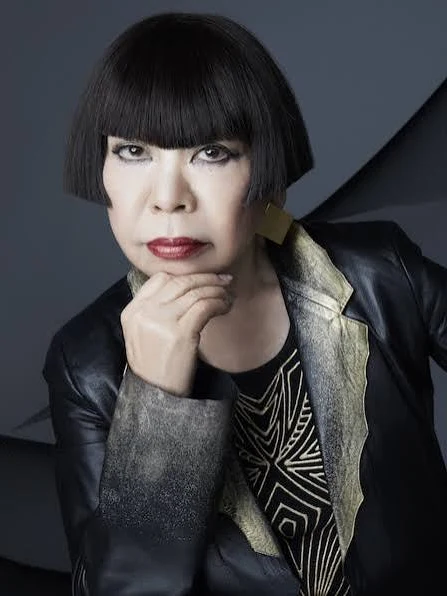
Junko Koshino
Japanese designer and president of JUNKO KOSHINO, the third fashion designer to receive Japan's Order of Culture, in 2025.
Junko Koshino is the founder and designer of JUNKO KOSHINO, a Tokyo house entirely separate from those of her sisters Hiroko and Michiko. In 2025 she became only the third fashion designer, after Hanae Mori and Issey Miyake, to receive Japan's Order of Culture, the state's highest honour in the arts and sciences — recognition for a career that runs from Paris ready-to-wear to opera, Broadway and civic uniform design rather than for any single collection. (WWDJAPAN; Nankai Electric Railway)
Kishiwada to the "Flower of the Ninth Class"
Koshino was born on 25 August 1939 in Kishiwada, a port city in Osaka Prefecture, where her mother, Ayako Koshino, ran a dressmaking shop. (Nankai Electric Railway) She entered the design department of Bunka Fashion College in Tokyo, graduating in 1961, and there met a classmate a year her junior named Kenzo Takada; the two spent their student years together in jazz cafés and cinemas, bonding over an unusual seriousness about fashion at a school where most students had no such ambition. (junkokoshino.com; Nippon.com)
Koshino, Takada, and classmates Mitsuhiro Matsuda, Isao Kaneko and Akiko Kitahara became known as Bunka's 花の9期生 (hana no kyūkisei, "the flower of the ninth class"): five students from one cohort who each went on to found an internationally recognised label — Takada's Kenzo, Matsuda's Nicole, Kaneko's Pink House and Kitahara's Mine May among them. All five were selected to appear together in a 1979 runway show marking Bunka's sixtieth anniversary, titled "Ten Designers Taking Off to the World." (Fashionsnap)
While still a student, Koshino entered the Soen Award (装苑賞), the design competition Bunka's own magazine Soen ran as fashion's principal gateway for new talent. Her third entry took an honourable mention at the competition's sixth round; her fourth won the award outright at the seventh round in 1960, when the judging panel — which included the designer Hanae Mori — praised a cocoon-silhouette coat dress with bell sleeves as "an avant-garde piece that expresses the cheeky good sense of youth." At nineteen, she was its youngest winner to date. (Soen Online; Nippon.com) In the years immediately afterward she designed stage costumes for Group Sounds acts of the day, including the rock band The Tigers, work that gave her an early public profile well outside conventional womenswear. (WWDJAPAN)
Boutique Junko and Killer Street
In 1966 Koshino opened her first shop, Colette, in Tokyo's Minami-Aoyama district. In 1971 she opened a second boutique on the same site under her own name, Boutique Junko; the narrow street beside it became known informally as Killer-dōri (Killer Street), a name Aoyama still carries. That shop is the direct predecessor of the company that later traded internationally as JUNKO KOSHINO. (junkokoshino.com)
Koshino married the photographer Hiroyuki Suzuki on 2 February 1975; their son, Junshi, was born in 1980. She has said it was during that pregnancy that she began to develop 対極の美 (taikyoku no bi, "the beauty of opposites"), the design principle she has returned to ever since — pairing East and West, round and square, tradition and modernity within a single garment rather than resolving the tension between them. (Nippon.com; Kateigaho)
Paris and the world beyond it
Koshino showed in Paris for the first time in 1978, with a collection themed "Primitive Oriental" at the Théâtre Le Palace, and continued presenting there for twenty-two consecutive years, through 2000. (junkokoshino.com) Her international work reached well past the Paris runway calendar: in 1985 she staged what was then China's largest fashion show, at the Beijing Hotel, and opened a JUNKO KOSHINO boutique in Beijing the following year, followed by a second retail line, Mr. Junko, in 1987. She opened a gallery on Paris's Avenue Montaigne in 1989 and a design gallery on New York's Park Avenue in 1992, the same period in which she staged a show and reception at the Metropolitan Museum of Art. (junkokoshino.com)
Later in her career she made a habit of being first: the first foreign designer to present a fashion show in Vietnam, in 1994, and again in Cuba in 1996, where she staged the "JUNKO KOSHINO Habana Collection" — for which the Cuban Council of State later made her a recipient of the Order of Friendship of the Republic of Cuba, in 2011. Shows in Poland followed in 1999 and in Myanmar in 2009. (junkokoshino.com)
Commissions beyond the runway
Running alongside her ready-to-wear collections is a second, recurring practice: taking design briefs from companies, sporting bodies and public institutions, governed by requirements a runway collection never has to meet. It began early — in 1970 she designed staff uniforms for three pavilions at Expo '70 Osaka (the Pepsi-Cola Pavilion, the Takara Beautilion and the Living Industry Pavilion) — and continued through a government pavilion at Expo '85 Tsukuba, uniforms and sponsorship for the Formula One team Rial Ford and for an equestrian team at the 1988 Deauville polo world championship, kit for the football club Verdy Kawasaki in 1994, an emblem for the Japan national team at the World Judo Championships and a logo for the All Japan Judo Federation in 1995, and the attire worn by heads of state at the 2000 G8 Kyushu-Okinawa Summit. (junkokoshino.com)
Theatrical costume forms a related but distinct strand. Koshino designed costumes for the opera Orphée aux Enfers in 1989 and for a 2002 staging of Madama Butterfly mounted as a Japan–Korea citizens' exchange project, and from 2012 has designed costumes for the Japanese drum-and-performance company DRUM TAO. Her best-documented Western theatre credit is the costume design for the December 2004 Broadway revival of Pacific Overtures, Stephen Sondheim and John Weidman's musical on the opening of Japan to Western trade; for that production she was nominated for the Tony Award for Best Costume Design of a Musical at the 59th Tony Awards and for the Outer Critics Circle Award for Outstanding Costume Design, both in 2005, without winning either — the Tony went to Doubt's design team and the Outer Critics Circle prize to Tim Hatley for Monty Python's Spamalot. (junkokoshino.com; New York Theatre Guide) In 2025, to mark its 140th anniversary, Nankai Electric Railway commissioned her to redesign its transportation and technical-division uniforms — replacing the old navy with charcoal grey, eliminating separate men's and women's cuts, and adding a one-touch detachable necktie — work the company's announcement tied explicitly to her being a native of Kishiwada and a senior advisor to Expo 2025 Osaka-Kansai, her second Expo uniform commission fifty-five years after the first. (Nankai Electric Railway; WWDJAPAN)
None of this work was sold as JUNKO KOSHINO ready-to-wear. A uniform commissioned by a railway operator or an emblem designed for a sporting federation carries no collection label and should not be read as connected to any dated runway season; conversely, a JUNKO KOSHINO retail garment has no relationship to these one-off briefs.
Still working past eighty
Koshino has continued to take on projects that sit outside a conventional collection calendar. In October 2013, at seventy-four, she formally joined BiS, a Japanese idol group, as a member rather than a guest, an announcement that circulated as genuine news in the Japanese entertainment press. (Fashionsnap) In March 2019 she returned to Tokyo's runway calendar after a twelve-year absence with Fukushima Pride by Junko Koshino, a collection built around Fukushima's traditional crafts. (Fashionsnap) In 2020 she collaborated with the Noh actor Kiyokazu Kanze on a project pairing Noh staging with fashion, designing sets and costumes in materials — jersey, leather — the form does not traditionally use. (Soen Online)
Recognition from the Japanese and foreign states
Koshino's honours span six decades and several countries: Italy made her a Cavaliere of the Star of Solidarity of the Italian Republic in 2006; she received the Montblanc International Culture Prize in 2009; Cuba's Council of State named her a recipient of its Order of Friendship in 2011; Japan designated her a Person of Cultural Merit (文化功労者) in 2017; France made her a Chevalier of the Légion d'honneur at a ceremony at its Tokyo embassy on 18 May 2021; Japan awarded her the Order of the Rising Sun, Gold Rays with Neck Ribbon, in 2022; and on 3 November 2025 the Emperor conferred the Order of Culture (文化勲章) on her at the Imperial Palace — an honour previously given to only two other fashion designers, Hanae Mori in 1996 and Issey Miyake in 2010. (Nippon.com; WWDJAPAN; Fashionsnap)
Reading the label: which Koshino is it?
The surname alone identifies a family, not a company. JUNKO KOSHINO is Junko's own house; Hiroko Koshino and Michiko London Koshino are independent labels run by her sisters, with their own designers, ateliers and collections. A garment or label reading only "Koshino" cannot be attributed to any one of the three without further evidence.
Within Koshino's own output, the retail name has changed with the decades — Colette in 1966, Boutique Junko from 1971, Mr. Junko from 1987, JUNKO KOSHINO internationally from the mid-1980s — so an older label bearing one of the earlier names belongs to the same design house rather than to an unrelated predecessor brand. And because so much of Koshino's career has run through one-off commissions rather than seasonal collections, a uniform, stage costume or sporting emblem she designed should be dated to the specific commission it came from, not to any JUNKO KOSHINO season: the retail line and the institutional work have always been produced, and should be read, as separate bodies of work.
References
- JUNKO KOSHINO. "About." Accessed September 2026.
- Nankai Electric Railway. "Announcement of new employee uniforms for the company's 140th anniversary, designed by Junko Koshino." 26 March 2025.
- WWDJAPAN. "コシノジュンコさんに文化勲章 ファッションデザイナーで3人目." October 2025.
- Fashionsnap. "コシノジュンコが文化勲章受章 森英恵、三宅一生に続きファッションデザイナーで3人目." 20 October 2025.
- Fashionsnap. "文化服装学院「花の9期生」とは?" 29 November 2021.
- Fashionsnap. "Report on Junko Koshino's formal membership of the idol group BiS." 29 October 2013.
- Fashionsnap. "Report on Junko Koshino's Tokyo collection presentation and the 'Fukushima Pride by Junko Koshino' project." 19 March 2019.
- Soen Online. "コシノジュンコ 装苑賞に挑んだデザイナーたち Vol.3." 8 January 2025.
- Soen Online. "コシノジュンコと現役文化生が語り合う、ファッションの世界で生きていくということ。" 19 October 2022.
- Nippon.com. "デザイナー・コシノジュンコ、盟友の高田賢三を語る." Accessed September 2026.
- Kateigaho. "「思ったら行動する、それが私の人生哲学です」コシノジュンコさんが語る半生." Accessed September 2026.
- New York Theatre Guide. "2005 Outer Critics Circle Award winners announced." Accessed September 2026.
- Wikidata. Junko Koshino (Q11302043). Accessed September 2026.
- 生年
- 1939年8月25日
- 原語表記
- コシノジュンコ
- 別名
- 小篠順子鈴木順子
- 学歴
- Bunka Fashion College (1961)
- 受賞
- 7th Soen Award, 1960Cavaliere, Star of Solidarity of the Italian Republic, 2006Montblanc International Culture Prize, 2009Order of Friendship of the Republic of Cuba, 2011Person of Cultural Merit, 2017Chevalier, Légion d'Honneur (France), 2021Order of the Rising Sun, Gold Rays with Neck Ribbon, 2022Order of Culture, 2025
主な作品
該当する結果が見つかりませんでした
キーワードやフィルター条件を変更して再度お試しください。