
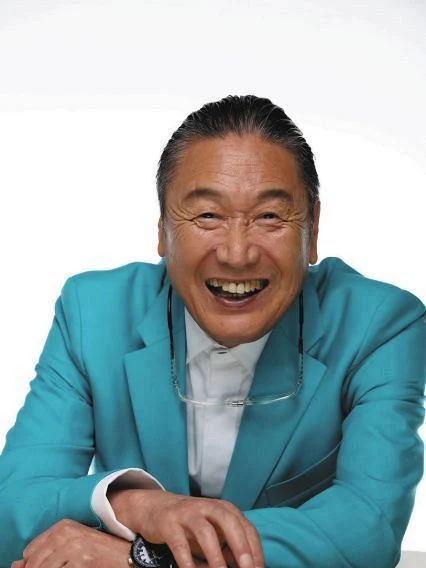
Kansai Yamamoto
Japanese designer (1944–2020): the first to show a collection in London, in 1971, and the maker of David Bowie's Ziggy Stardust costumes.
Kansai Yamamoto is filed in most English accounts as the man who dressed David Bowie, and the costumes are real enough: the Tokyo Pop vinyl jumpsuit and the knitted one-shouldered bodysuit are among the most reproduced garments of the 1970s. The corrective is that the Bowie work was a consequence of something else. Yamamoto had already become the first Japanese designer to stage a fashion show in London, in 1971, and he went on to show in Paris, New York and Tokyo for nearly two decades before abandoning the seasonal calendar entirely. From 1993 he worked mostly as a producer of open-air spectacles. He died on 21 July 2020, aged 76. (KANSAI YAMAMOTO, Inc.; Victoria and Albert Museum; FASHIONSNAP)
The through-line of the whole career is a single aesthetic word. 婆娑羅 (basara) describes a strain of deliberate, gaudy, rule-breaking excess in Japanese taste, associated with the Azuchi–Momoyama period of the late sixteenth century. His own company states it plainly: Yamamoto's origin point was that world of lavish, energy-shedding ornament, and the London show borrowed its staging and its costumes from kabuki. Forty-two years later he returned to London and used basara as the explicit theme of the show. (KANSAI YAMAMOTO, Inc.; FASHIONSNAP)
Yokohama, Gifu, and eight rejected entries
Yamamoto was born in Yokohama, Kanagawa Prefecture, on 8 February 1944, the eldest of three brothers. His parents separated in his childhood and he was raised on his father's side, settling eventually in Gifu, where his father ran a garment-sewing business and the boy worked the machine himself. He entered Nihon University to read English literature and left in 1965 without graduating. (SOW.TOKYO; Wikidata)
After leaving university he worked as an ohariko — a sewing hand — in the ateliers of Junko Koshino and Hisao Hosono, sewing garments by day and teaching himself fashion illustration at night from the magazine Sōen. The 装苑賞 (Sōen-shō) was that magazine's annual open competition, effectively the entry ticket to the Tokyo industry for anyone without a design school behind them. Yamamoto entered eight times before winning the 21st Sōen Award in 1967, at twenty-three. (SOW.TOKYO)
In 1971 he set up Yamamoto Kansai Inc. and held the show that made his name. Published histories date both events to the year without giving a day for the incorporation or the London presentation. (SOW.TOKYO)
KANSAI IN LONDON, 1971
KANSAI IN LONDON was the first fashion show held in London by a Japanese designer. What drew the applause was not only the clothes but the direction, which took its cues from kabuki staging. The clothes themselves ran Japanese vernacular imagery through Western silhouettes: one jumpsuit rearranged the design of a belabō kite from Akita Prefecture as patchwork rather than print, closed with a front zip; another took its motif from the white hare of Inaba, a figure from Japanese myth. He had spent the early 1970s reading up on old kimono patterning, taken with a popular sensibility that would put skulls, snake-eye parasols and dragonflies on a garment. (KANSAI YAMAMOTO, Inc.)
The show also introduced the device he is most imitated for. 引き抜き (hikinuki) is a kabuki quick-change: basting threads are pulled and an outer garment falls away on stage to reveal a second costume already worn underneath. Yamamoto used it at the 1971 debut and kept returning to it. It is a theatrical mechanism rather than a tailoring one, and it tells you what he thought a fashion show was for. (FASHIONSNAP; KANSAI YAMAMOTO, Inc.)
Dressing Ziggy Stardust
Bowie saw the work before he met the man. The V&A records that an editorial of Yamamoto's clothes in Harpers & Queen was the direct source of the Ziggy Stardust haircut — Bowie said the hairstyle was "taken lock, stock and barrel from a Kansai display in Harpers". Yamamoto's stylist Yasuko Hayashi had been dressing Bowie for shoots with the photographer Masayoshi Sukita, and Yamamoto pieces first appeared on stage at the Rainbow Theatre, Finsbury Park, on 19 and 20 August 1972. Hayashi then arranged for the two to meet. (Victoria and Albert Museum)
The commission that followed was for Bowie's first American concerts and the Ziggy Stardust and Aladdin Sane tours of 1973. Tokyo Pop, the best known of the results, is a black polyurethane jumpsuit padded with foam, its legs cut extremely wide. The V&A's catalogue entry reads the legs as an adaptation of hakama, the loose trousers once worn by samurai, and suggests the bulging volume and radiating white stitching may owe something to Oskar Schlemmer's costumes for the Triadisches Ballett of 1922. On stage it was rigged for hikinuki: two stage hands pulled the jumpsuit off in a single movement to expose the costume beneath. (Victoria and Albert Museum)
What was underneath was the other famous piece: a knitted bodysuit cut asymmetrically to leave one shoulder and one leg bare, with matching knitted bracelet and anklet. Yamamoto's stated reasoning was technical rather than theatrical. He had analysed the kimono's defining feature as the layering of one pattern over another, and the knit was his attempt to reproduce that layering in a different medium. His embroidery and knitwear were, at that moment, the strongest part of the label — the French edition of ELLE ran a series on how to make Kansai-brand knits — and he recalled keeping an abnormal quantity of coloured yarn in the atelier at all times. (KANSAI YAMAMOTO, Inc.)
Of Bowie in the costume at Radio City Music Hall, Yamamoto said only that the image "has been chiselled in my brain with unfading vividness". He continued to make pieces for Bowie through the rest of the Ziggy Stardust tour. (Victoria and Albert Museum)
Embroidery, and the collections that are easy to miss
Between 1974 and 1992 Yamamoto showed in Paris, New York and Tokyo and opened Boutique Kansai stores in several cities. This is the least-discussed part of his career in English and it contains the most technically demanding clothes. A 1983 Paris two-piece worn by the model Sayoko Yamaguchi took its imagery from the dress of hill peoples around Kunming, in Yunnan, with a phoenix embroidered across it. A jacket from the Autumn/Winter 1990–91 Paris collection carried Russian Orthodox icon imagery in gold and silver thread across the entire back; Yamamoto wore it himself as a tuxedo jacket. Both used 横振り刺繍 (yokofuri shishū), a free-motion embroidery technique in which the operator swings the needle bar by hand to draw with thread, a traditional industry of Kiryū in Gunma Prefecture that he called the finest in the world. (KANSAI YAMAMOTO, Inc.; KANSAI YAMAMOTO, Inc.)
Leaving the calendar: the Super Shows
From 1993 Yamamoto stopped working to the seasonal rhythm and became a producer of large-scale live events. The KANSAI SUPER SHOW series opened with Hello! Russia in Red Square, Moscow, in 1993, followed by Hello!! Vietnam on Bay Mau Lake in Hanoi's Lenin Park in 1995 and Hello!! India at the Jawaharlal Nehru Stadium in New Delhi in 1997. Later editions included Abordage at the Nippon Budokan in 2004 and Taiyō no Fune at the Tokyo Dome in 2007, which drew 42,000 people. The Super Shows and the later Nihon Genki Project events together reached a cumulative audience the company puts above 3.7 million. (KANSAI YAMAMOTO, Inc.)
The costumes for these were not runway clothes. For Abordage he collected Taishō- and early Shōwa-era kimono from across Japan, found them too short for contemporary performers, and had two or three unpicked and recombined into each single new garment. A jacket for Hello! Russia was built from 裂織 (sakiori), a Japan Sea coastal technique of tearing worn kimono into strips and reweaving them, on a design derived from the shoiko carrying frame used by farmers in the north-east. (KANSAI YAMAMOTO, Inc.)
Design commissions ran alongside. He produced the venue and social programme for the 2008 G8 Tōyako summit, and designed the interior and exterior of the Keisei Skyliner's new AE-series trains, which took a Good Design Award in 2010 and a Blue Ribbon Award in 2011. (KANSAI YAMAMOTO, Inc.)
Illness and death
Yamamoto was diagnosed with 急性骨髄性白血病 (kyūsei kotsuzuisei hakketsubyō), acute myeloid leukaemia, in February 2020. He made the diagnosis public on his own Instagram account on 31 March, saying he was in hospital and under treatment and would come back "super genki". He died on 21 July 2020, aged 76, with his family present. The funeral was held privately; his daughter, the actor Mirai Yamamoto, announced the death on 27 July. Nine days later his company confirmed that KANSAI SUPER STUDIO would continue the brand-licensing business. (FASHIONSNAP; FASHIONSNAP; FASHIONSNAP)
Reading and dating a Kansai Yamamoto garment
The single most useful thing to establish about a piece is which era of the business it comes from, because the label covers at least four distinct ones. Roughly: the 1971–1992 designer collections, shown in London, Paris, New York and Tokyo and sold through Boutique Kansai; a long middle period from 1993 in which Yamamoto was primarily a producer and the name circulated mainly through licensing; a deliberate relaunch in 2013, when he showed Fashion in Motion: Kansai Yamamoto at the V&A on 1 November and followed it with a limited-run shop at Isetan Shinjuku from 2 January 2014; and the post-2020 continuation by a creative team at KANSAI SUPER STUDIO. (KANSAI YAMAMOTO, Inc.; FASHIONSNAP; FASHIONSNAP)
That last point matters for resale listings, which routinely treat anything carrying the name as having been designed by Yamamoto personally. It cannot have been after July 2020, and for large stretches before that the name was licensed rather than designed. The company's own brand page currently lists KANSAI YAMAMOTO, the jacket-led KANSAIMAN line built around Kiryū embroidery, and SUPER LADY alongside wholly separate licensed labels; it describes the post-2020 work as carried on by a team inheriting his intent, not by the designer. (KANSAI SUPER STUDIO)
Two further cautions. First, Japanese vernacular motifs on a garment prove nothing about the era — kite patterns, tigers, dragons and brush-drawn calligraphic marks recur across fifty years, and the 2013 relaunch reissued items shown that year in London. Second, "Kansai Yamamoto" appears on garments he did not make at all: the 2018 Cruise collection presented by Louis Vuitton at the MIHO Museum near Kyoto in May 2017 carried traditional Japanese motifs designed by Yamamoto for that house, and those are Louis Vuitton products. The name on a woven label, in this case more than most, is not by itself evidence of authorship. (KANSAI YAMAMOTO, Inc.; Hypebeast Japan)
References
- KANSAI YAMAMOTO, Inc. "PROFILE." Accessed 11 September 2026.
- KANSAI YAMAMOTO, Inc. "FASHION." Accessed 11 September 2026.
- KANSAI YAMAMOTO, Inc. "熱き心展~寛斎元気主義~." Exhibition site, Edo-Tokyo Museum, 2008.
- Victoria and Albert Museum. "Jumpsuit — 'Tokyo Pop', Kansai Yamamoto, 1973." V&A Explore The Collections, accession LOAN:AMERICASFOUNDATION.1022-2024.
- SOW.TOKYO. "山本 寛斎 Vol.2 デザイナーを目指し、必死になった20代前半。" Inter Belle Inc., 2 September 2015.
- SOW.TOKYO. "山本 寛斎 Vol.3." Inter Belle Inc., 2015.
- FASHIONSNAP. "デザイナー山本寛斎が急性骨髄性白血病を告白." 31 March 2020.
- FASHIONSNAP. "ファッションデザイナーの山本寛斎が逝去 享年76." 27 July 2020.
- FASHIONSNAP. "寛斎スーパースタジオ、「カンサイヤマモト」のブランドライセンス事業を継続." 29 July 2020.
- FASHIONSNAP. "山本寛斎がロンドンV&Aでファッションショー、テーマは「婆娑羅」." 13 November 2013.
- FASHIONSNAP. "山本寛斎がブランドを本格再開、伊勢丹新宿店に期間限定店." 8 December 2013.
- Hypebeast Japan. "ルイ・ヴィトン 2018年クルーズコレクション." 12 May 2017.
- KANSAI SUPER STUDIO. "Brand." Accessed 11 September 2026.
- Wikidata. "Kansai Yamamoto (Q6364496)." Accessed 11 September 2026.
- 生年
- 1944年2月8日
- 没年
- 2020年7月21日
- 原語表記
- 山本寛斎
- 別名
- やまもと寛斎Kansai
- 受賞
- 21st Sōen Award, 1967
主な作品
該当する結果が見つかりませんでした
キーワードやフィルター条件を変更して再度お試しください。