

Keijiro Komori
Japanese founder and designer of COMOLI, making purposeful daily clothing around climate, bodily ease, travel and the life of fabric.
Keijiro Komori founded COMOLI in 2011 and remains its designer and owner. The label is known for loose shirts, drawstring trousers, dark tailoring and fabrics that become richer through wear. It is often filed under minimalism or normcore, but neither word accounts for Komori's appetite for old work clothes, leather, rock music and emotionally charged material. The surfaces are quiet; the person choosing them is not trying to disappear. (BIOTOP; Silver)
Komori was born in Tokyo in 1976 and grew up in its suburbs. As a teenager he noticed the atmosphere changing during the train ride between home and Shibuya. He did not want to look hopelessly provincial in the city or return home looking as though the city had swallowed him. That instinct—to belong in sharply different surroundings without becoming anonymous—became one of COMOLI's deepest concerns. (Dressterior; moc graph)
He studied at Bunka Fashion College and, after an unanswered approach to the one label he initially wanted, joined Baycrew's through a job advertisement. Assigned to French-casual menswear rather than his preferred womenswear, he felt like an outsider in long hair, a mohair cardigan, old Levi's 519 cords and large trainers. Yet the company taught him European clothing beyond the American and street styles he already knew. He later worked as a designer for ÉDIFICE and, from 2004, spent several years with Dressterior, completing roughly a decade inside large select-shop businesses before going independent. (moc graph; Dressterior)
At Dressterior, exacting patternmakers demanded a reason for each design decision. Komori has said that this cured him of drawing vaguely and helped condense a practice that was never naturally decorative. Working among colleagues with forceful, different tastes also clarified his own position. He wanted to make European-derived clothing at a level where it would be judged as clothing—not received abroad merely as an exotic example of “Japanese culture.” (Dressterior)
Clothes for Japanese air
COMOLI's first collection was Spring/Summer 2012. Komori's starting question was physical: if most familiar clothing archetypes came from Europe or the United States for particular purposes, what would daily Western dress become when adjusted to Japan's humidity, temperature, bodies and streets? His answer was not traditional national costume. It was more space between skin and cloth, ventilation, soft structure and enough ambiguity to work in several social settings. (BIOTOP; moc graph)
He has described the ideal sensation as wearing a tube: cloth surrounds a relatively flat body without clinging to it, holding a small volume of air. The image explains the generosity of a COMOLI shirt or coat better than “oversized.” Extra room is not automatically dramatic; it lets the material hang, catches moving air and reduces contact in humid weather. Ease is engineered through relation to the body, not obtained by scaling every measurement equally. (BIOTOP)
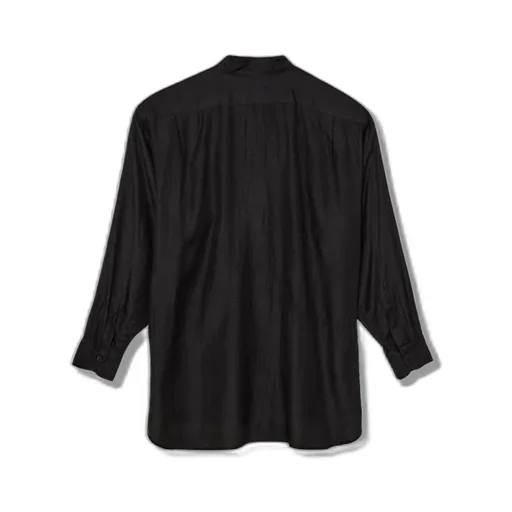
The COMOLI shirt makes that principle ordinary. Its soft collar, dropped shoulder, wide body and fine cotton create an outline with little visible insistence. It can be worn in a smart shop without looking careless and in a less formal street without announcing luxury. Komori's goal is not a universal uniform in the abstract: it is one garment capable of protecting the wearer from feeling misplaced as situations change. (BIOTOP; Dressterior)
Removing the unnecessary
The Tielocken coat became an early COMOLI signature. Komori wanted a trench coat but found its hard shoulder, buttons and accumulation of details unsympathetic to his own body and to the drape he wanted. Removing the elements that obstructed ordinary movement led him backwards to the tielocken, an early belted ancestor of the trench. The result resembles heritage because his practical editing rediscovered the purpose beneath later decoration. (Silver)
This process should not be confused with purification for its own sake. Komori admires work, military and sports garments because their pockets, cloth and shapes once answered a concrete request. For him, heritage is not simply anything old or collectible; it is an object whose purpose was strong enough to keep it intelligible. COMOLI changes those models because contemporary wearers occupy different bodies, climates and lives. (Silver)
Travel tests that purpose. Before designing summer clothing Komori visits heat; before winter clothing he seeks cold. A garment packed into a suitcase must recover, work across rooms and streets, and justify the burden of carrying it. He gives dark cashmere as an ideal tool: light, warm, resilient after being rolled and acceptable in many surroundings. This is luxury measured in time and use, not fragility. (Silver; GQ Japan)
Fabric with a past ahead of it
Komori is drawn to the liquid softness that high-quality older cotton can develop after years of washing. Rather than print fake age over a new garment, he asks how a newly woven cloth might approach the hand of a nearly worn-out vintage piece and then continue ageing honestly. In chambray, denim, wool and silk, the point is not immaculate material at purchase but the life it can acquire. (Silver)
That approach makes “simple and high quality” an inadequate summary. A cloth may be napped until it looks slightly neglected, woven with irregular silk, made in paper-like leather or allowed to pill. Black became increasingly important not as safe minimalism but as a way to give rough and sensuous materials weight. Komori speaks of adjusting or “putting in order” existing clothing rather than inventing from nothing, but those adjustments can yield garments that feel peculiarly unstable between elegance and damage. (GQ Japan; Silver)
He also rejects a compulsory seasonal reinvention. Good pieces return with a different cloth or a small revision, while the collection grows when his own desire or an imagined wearer makes another form necessary. In 2024 COMOLI introduced womenswear, extending the practice beyond the male body that had originally supplied its fit and daily tests. Continuity is valuable only while the designer still feels enough desire to change what needs changing. (GRIND; UOMO)
Independence and cultural appetite
COMOLI's restraint is sharpened by Komori's interests outside respectable basics. He has spoken passionately about Nine Inch Nails, Chrome Hearts and the emotional force of Akihiro Miwa's performance of “Yoitomake no Uta.” A 2022 Nine Inch Nails project, made with BIOTOP, was marked by an outdoor screening as well as merchandise. These references do not appear as a parade of graphics across every collection; they explain the darkness and force that the “quiet luxury” label tends to edit out. (THEM; moc graph)
Komori argues that the designer should also be the business owner, because independence keeps responsibility with the person making the decisions. That view is not a generic celebration of entrepreneurship. It follows from his suspicion of fashion systems that can manufacture credibility through expensive production, fashionable collaborators and borrowed ideas. He wants enough control—and enough financial freedom—to protect the conditions in which his own judgement stays sharp. (moc graph)
Identifying and dating COMOLI
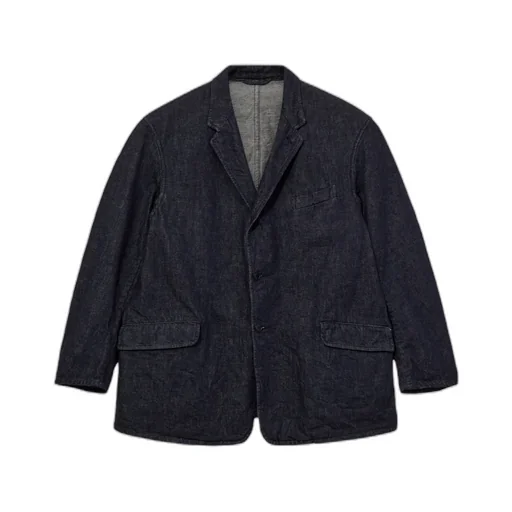
COMOLI repeats names such as COMOLI Shirt, drawstring pant and denim jacket, while changing cloth and details. Preserve the full material-led product title and the complete number from the care label. A generic retailer title such as “long-sleeved shirt” can conceal whether a piece is the standard cotton model, black version, rayon, silk-dot or another seasonal variation. (COMOLI; Dressterior)
For 2011–15 pieces, article numbers commonly begin with a two-digit year followed by S or A for the spring/summer or autumn/winter season. From Spring/Summer 2016 the leading letter advances by season: I marks 2016SS, J 2016AW, through Y for 2024SS and Z for 2024AW; the sequence then restarts with A for 2025SS. This is a useful catalogue key, but label photographs and retailer records should corroborate it, especially where marketplaces omit or mistype a character. (Aurarian)
The same restraint that makes COMOLI easy to wear makes it easy to misdescribe. Its biography is not a story of eliminating personality. Komori has built a personal wardrobe outward: from the suburban train, the humid summer, the cold journey, the concert and the old cloth on the edge of failure. The clothes feel calm because those competing demands have been put in order. (GQ Japan; BIOTOP)
References
- BIOTOP. “No.13 Keijiro Komori.” 20 March 2015.
- Dressterior. “COMOLI Interview.” 25 May 2018.
- Silver. “Interview with Keijiro Komori.” Accessed September 2026.
- moc graph. “COMOLIの魅力と、小森の魅力 (2/2).” 2 January 2026.
- GQ Japan. “なぜ、いまCOMOLIなのか.” 20 April 2026.
- GRIND. “the Force: COMOLI.” 29 April 2020.
- THEM Magazine. “COMOLI × Nine Inch Nails Launch Event.” 16 December 2022.
- Aurarian. “COMOLI タグ判別:品番からわかる年代・シーズン.” Accessed September 2026.
- UOMO. “『コモリ』が待望のウィメンズを始動.” 12 November 2024.
- COMOLI. Official website. Accessed September 2026.
- 原語表記
- 小森啓二郎
- 学歴
- Bunka Fashion College
主な作品
該当する結果が見つかりませんでした
キーワードやフィルター条件を変更して再度お試しください。