
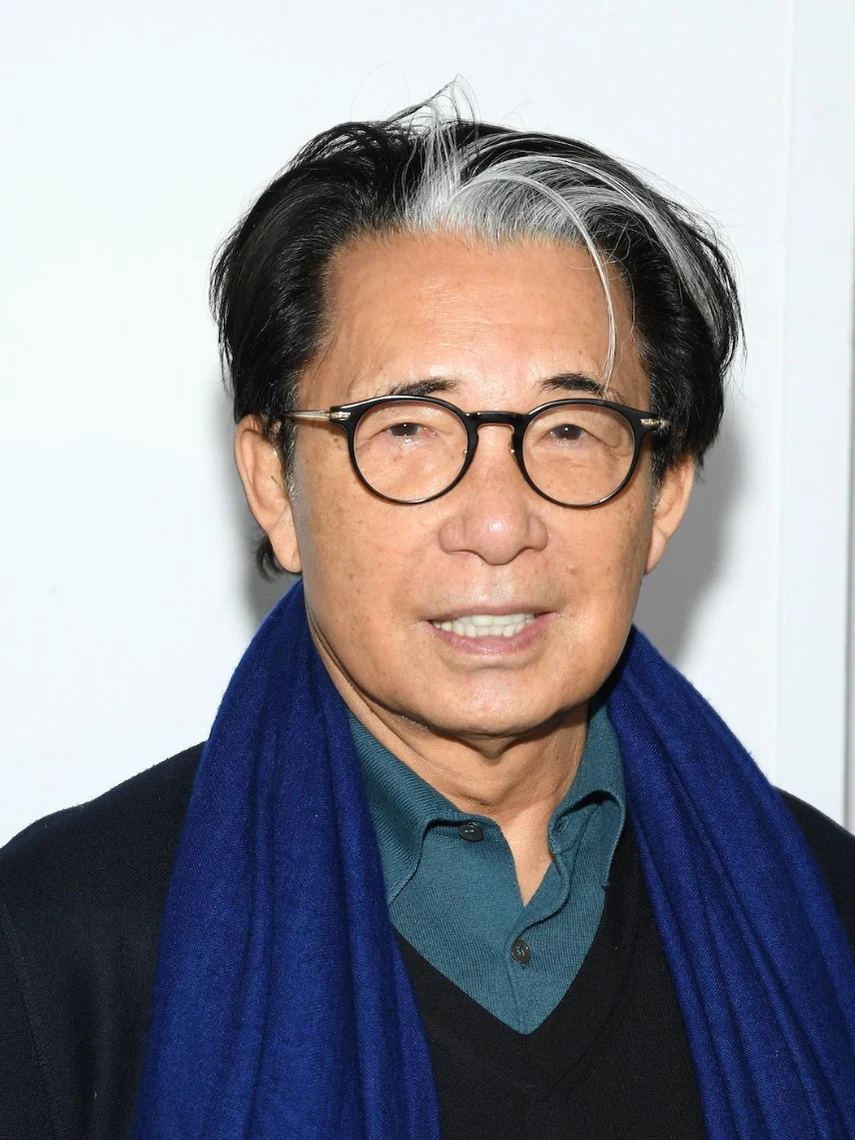
Kenzo Takada
Japanese designer who founded KENZO in Paris in 1970 and led it until 1993's sale to LVMH; died of COVID-19 in October 2020.
From Himeji to the design room
Takada was born on 27 February 1939 in Himeji, Hyōgo Prefecture, one of seven siblings; he has cited his sisters' dressmaking and fashion magazines as an early, informal introduction to clothes. (The Fashion Post; SOW.TOKYO, Vol.1) He first enrolled at Kobe City University of Foreign Studies to study English and American literature. On learning that Bunka Fashion College in Tokyo was, for the first time, admitting men — Takada was among the college's earliest male students — he left university, worked to fund the move, and won his parents' permission to enrol in 1958. (SOW.TOKYO, Vol.1; Bunka Fashion College)
At Bunka he completed a year in the 師範科 (instructor course), covering the basics of garment construction, before moving into the design programme. His class of 1960 became known informally as 花の9期生 ("the flower of the ninth class"), a cohort that also produced Junko Koshino, Mitsuhiro Matsuda and Isao Kaneko — several of the designers who would go on to define Japanese fashion's postwar generation. While still a student, Takada won the eighth Soen Prize (装苑賞) in 1960, a leading student design award that led to early illustration work for fashion magazines. (Bunka Fashion College; SOW.TOKYO, Vol.1) After graduating he worked briefly for the apparel maker Mikura, then moved with classmates to San-Ai, where he spent roughly four years designing junior-market clothing lines. (SOW.TOKYO, Vol.1)
The voyage to Marseille
Takada left Japan for Paris in late November 1964, sailing from Yokohama with friends (the Matsudas) on a passage that called at Hong Kong, India and African ports before reaching Marseille around the end of the year; he went on by train to Paris, arriving at the Gare de Lyon on 1 January 1965. He had planned a six-month stay and never left. (SOW.TOKYO, Vol.2; SOW.TOKYO, Vol.1)
The early months were hard. His companions returned to Japan after three months, and Takada, alone, short of money and without French, described the period bluntly: "街は寒いし、友達もいない。小さな部屋で途端にホームシックになってしまった" — the city was cold, he had no friends, and homesickness set in almost at once in his small room. (SOW.TOKYO, Vol.2) He began French classes and slowly built a circle of contacts. The turn came in late February 1965, when he took his own sketches to the Paris boutique of Louis Féron and sold five of them; the following day, Elle bought ten more. It was the first paid work of his career as a designer in France, and it gave him a reason to stay. (SOW.TOKYO, Vol.2)
Jungle Jap, and the name that became KENZO
Takada spent the next several years doing freelance design and illustration work before securing, in December 1969, an inexpensive lease on a space at the Galerie Vivienne, a covered arcade in Paris's 2nd arrondissement. He returned briefly to Japan to raise capital — roughly five million yen borrowed from four or five backers — then went back to Paris to fit out the shop, which he named JUNGLE JAP after a mural he had painted referencing Henri Rousseau's jungle paintings. It opened in April 1970 with his debut spring/summer collection shown inside the boutique itself. Editors from Elle, Marie Claire and Vogue attended; within months his prints, cut from Japanese cotton and kimono fabrics sourced in Tokyo's Shimokitazawa district, were on magazine covers. (SOW.TOKYO, Vol.3) Takada later described the choice not to imitate French haute couture as deliberate: "I decided to believe in my sensibility and pride as a Japanese person," rather than compete on Paris's own terms. (SOW.TOKYO, Vol.3)
The Frenchman Gilles Ritz joined as business partner in June 1970, running operations so Takada could concentrate on design. Growth was fast: the label staged shows in rented halls rather than conventional showrooms — an approach that helped set the template later formalised as Paris ready-to-wear fashion week — and Takada's debt from the 1970 launch was cleared within a year. By the 1971–72 autumn/winter collection, American Vogue's editor was visiting his atelier unannounced, and Elle gave his collection two-thirds of a twenty-page feature. (SOW.TOKYO, Vol.4) His signature idea — loosely cut, kimono-influenced volume laid over Western tailoring — was, in his own words, that "clothes with more space to move in looked very elegant to me." (The Fashion Post)
The "Jungle Jap" name drew objection from Japanese-American groups over its use of a wartime slur, and the house adopted KENZO — Takada's given name — as its formal brand name, debuting under it at the Paris prêt-à-porter collections in 1973. (SOW.TOKYO, Vol.4; The Fashion Post) Under that name the house built a run of thematic collections through the 1970s, including the 1975–76 "China Look" and the 1978–79 "Military Look," the latter closing with a live white horse brought onto the runway. (SOW.TOKYO, Vol.4)
Selling the house he built
By 1990, Takada described the business as at its lowest point: a close friend and co-managing partner died that year, and his longtime right-hand associate suffered a stroke soon after. He later said the losses cost him "経営を続けていく自信" — his confidence to keep running the company. (SOW.TOKYO, Vol.5) In August 1993 he sold KENZO to LVMH, reportedly for around $80 million, at a point when the brand's annual revenue was roughly $144 million; Takada stayed on as the house's designer under the new ownership rather than departing at the sale. (Forbes JAPAN)
He continued designing for KENZO through the 1990s before stepping back in October 1999, marking the moment with KENZO 30ANS, a retrospective show at Le Zénith in the Paris suburbs that presented roughly three hundred pieces drawn from thirty years of collections to an audience of about four thousand. Takada said the round number — sixty years old, thirty years of the house — gave the moment a natural close. A non-compete clause kept him out of fashion design afterward, and he spent roughly two years painting before resuming independent design and creative work around 2002, including a commission for the Athens 2004 Olympics ceremony and transport-staff uniforms. (SOW.TOKYO, Vol.5; Forbes JAPAN)
K3, and the years after fashion
Takada remained based in Paris after 1999, working across interiors, opera and theatre production design, and fragrance, and returning to Japan roughly once a year. In June 2016 the French government made him a Chevalier of the Légion d'honneur. (WWDJAPAN) In January 2020, at the age of 80, he unveiled K3, a luxury homeware and lifestyle brand launched at Maison et Objet in Paris, offering furniture, ceramics, rugs, linens and textiles produced in Italy, France and the United States; some of the ceramics incorporated Japanese kintsugi gold-repair techniques. He named the brand for its three founding principals — himself, managing partner Jonathan Bouchet Manheim, and creative assistant Engelbert Honorat — and said the project answered a wish to keep working that his 1999 retirement had cut off too early. (WWDJAPAN)
Death, in the pandemic's first year
Takada contracted COVID-19 in Paris in mid-September 2020, appeared to be recovering, then entered critical condition in early October and died on 4 October at the American Hospital of Paris in Neuilly-sur-Seine, aged 81 — one of the earliest widely reported deaths of a major fashion figure in the pandemic. (Fashionsnap; WWDJAPAN) LVMH chairman Bernard Arnault said Takada had "infused fashion with poetic lightness and sweet freedom from the 1970s onward, inspiring many designers who followed," and Fédération de la Haute Couture et de la Mode president Ralph Toledano credited him with "writing a new page in fashion — the fusion of East and West" through his cuts and use of prints drawn from cultures outside Europe. (Forbes JAPAN)
Labels, dating and how to read the work
A KENZO label alone does not identify a Takada-era garment. Takada personally designed the house's collections from the Jungle Jap boutique's 1970 opening through his October 1999 retirement; pieces from that window are his. Everything shown under the KENZO name after 1999 was designed by his successors at the house under LVMH ownership, and the brand has continued as an active going concern since — a KENZO label from any season after autumn/winter 1999 was not his work, whatever the label itself says. (SOW.TOKYO, Vol.5)
Within the Takada years, the earliest and rarest pieces carry the JUNGLE JAP name rather than KENZO; those labels predate the 1973 rebrand. Later garments use the KENZO wordmark, so dating a specific season requires matching print, silhouette and construction against period coverage. The named China Look (1975–76) and Military Look (1978–79) collections are easier to identify than much of the early-1970s output, for which surviving season records are incomplete. (SOW.TOKYO, Vol.3; SOW.TOKYO, Vol.4)
References
- SOW.TOKYO. "高田 賢三氏 Vol.1: 日本人としての感性と矜持を常に忘れずに生きてきた。" Accessed September 2026.
- SOW.TOKYO. "高田 賢三 Vol.2: 日本人としての感性と矜持を常に忘れずに生きてきた。" Accessed September 2026.
- SOW.TOKYO. "高田 賢三 Vol.3: 70年、ブティックを構えコレクションを発表。瞬く間にモード界の寵児となる。" Accessed September 2026.
- SOW.TOKYO. "高田 賢三 Vol.4." Accessed September 2026.
- SOW.TOKYO. "高田 賢三 Vol.5: 経営パートナーとの関係悪化。そしてブランドの売却を決意。" Accessed September 2026.
- Bunka Fashion College. "文化服装学院卒業生のデザイナー高田賢三氏が逝去。心よりご冥福をお祈り申し上げます。" Accessed September 2026.
- WWDJAPAN. "デザイナーの高田賢三が死去 新型コロナウイルス感染で." October 2020.
- WWDJAPAN. "高田賢三が新たにライフスタイルブランド「K3」を立上げ." 2020.
- Fashionsnap. "デザイナー高田賢三が逝去 新型コロナにより半月にわたり闘病." 5 October 2020.
- Forbes JAPAN. "高田賢三さん逝去に追悼の声、LVMH会長らが贈った言葉." October 2020.
- AFPBB News. "高田賢三氏、死去 ケンゾー創業者 コロナ感染." October 2020.
- The Fashion Post. "KENZO(ケンゾー)創始者、高田賢三 インタビュー." Accessed September 2026.
- 生年
- 1939年2月27日
- 原語表記
- 高田賢三
- 別名
- Kenzō Takada
- 学歴
- Bunka Fashion College (1958–)
- 受賞
- 8th Soen Prize (装苑賞), 1960Chevalier, Légion d'honneur, 2016
主な作品
該当する結果が見つかりませんでした
キーワードやフィルター条件を変更して再度お試しください。