Martin Margiela
Belgian designer who founded Maison Martin Margiela, transformed fashion through deconstruction and anonymity, and later became a visual artist.
Martin Margiela changed how fashion understands authorship without making himself its public character. The Belgian designer co-founded Maison Martin Margiela with Jenny Meirens in Paris in 1988, showed his final collection twenty years later, and subsequently left the industry. He has never returned to design for the house now called Maison Margiela. Since 2021 he has exhibited sculpture, installation, film, painting and collage under his own name as a visual artist. (MoMu; Palais Galliera; Lafayette Anticipations)
“Deconstruction” is the usual shorthand for his clothes, but it catches only one operation. Margiela did expose linings, seams, darts and shoulder pads; he also enlarged doll clothes to human scale, reproduced anonymous garments, turned old gloves and broken crockery into new objects, reconsidered luxury at Hermès and questioned why a designer's face should matter more than a team. His work was not the destruction of clothing. It was a sustained examination of how clothes acquire shape, value, memory and authority. (Palais Galliera press dossier; Museo del Traje)
Genk, Antwerp and the Gaultier studio
Margiela was born on 9 April 1957 in Leuven and grew up in Genk. His mother Léa, a hairdresser, encouraged him and preserved his early work. He graduated from the Royal Academy of Fine Arts Antwerp in 1980. Although close to the group later known as the Antwerp Six, he was not one of the six who travelled together to London in 1986; “six plus one” is more accurate. (Palais Galliera press dossier; MoMu)
After trying to find work in Paris, Margiela became an assistant to Jean Paul Gaultier from 1984 to 1987. Gaultier's studio demonstrated that technical command and irreverence could coexist: familiar codes such as corsetry, underwear and sailor dress could be displaced without losing their cultural charge. Margiela also encountered the speed and hierarchy of an established Paris house, a structure against which his own collective studio would later define itself. (Palais Galliera; Museo del Traje)
The other indispensable founder was Jenny Meirens, a Brussels retailer and gallerist with a sharp understanding of how an unconventional label could communicate. Together they established Maison Martin Margiela in 1988. The “we” used in correspondence, the white-painted shops and furniture, the staff's white laboratory coats and the refusal to privilege a star designer all belonged to a coherent house identity, not simply to Margiela's personal shyness. (MoMu; Maison Margiela)
The first shows: construction made public
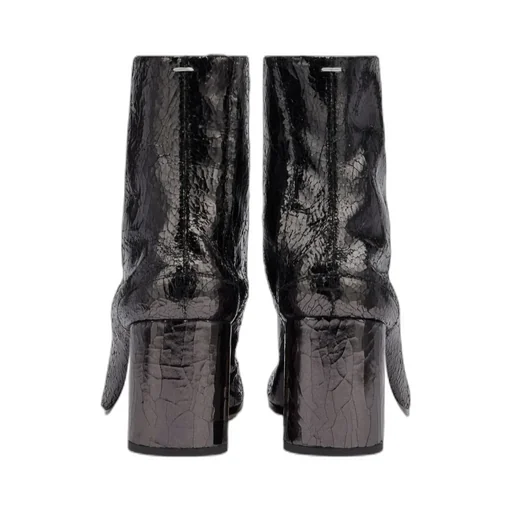
The first collection, Spring 1989, was shown at Paris's Café de la Gare on 23 October 1988. Raw hems, exposed seams, butcher's aprons and shoulders salvaged from old evening dresses established the vocabulary. The split-toe Tabi boot, based on Japanese work socks Margiela had seen in Tokyo, left red footprints across a white runway cloth that later became clothing. (Palais Galliera press dossier; MoMA)
The Spring 1990 show took place on waste ground beside a children's playground in Paris's 20th arrondissement. Local children made the invitations and sat among neighbourhood families and editors; models walked through the crowd. The carefully arranged event removed fashion's usual boundary between spectacle and street. (Palais Galliera press dossier; Vogue)
The garments asked similarly direct questions. A jacket could show the Stockman dress-form markings normally concealed during production. A lining might become an exterior. Sleeves from an old dress could be retained while its damaged body disappeared. Patternmaking—the engineering by which flat pieces become volume around a body—was no longer backstage information. Margiela made its decisions visible, allowing the wearer to see where a garment had come from and how it held together. (Metropolitan Museum of Art; Museo del Traje)
Replica, scale and the life already inside an object
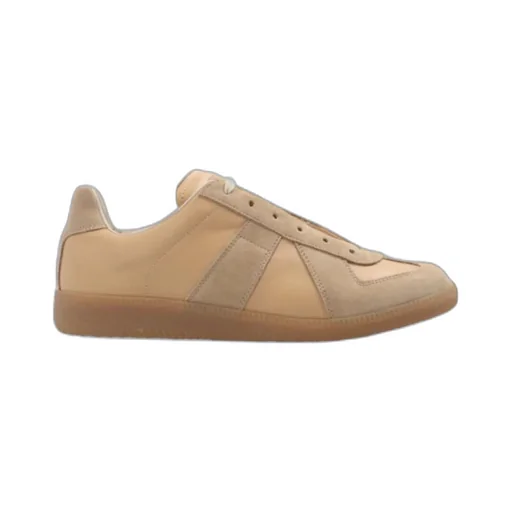
The Artisanal line converted old gloves, scarves, combs, records or playing cards through hours of atelier labour. Introduced in 1994, Replica instead reproduced a found garment and labelled its type, provenance and approximate date. Copying, usually fashion's enemy, became a way to preserve a good object with no celebrated author. (Maison Margiela line guide; Museo del Traje)
Fall 1994 brought scale into the same argument. Margiela enlarged clothes from a 1960s doll's wardrobe to adult dimensions, preserving giant buttons and coarse, out-of-scale knit stitches. For Spring 1996 he photographed second-hand garments and printed the flat images onto new ones, so age and wear became an optical surface. Spring 1998 pushed paper pattern pieces into “flat” garments that appeared two-dimensional on a hanger and changed only when a body entered them. The wearer completed the design. (Metropolitan Museum of Art; Palais Galliera press dossier)
For Spring and Fall 2000, wardrobe pieces were expanded to Italian size 78—roughly twice their standard scale. Seams, armholes and closures became strange against the body, revealing that a “normal” size is itself a design choice. Margiela developed such experiments over years instead of replacing them with a new theme each season. (Palais Galliera press dossier; Sotheby's)
Anonymous authorship and a public cause
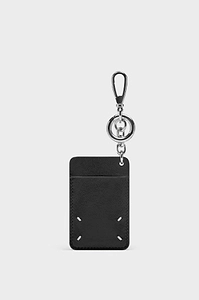
The house's first neck label was a blank white rectangle held by four visible white stitches. It could be removed, leaving only the four small marks. In 1997 the familiar grid numbered 0 to 23 appeared, with one number circled to identify a line. Neither device erased authorship: both became highly recognisable. Their more durable effect was to make branding and collective labour subjects that a garment openly discussed. Press questions were answered in the plural, and runway bows did not produce a designer for photographers to acclaim. (Musée des Arts Décoratifs; Maison Margiela)
Margiela did put a direct public message on one recurring garment. The AIDS T-shirt, first made for Autumn 1994, printed a sentence about the need for continuing action against AIDS; the text was deliberately placed so part remained hidden when worn. Reissued over many years and translated into different languages, it used the repetition of a commercial basic to resist the fashion calendar's short memory. (Palais Galliera press dossier)
Hermès: radical clothes without the appearance of rupture
Jean-Louis Dumas appointed Margiela to design women's ready-to-wear at Hermès in 1997. The choice surprised observers who equated him with distressed material, yet his twelve collections through 2003 clarified the precision beneath his own label. At Hermès he worked with double-faced cashmere, supple leather and exacting manufacture to build a calm wardrobe rather than seasonal theatre. (MoMu; Vogue)
His Hermès clothes prioritised movement and repeated use: jackets with reduced internal structure, trousers adjusted by waist tabs, deep-V Vareuse tops, removable elements and knits worn in layers of closely related colour. Models of different ages were presented with minimal make-up. The apparent simplicity was expensive in the literal sense—exceptional cloth and construction made it possible—and conceptual in another: luxury meant comfort, longevity and attention that did not need to announce its price. (Vogue; Vogue archive)
The two jobs were not opposites. Hermès refined the wardrobe; Maison Martin Margiela exposed its cultural and physical construction. Both resisted planned obsolescence and conspicuous logos. Income from the Hermès appointment also helped sustain and expand the independent house, which Meirens later said was rarely highly profitable. (Museo del Traje; MoMu)
Leaving fashion, entering art
Renzo Rosso's group acquired a majority stake in 2002. Meirens left in 2008, and Margiela withdrew without a farewell bow. Spring 2009, shown on 29 September 2008, was his final authored collection; his departure was confirmed publicly in December 2009, while the studio continued anonymously. (Palais Galliera; El País)
Retirement did not end the underlying practice. Martin Margiela: In His Own Words, Reiner Holzemer's 2019 documentary, let viewers hear him and watch his hands while still withholding his face. In 2021 his first solo art exhibition occupied Lafayette Anticipations with more than twenty installations, sculptures, collages, paintings and films concerned with skin, hair, ageing, residue and transformation. The medium changed; the attention to overlooked surfaces did not. (Time; Lafayette Anticipations)
In July 2026 Margiela helped sell nearly 200 objects from his private archive. Graffiti-covered Tabi boots reached roughly ¥68 million, confirming that work devised partly against conventional luxury had become a scarce luxury artefact itself. (Le Monde; Valuence)
Reading and dating Martin Margiela's work
The clearest first distinction is authorship. Martin Margiela designed his house's collections from 1988 through the Spring 2009 season. Garments produced by the studio after that season and before John Galliano's first collection in January 2015 are Maison Martin Margiela, but they are not automatically “Martin-designed.” Galliano-era and Glenn Martens-era products retain many founder codes, so a Tabi toe or four white stitches cannot establish who directed a particular season.
The neck label identifies the line, not the year. On the 0–23 grid, 0 and 0 10 indicate Artisanal, 1 the women's collection, 4 the women's wardrobe, 6 MM6, 10 the men's collection, 14 the men's wardrobe and 22 shoes. “Replica” identifies a reproduced found object or the product family that grew from that concept; it does not mean counterfeit. See the complete Maison Margiela number-line guide and, for footwear, the Tabi sizing guide. (Maison Margiela; Museo del Traje)
For an archival piece, check the composition and care label, season code, line number, provenance and documented runway image together. The wording Maison Martin Margiela remained after the founder left and therefore does not prove his involvement; the shortened Maison Margiela name arrived with Galliano's 2015 debut. Attribution should follow the collection date, not the mythology attached to the four stitches. (Vogue; Palais Galliera)
References
- Palais Galliera. “Margiela / Galliera, 1989–2009.” 2018.
- Alexandre Samson. “Margiela / Galliera, 1989–2009: press dossier.” Palais Galliera, 2018.
- MoMu Fashion Museum Antwerp. “Maison Martin Margiela ‘20’ The Exhibition.” 2008.
- MoMu Fashion Museum Antwerp. “Martin Margiela.” Collection story.
- Museo del Traje. “Martin Margiela.” Spanish Ministry of Culture.
- Museo del Traje. “Camiseta, pantalón y pulsera.” Spanish Ministry of Culture.
- Metropolitan Museum of Art. “Jacket, Maison Margiela, Spring/Summer 1989.”
- Metropolitan Museum of Art. “Sweater, Maison Margiela, Autumn/Winter 1994–95.”
- Museum of Modern Art. “Pirouette: Turning Points in Design—object labels.” 2024.
- Musée des Arts Décoratifs. “Margiela, les années Hermès.” 2018.
- Laird Borrelli-Persson. “‘Margiela: The Hermès Years’: Inside Antwerp's Retrospective.” Vogue, 30 March 2017.
- Laird Borrelli-Persson. “13 Photographs of Martin Margiela's Hermès Collections From the Vogue Archive.” Vogue, 12 April 2017.
- Vogue Runway. “Maison Margiela: collections and archive.”
- MoMu Fashion Museum Antwerp. “Margiela, les Années Hermès.” 2017.
- Maison Margiela. “Our House.”
- Maison Margiela. “The 12 Days of Margiela.”
- Sotheby's. “Martin Margiela: Hors Normes II.” 2019.
- Lafayette Anticipations. “Martin Margiela.” 2021.
- Stephanie Zacharek. “Martin Margiela: In His Own Words Explores the Revolutionary Designer's Secrets.” Time, 4 August 2020.
- El País. “Margiela abandona la casa.” 10 December 2009.
- Jonathan Van Meter. “John Galliano Reflects on His New Role Helming Maison Margiela.” Vogue, 23 February 2015.
- Valentin Pérez. “Martin Margiela puts 200 pieces from his personal archives up for sale.” Le Monde, 28 June 2026.
- Valuence Holdings. “Valuence Acquires Martin Margiela's Personally Preserved Graffiti Tabi at Auction.” 10 July 2026.
- 生年
- 1957年4月9日
- 学歴
- Royal Academy of Fine Arts Antwerp (1980)