
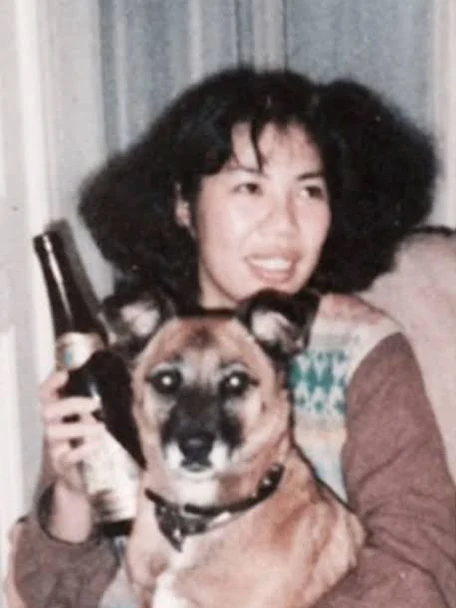
Michiko Koshino
Japanese-born designer who has run her fashion business from London since the early 1980s as MICHIKO LONDON KOSHINO.
Michiko Koshino left Japan for London in the late 1970s and built MICHIKO LONDON KOSHINO around the city's club, street and youth cultures. Unlike the separate houses run by her sisters Hiroko and Junko, her archive is rooted in British streetwear: nylon biker jackets, club-ready sportswear and industrial fabrics rather than couture. (The Observer; Pen Magazine International)
Her black inflatable nylon dress at London Fashion Week in March 1987 made that approach literal. It reportedly travelled with patches and a bicycle pump in case of puncture, turning an industrial material into both silhouette and spectacle. (Los Angeles Times)
From Osaka to Covent Garden
Koshino was born in 1943 in Osaka, the youngest of three daughters of the designer Ayako Koshino, who raised the family alone after her husband died fighting in the Second World War. Her two older sisters, Hiroko and Junko, were already established designers in Japan by the time Michiko considered a career of her own. (Manon Baeza, Pen Magazine International, 5 February 2020; The Observer, 2002.)
Rather than compete with them at home, Koshino left. She has said plainly that she "never thought of starting a label in Japan because my older sisters were already very well known there," and by her own account arrived in London in the late 1970s "very poor," falling into the fashion trade because it was, in her words, the easiest way to make a living. (The Observer, 2002.) A single wool-and-nylon ensemble in the Victoria and Albert Museum's collection, dated 1979 and donated the same year as part of a set of complete outfits documenting youth style of the period, is the earliest surviving record of her design work from this period — made before she had a shop of her own. (Victoria and Albert Museum, object O138555.)
A shop built like a nightclub
Koshino opened her first shop on Neal Street in Covent Garden in 1981. It did not read as a conventional boutique: contemporary accounts describe an interior that functioned like a nightclub, and a retrospective account written for the University of the Arts London's V&A partnership project describes the store's club atmosphere, complete with DJ turntables, as inseparable from the clothes sold inside it. ("Devotees went to buy one particular nylon jacket — it became her core business — and Motorking clothes and accessories," reported The Observer in 2002.) ("Club to Catwalk: London Fashion in the 1980s." Exhibiting Fashion, V&A Museum, 9 July 2013; The Observer, 2002.)
Koshino described the shop's own retail concept, which she kept as she moved premises over the following two decades, as "ornamental kitsch": she filled it with bright plastic toys, Japanese knick-knacks and trinkets gathered on her travels, treating the shop floor as an extension of the clothes rather than neutral space to sell them from. (The Observer, 2002.)
From that shop grew a licensed streetwear business that began trading in 1986 under the name that survives today, MICHIKO LONDON — a fact the brand itself marked thirty years later with an anniversary show in Tokyo. (WWD Japan, "「ミチコ ロンドン」が原宿ストリートをテーマに30周年記念ショーを開催." 8 October 2016.) The following year, 1987, she launched Motorking, a men's line built from biker-jacket silhouettes that found an audience well beyond the shop: David Bowie and Moby were both photographed wearing it. ("Club to Catwalk: London Fashion in the 1980s." V&A Museum, 2013.)
Inflatable and neoprene
The 1987 inflatable dress was not a one-off stunt. Koshino built an Inflatable line around air-filled nylon panels that recurred across her collections, and she returned to the idea explicitly for her thirtieth-anniversary show in Tokyo in October 2016, reworking the same air-filled construction in camouflage prints and Tyvek, the bonded synthetic paper more commonly used for building membranes and protective clothing. That show closed with Koshino herself walking out in a Union Jack dress paired with a transparent inflatable piece. (WWD Japan, "「ミチコ ロンドン」が原宿ストリートをテーマに30周年記念ショーを開催." 8 October 2016.) Her willingness to build a wearable garment from an industrial or novelty material — air-filled nylon, neoprene, Tyvek — rather than treat it as a special-occasion gimmick is the throughline between the 1987 dress and the later collection.
The Victoria and Albert Museum's costume collection preserves a more workaday version of the same period. Two ensembles acquired directly from Koshino for the museum's 1994–95 Streetstyle exhibition — one titled Fashion Techno 1993, built around a dark grey nylon waistcoat and bodysuit from her 1992 collection, the other Fashion New Age Traveller, built around a brown wool waistcoat from her 1993–94 collection — show a plainer, more functional register: outerwear cut for movement and cold rather than for spectacle. Both are recorded in the museum's database as "given by the designer." (Victoria and Albert Museum, objects O1175163 and O1175149.)
Denim, knitwear and a sushi bar
Koshino's business has never stayed still within clothing alone. A denim line, Yen Jeans, became one of her steadiest sellers, and in March 2013 she relaunched it with a broader womenswear range as YEN by MICHIKO KOSHINO, previewed at a trade event in Shibuya. (WWD Japan, "コシノ ミチコが「YEN by MICHIKO KOSHINO」をスタート." 18 March 2013; The Observer, 2002.) The following year she worked with nine knitwear manufacturers in Wakayama Prefecture, developing around sixty jersey fabrics that she showed as her Spring/Summer 2015 collection at London Fashion Week — a project she later described to fashion students in Tokyo by praising Japanese textile manufacturing specifically: "the exterior design is simple, but the wearability is excellent — the fabric's firmness and body are entirely different." (WWD Japan, "コシノ ミチコがモード学園生に説いた「成功の秘訣はポジティブ」." 20 June 2014.)
In July 2016 she opened Michiko Sushino, a sushi counter on the ground floor of her London office on Salusbury Road, in partnership with Asra Port Dining, the operator behind the Gyu-Kaku and Atari-Ya restaurant chains in the UK; the plan, as reported at the time, was a sushi bar customers could enter and order from as casually as a coffee shop. (WWD Japan, "コシノミチコが寿司バーをロンドンにオープン 牛角のアスラポートとコラボ." 5 July 2016.) A profile written around the same period described her as having "no interest" in slowing down. ("Michiko Goes Solo." Tokyo Weekender, 6 January 2013.)
A family business built abroad
Michiko is the only one of the three Koshino sisters to have based her business entirely outside Japan. Hiroko built her name through Rome and Paris while remaining rooted in Japan; Junko likewise operated from Japan. Michiko instead made London her permanent base and treated its biker, club and rave cultures as working material. (Pen Magazine International)
That decision shaped both the clothes and their institutional afterlife. Industrial synthetics, inflatable construction and biker-derived outerwear place her work in the London street cultures documented by the V&A's Streetstyle and Club to Catwalk projects. Japanese manufacturing remained important when a project called for it, as in the Wakayama knitwear collaboration, but London supplied the enduring context. (Victoria and Albert Museum; WWD Japan)
Reading and dating the work
A Koshino garment can carry several names. Shop-era pieces from the early 1980s predate MICHIKO LONDON, which begins with the 1986 relaunch. The denim line appears as YEN JEANS and, from 2013, YEN by MICHIKO KOSHINO. A generic "Michiko Koshino, London" label needs to be matched to dated collection evidence, as the V&A does with its 1992 and 1993–94 ensembles. (Victoria and Albert Museum, O1175163; Victoria and Albert Museum, O1175149)
Material can narrow the period but should not stand alone. Plain black inflatable nylon is consistent with the 1987 work; camouflage inflatable panels and Tyvek connect more directly to the 2016 anniversary revival. Motorking points to the men's biker-derived line launched in 1987, but its cut and fabric still need support from the garment label or dated imagery. (WWD Japan; Los Angeles Times; Victoria and Albert Museum)
References
- Tamsin Blanchard. "Fever Kitsch." The Observer, 6 April 2002.
- Bettijane Levine. "Designers Eschew Protest for Prosperity in London Shows." Los Angeles Times, 18 March 1987.
- Manon Baeza. "The Koshino Family: Reinventing Fashion over the Generations." Pen Magazine International, 5 February 2020.
- "Michiko Goes Solo." Tokyo Weekender, 6 January 2013.
- Victoria and Albert Museum. "Club to Catwalk: London Fashion in the 1980s." Exhibiting Fashion, 9 July 2013.
- WWD Japan. "「ミチコ ロンドン」が原宿ストリートをテーマに30周年記念ショーを開催." 8 October 2016.
- WWD Japan. "コシノミチコが寿司バーをロンドンにオープン 牛角のアスラポートとコラボ." 5 July 2016.
- WWD Japan. "コシノ ミチコが「YEN by MICHIKO KOSHINO」をスタート." 18 March 2013.
- WWD Japan. "コシノ ミチコがモード学園生に説いた「成功の秘訣はポジティブ」." 20 June 2014.
- Victoria and Albert Museum. Collection records: Waistcoat, O1175163; Waistcoat, O1175149; Dress ensemble, O138555. Accessed September 2026.
- 原語表記
- 小篠美智子
主な作品
該当する結果が見つかりませんでした
キーワードやフィルター条件を変更して再度お試しください。