
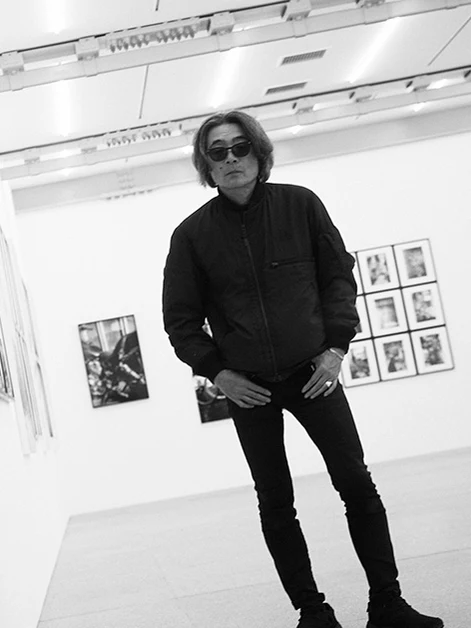
Nobuhiko Kitamura
Japanese designer and founder of Hysteric Glamour, the Tokyo rock-and-biker label he has directed since 1984.
Nobuhiko Kitamura founded Hysteric Glamour in Tokyo in 1984 and has designed every collection the label has released since. He is often filed alongside the "bootleg" T-shirt trade that ran on unlicensed band imagery through the 1980s and 1990s, and the label's early work does draw on that same vernacular of pirated rock photography and pin-up illustration. But Hysteric Glamour was a registered fashion house from its first season, not a market-stall operation, and over four decades its relationship to the music and photography it reproduces has moved from open homage toward formal, paid licensing—a shift that matters for anyone trying to work out what a given piece actually is. (WWDJAPAN; HYSTERIC GLAMOUR)
Origins: a record collection before a sketchbook
Kitamura was born in Tokyo on 19 December 1962, a fact recorded on the cover of a 1991 monograph the designer himself supervised. He has described being drawn to rock music before he was drawn to clothing: album sleeves, particularly work touched by Andy Warhol and the design collective Hipgnosis, taught him to read a record cover as a piece of visual design, and he has named The Velvet Underground's debut as a formative encounter with the overlap of contemporary art and pop music. (Mode Gakuen Publishing Bureau; Hypebeast JP)
He enrolled at Tokyo Mode Gakuen, compressing what was structured as a longer course into three years by attending both day and evening classes, and worked part-time for Ozone Community, a Tokyo apparel company, while still a student. He has said plainly that he was more interested in vintage shops and subculture than in runway fashion design as it was then taught. When Ozone Community decided to launch a new label in 1984, it hired him, at 21, to design it. (RINKAN; WWDJAPAN)
Punk meets pretty: building the label
The brand name was chosen to resist translation into Japanese. Kitamura has said he arrived at it by combining the intensity he associated with Patti Smith with the glamour he associated with Deborah Harry of Blondie—"Hysteric" for one, "Glamour" for the other—rather than by describing the clothes directly. The turnaround from decision to shop floor was fast even by the standards of the industry: the brand launched in June 1984, held its first exhibition the following month, and had product in stores by August. (Hypebeast JP; WWDJAPAN)
From the start, Kitamura rejected the seasonal storytelling that structured most Japanese fashion labels at the time, choosing instead to keep working a consistent set of references: American punk and New Wave, 1960s and 1970s biker culture, hot-rod and pin-up illustration, and a strand of "white trash"-inflected Americana filtered through mid-1970s Hollywood imagery. Recurring pin-up graphics on T-shirts and outerwear became one of the label's most recognisable devices, sitting alongside slim, closely fitted silhouettes and unusually careful attention to fabric weight and print quality for a brand working in that register—qualities that separated Hysteric Glamour from cheaper band-merchandise imitators even when the two traded in similar imagery. (sabukaru; RINKAN)
The brand's early Japanese exposure owed a great deal to the magazine Olive, whose readership picked up the label quickly and helped establish it as one of the visual anchors of the emerging Harajuku street scene, alongside its reputation as an early example of designer-led "rebellious" streetwear rather than a diffusion line of an established house. (WWDJAPAN)
From Harajuku to the world
Hysteric Glamour opened its Harajuku flagship in 1986. Expansion followed on a scale unusual for a Tokyo label of its size: a temporary storefront in New York's East Village in the late 1980s drew customers including Sonic Youth's Kim Gordon and photographer Terry Richardson, and in 1991 the London retailer Gimme Five, run by Michael Kopelman, began producing Hysteric Glamour UK locally, with early supporters including John Galliano. A US entity, Hysteric Glamour USA, followed in 1998. (RINKAN; Hypebeast JP)
The product range widened alongside the geography. Hysteric Mini, a children's line, launched in 1985; Hysterics, a higher-end womenswear line, followed in 1990. Kitamura started a dedicated menswear line in 2001, applying to men's clothing an idea he had first tested on women—taking overtly masculine military and workwear pieces, such as the MA-1 flight jacket, and repositioning them as womenswear, a move he traces to vintage-shop finds and to the way 1960s and 1970s musicians actually dressed rather than to any runway precedent. Thee Hysteric XXX, a more experimental men's offering, followed in 2003. (WWDJAPAN; Fashion Press)
Photography as a second discipline
From 1991 the brand's seasonal catalogue gave way, at points, to something closer to independent art publishing. A turning point was Kitamura's discovery of Daido Moriyama's photobook Farewell Photography; he approached Moriyama directly, and the photographer agreed to collaborate on the condition that he be left to work alone across a full 400-page book. The result, Daido Hysteric No. 4 (1993, known informally as "Blue Daido" for its cover), sold out its 300-copy first run immediately and was followed by further volumes, including a horizontal, red-covered No. 6 the following year. Kitamura later converted the basement of the brand's Aoyama store into RAT HOLE GALLERY, which operated from 2008 to 2020 and extended the same curatorial instinct from photography into contemporary art more broadly. (IMA ONLINE; Hypebeast JP)
Similar partnerships followed with Nobuyoshi Araki, and later with Terry Richardson, whose first collection for the brand appeared in 1998, and with Patti Smith, whose polaroid work Kitamura published in 2003—a project he has described as unusually personal, given how much Smith's music shaped him as a teenager. Read together, these projects place Hysteric Glamour closer to a small art-publishing house that also makes clothes than to a fashion label that occasionally sponsors a photographer. (IMA ONLINE; Hypebeast JP)
From homage to licence
The same rock-and-roll iconography that fills Hysteric Glamour's archive has, over time, moved from being simply drawn on to being formally licensed. The clearest recent example is the brand's collaboration with The Rolling Stones, built around the band's trademarked Lips and Tongue logo, which the label released as a full collection for 1 January 2026—one entry in a longer, if loosely documented, history of Hysteric Glamour products carrying the band's imagery. For the brand's fortieth anniversary, Hysteric Glamour also mounted "New York Hysteric: 40 Punk Rock Years," an exhibition and sales list spanning work and ephemera connected to Andy Warhol, The Velvet Underground, Patti Smith, The Clash, Sid Vicious and a wide cast of other late-1950s-to-1980s New York countercultural figures, framed explicitly as a record of the influences behind the label rather than as new licensed merchandise. (SNKRDUNK; HYSTERIC GLAMOUR)
Kitamura has resisted calling Hysteric Glamour a company in interviews, describing himself instead as a designer who happens to run one, and has said he tries to keep the brand outside straightforward commercial logic even as it has grown into an international operation with, as of the 2024 interviews marking the brand's fortieth year, a design team of around two dozen people working under him. He remains its design director. (Hypebeast JP)
Labels, dating and how to read a Hysteric Glamour piece
Because Hysteric Glamour has traded for over forty years under a single company, changes to its hangtags and interior labels provide a more reliable dating tool than the printed graphics, which the brand has repeated across decades. (GEEKS ARCHIVE SHOP)
The earliest pieces, from the 1980s into the early 1990s, carry what collectors informally call a "mama tag," alongside simplified numbering with no hyphens and, on some of the very earliest garments, a red-sun ("hinomaru") style tag with "Ozone" printed separately on the garment, for instance inside a pocket. Through the 1990s, interior labels read OZONE COMMUNITY without the Hysteric Glamour brand name printed beneath it. Sometime around the turn of the millennium the brand name HYSTERIC GLAMOUR began appearing under the Ozone Community line on the tag; garments from the transition years can carry either version, or occasionally both, which limits precise dating to "roughly 1990s" or "roughly early 2000s" for that period rather than a specific year. (GEEKS ARCHIVE SHOP)
From Autumn/Winter 2009 the brand adopted a more legible numbering system that survives, with one revision, to the present. On garments from AW2009 through 2016, an eight-digit style number encodes the year as the third digit and the season as the fourth digit. From Spring/Summer 2017 onward, the system expanded to nine digits: the third and fourth digits give the last two digits of the year, and the fifth digit gives the season—1 or 2 for spring/summer, 3 or 4 for autumn/winter. A tag reading in that format can therefore be dated to a specific season with real confidence; anything from before 2009 generally cannot be narrowed past the decade. (GEEKS ARCHIVE SHOP)
This matters more for Hysteric Glamour than for many labels because its pin-up and rock-derived graphics recur across seasons with only minor variation. A print alone rarely proves an item's age; the label and style number are better evidence. A licensed collaboration, such as a Rolling Stones T-shirt, should also carry the partner's trademark or copyright line, unlike an independent Hysteric Glamour graphic referring to the same era. (GEEKS ARCHIVE SHOP; Fashion Press)
References
- 大塚千践 (Kazufumi Otsuka). "「ヒステリックグラマー」北村信彦デザイナーが語る再ブレイクまでの39年【90年代リバイバルの源泉】." WWDJAPAN, 26 April 2023.
- Takeshi Kikuchi. "北村信彦とヒステリック グラマーの40年." Hypebeast JP, 22 November 2024.
- Eiji Kobayashi (interview); IMA (text). "ヒステリックグラマー北村信彦が森山大道から紡いだ東京写真カルチャー." IMA ONLINE, 21 June 2022.
- kosuke. "タグから見るHYSTERIC GLAMOUR(ヒステリックグラマー)の年代判別." GEEKS ARCHIVE SHOP, 24 April 2024.
- RINKAN. "デザイナー 北村信彦." Accessed September 2026.
- RINKAN. "ヒステリックグラマーの歴史." Accessed September 2026.
- Fashion Press. "ヒステリックグラマー : HYSTERIC GLAMOUR." Accessed September 2026.
- Mode Gakuen Publishing Bureau; Miho Ueda (text), Nobuhiko Kitamura (editorial supervision). 北村信彦。1962年12月19日、東京生まれ。 1991.
- sabukaru. "Trust in Glamour: The Artistic Direction of Hysteric Glamour." Accessed September 2026.
- HYSTERIC GLAMOUR. "New York Hysteric: 40 Punk Rock Years." Accessed September 2026.
- SNKRDUNK. "HYSTERIC GLAMOUR × THE ROLLING STONES、人気タッグの最新コラボコレクションが1/1発売." Accessed September 2026.
- Wikidata. "Nobuhiko Kitamura (Q11401940)." Accessed September 2026.
- 生年
- 1962年12月19日
- 原語表記
- 北村信彦
- 学歴
- Tokyo Mode Gakuen (1984)
主な作品
該当する結果が見つかりませんでした
キーワードやフィルター条件を変更して再度お試しください。