
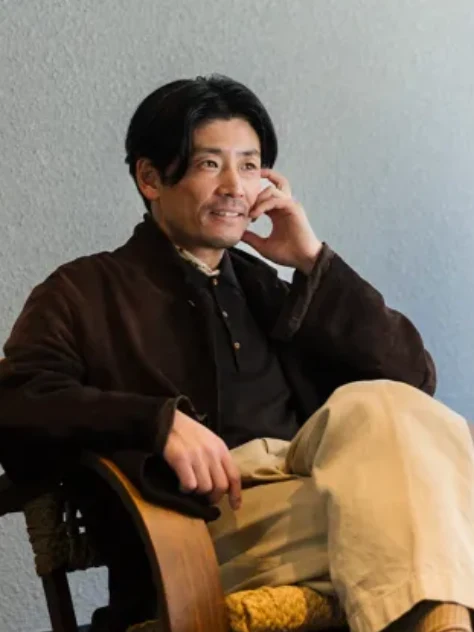
Shinsuke Kojima
Japanese menswear designer and former magazine editor who founded Kaptain Sunshine in 2013 and still designs it from Minami-Aoyama, Tokyo.
Shinsuke Kojima is the founder and designer of Kaptain Sunshine, the Tokyo menswear label he started in 2013 and still directs. He did not come to it through a fashion school or a patternmaking apprenticeship. He spent his twenties editing a men's fashion magazine, began working as a designer alongside that job from 2002, and only set up his own label eleven years later. (BRUTUS; HOUYHNHNM)
That route matters, because it is the method. Kojima describes his practice as editing rather than invention: "I think I have always been editing when I make clothes," he told PADDLER SHONAN, adding that he works less by drawing from zero than by re-editing an archive of Japanese and international garments from fifty or a hundred years ago. English-language listings often file Kaptain Sunshine simply as Americana revival. The brand's own statement of intent is narrower and more specific — traditional clothing and field and naval wear, made into "your best companion to take to adventures" — and its production base is entirely Japanese. (PADDLER SHONAN; Kaptain Sunshine)
From a ski lift in Hakuba to an editor's desk
Kojima was born in 1976 in Hyōgo Prefecture and moved as a primary-school child from the coast near Kobe to Hakuba, in the mountains of Nagano. The family house stood beneath a ski lift; going anywhere meant sledging down the hill first. He joined a local ski team in his fourth year of primary school and raced competitively until the end of junior high, in an environment he remembers as unforgivingly high-level. (Goldwin)
He has said that the length of time he spent living inside that landscape is his central source of inspiration as a designer — clothes that can be worn around surfing, clothes that let you head for the snow when winter comes — and that his seasonal colours are usually cut out of nature rather than assembled from a trend forecast. He was drawn to secondhand clothing from his high-school years, and by his mid-twenties was editing a men's fashion magazine. (Goldwin; PADDLER SHONAN)
After leaving the magazine, Kojima designed for domestic brands and planned products for select shops, although published profiles do not name those employers. He had been working in design since 2002 by the time he joined the textile company that became Kaptain Sunshine's parent business. The move gave him both a manufacturing network and the material knowledge on which the label would be built. (HOUYHNHNM; BRUTUS; PADDLER SHONAN)
Fabric first, garment second
Because of that parent company, a Kaptain Sunshine garment usually begins with cloth rather than with a silhouette. Kojima travels to the producing regions — 尾州 (Bishū, the Owari district of Aichi, Japan's principal worsted-wool area) for wool, Shizuoka for cotton — and develops material in conversation with the mills. "Meeting people who make interesting fabric is what gives me the hint," he has said; sometimes the mill offers him a yarn or a cloth, sometimes he initiates. All material production and sewing is done in Japan, which he frames as a deliberate cost decision rather than a marketing one. (PADDLER SHONAN)
The detail he gives about yarn is the useful part. For a 2017 collaboration he built an original ripstop from FINX — a Japanese-spun yarn made from Egyptian extra-long-staple cotton — in a 100/2 count, woven as densely as possible. A 100/2 is a very fine two-ply yarn, far higher-grade than anything a 1940s work or military garment would have used; Kojima chose it precisely as the inverse of the coarse American hand he also likes, producing a cloth that is thin but stiff-bodied, with a faint sheen and a slippery handle. He has used FINX repeatedly in the main collection. (HOUYHNHNM)
The same collaboration was dyed by BUAISOU, the Tokushima group who grow, harvest and ferment their own indigo into 蒅 (sukumo, composted indigo leaf) before dyeing with it. Kojima visited the workshop, and pushed back on the assumption that true indigo bleeds: BUAISOU wash a finished piece for about a week, and the colour deepens with wear rather than running. His reason for reaching for indigo on an American workwear project was that Japan has its own work-clothing tradition dyed the same way, in 作務衣 (samue, the padded work garment of a Buddhist temple). (HOUYHNHNM)
Clothes meant to be taken travelling
Kojima takes a longer holiday after each showroom season and uses it to road-trip — the length of France, the width of the United States — with the trip doubling as a wear test. Flights and long drives tell him whether the ease of movement, the number of pockets and the layering actually work, and the findings go into the next season. He is also a surfer and still skis; he moved out of Tokyo to the Shōnan coast in his late twenties and lives in Kamakura, while keeping the business in Minami-Aoyama, which he calls the epicentre of Japanese fashion. (PADDLER SHONAN; GQ Japan)
Two habits show up in the clothes themselves. Proportion is loose and slightly lengthened: when Goldwin's technical team worked with him, Kojima identified the way the sleeve is set and the oversized line as the two things that had to be carried over for a garment to read as his. And the models are revised rather than replaced. The Field Wrap Jacket, a long-running staple, is minor-changed every year with an updated fabric — one spring in a cotton-silk seersucker, cut unlined and unstructured with a strap inside so it can be rolled up and carried once taken off. (Goldwin; GQ Japan)
Guest work and collaborations
Kojima served as guest designer for Woolrich from Autumn/Winter 2016, and has since worked outside his own label steadily. He contributed a reversible 1943 Rip-Shirt Jacket to Big Yank's The Third Edition in 2017, reached back past the brand's workwear reputation to its parent Reliance company's wartime military contracting, and based the piece on the M-43 shirt. Goldwin produced a joint ski collection of four GORE-TEX and down pieces, Snow Dwellers, released for Kaptain Sunshine's tenth anniversary in 2023, explicitly on the strength of Kojima's Hakuba upbringing. (HOUYHNHNM; GQ Japan; Goldwin; HOUYHNHNM)
More recent partners include Paraboot, for two special-order shoes released on 15 August 2025 that take the 1990s Domingue as a base, borrow details from the brand's Barth deck shoe, drop the side lacing cord and run a shark sole; and Barbour, whose third collaboration with Kojima appeared on 5 February 2026 and reworked two archive pieces, the early-1990s Endurance Jacket and the 2000 Transport Jacket, as modular two-in-one garments. (HOUYHNHNM; HOUYHNHNM)
The brand opened its first flagship store on 7 March 2025, at 5-18-10 Minami-Aoyama, on a back lane behind Kottō-dōri. Kojima had been looking for premises for over three years, intending to open for the tenth anniversary, and had widened the search as far as the older districts around the Sumida river before settling on Aoyama; he wanted somewhere quiet enough that customers would slow down, and large enough to show the full range to the increasing number of overseas visitors. The interior was designed by Koichi Futatsumata's studio CASE-REAL. (Fashion Press; HOUYHNHNM)
Reading and dating a Kaptain Sunshine garment
Kaptain Sunshine names its garments by construction rather than by theme, and the name is usually prefixed with the fabric: Wool Cavalry Walker Coat, Cotton Mock Twist Umbrella Coat, Wool Herringbone Explorer Jacket, Cotton Drill Gurkha Pants, Traveller Easy Pants, Shoecut Slacks, Take Easy Jacket. The Traveller Coat is the best-known single model, a double-woven melton coat with a chin strap, three front flap pockets and a hem strap; stockists treat it as the label's autumn/winter signature. Because Kojima revises rather than retires a model, a name alone identifies the archetype, not the season. (Kaptain Sunshine; Ray Coal)
The product codes are more informative than the names. The brand's own store lists seasonal pieces under codes of the form KS + two-digit year + F or S for the season + a two-letter category + a number: KS26FCO02 is the Cotton Mock Twist Umbrella Coat from Autumn/Winter 2026, KS26FJK31 a jacket from the same season, and KS22SCO03 the Swedish Over Coat from Spring/Summer 2022. Category letters seen in use include CO coat, JK jacket, PT trousers, SH shirt, KN knit, VT vest, CS cut-and-sewn jersey and GD goods. Permanent, non-seasonal items drop the year entirely and take a KSBS prefix instead — KSBSCO01 for the Wool Cavalry Walker Coat, KSBS101DZ for the 5P Zipper Front Denim Pants — so a KSBS code is not undated stock, it is a continuity line. The brand has never published this as a key; it is a pattern consistent across its own store listings and stockist databases, so treat it as strong evidence rather than proof. (Kaptain Sunshine; haus)
Collaborations and outsourced production take their own prefixes and, usefully, their own country of origin. KSRF03 is the Unlined KS Trainer, a German-army-style trainer made for Kaptain Sunshine by Reproduction of Found; KSJS001 is a Sea Island cotton knitted polo shirt made with John Smedley; KSBR01 a shoulder bag by Brady; KSUP02 a pack marked Made in USA. Everything in the main collection is marked Made in Japan, so a Kaptain Sunshine label naming another country should send you to the collaboration rather than to a counterfeit. (Kaptain Sunshine; Fashion Press)
The brand's public lookbook archive begins with Spring/Summer 2018, five years after launch. Pieces from 2013 to 2017 therefore cannot be matched to an official season page and need to be dated from their product code and contemporary retail records. The company dates the label to Spring/Summer 2013 without publishing a precise launch day. As of September 2026, Kojima remains its designer. (Kaptain Sunshine; HOUYHNHNM)
References
- "BRAND / About." Kaptain Sunshine. Accessed 11 September 2026.
- "DOCUMENT — seasonal collection archive, SS 2018 onward." Kaptain Sunshine. Accessed 11 September 2026.
- Shuhei Sato. "Sono michi no shikisha kunin ga hyōgen suru, atarashii Big Yank no katachi. CASE5_Kojima Shinsuke-san (KAPTAIN SUNSHINE designer)." HOUYHNHNM, 13 January 2017.
- Tetsu Takasuka. "The 3 Essentials — KAPTAIN SUNSHINE designer Kojima Shinsuke." GQ Japan, 6 June 2018.
- Takuro Watanabe. "THE PADDLER | 055 Mr. Shinsuke Kojima." PADDLER SHONAN.
- "Yuki no jūnin ga umidasu, tokai to shizen no seamless na — interview by Shinsuke Kojima." Goldwin.
- Ryo Kikuchi and Rui Konno. "Denim ni knit, jacket mo! 'Kaptain Sunshine' designer no 'ao' shibutsu o chirami se." OCEANS, 19 April 2023.
- "'Kaputen Sunshine' ga hatsu no kikanten o Minami-Aoyama ni open." Fashionsnap, 28 February 2025.
- "Kaputen Sunshine ga Tōkyō Aoyama ni hatsu no kikanten open." Fashion Press, 5 March 2025.
- Tsuji and Yosuke Ishii. "Aoyama ni umareta Kaputen Sunshine no kikanten. Designer Kojima Shinsuke ga motomeru omise no arikata." HOUYHNHNM, 1 April 2025.
- "Summer casual ni tashitai, tokubetsu na Paraboot ga tōjō." HOUYHNHNM, 12 August 2025.
- Shigeo Kanno. "Aki kara fuyu no jacket kō. 'KAPTAIN SUNSHINE' designer Kojima Shinsuke no baai." BRUTUS, 15 September 2025.
- "Barbour × Kaputen Sunshine no dai-3-dan." HOUYHNHNM, 4 February 2026.
- "KAPTAIN SUNSHINE Swedish Over Coat (KS22SCO03)." haus.
- Terasu. "KAPTAIN SUNSHINE TRAVELLER COAT." Ray Coal, 30 October 2021.
- 原語表記
- 児島晋輔