
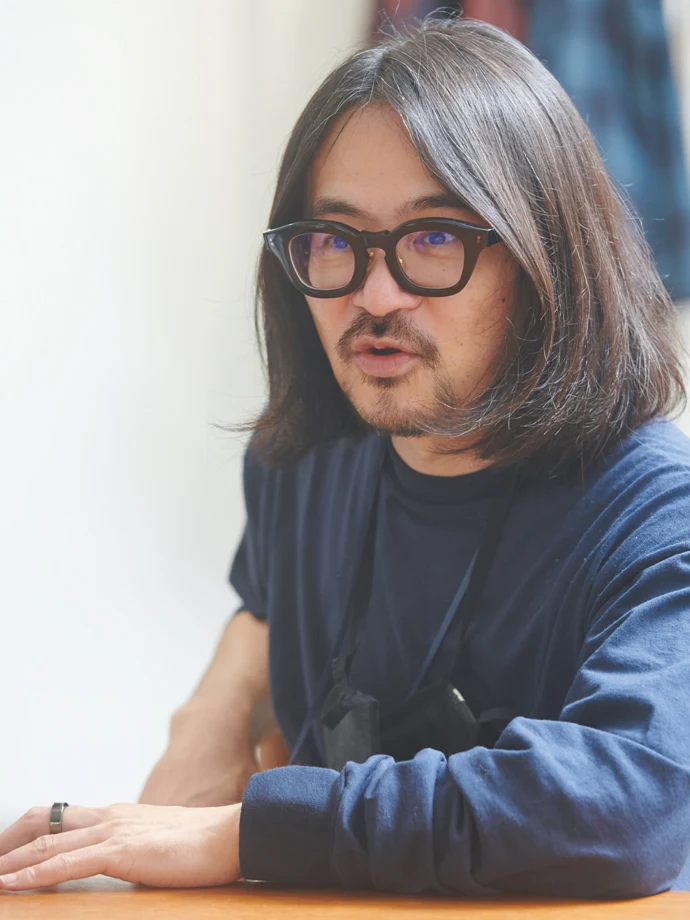
Shunsuke Ishikawa
Japanese menswear designer who founded marka in 2002 and MARKAWARE in 2009, designing from raw fibre he sources at the farm himself.
Shunsuke Ishikawa runs two menswear labels out of one Tokyo studio, and they are not the same label. marka came first, started in May 2002 and built on a single rule — that everything, from making the cloth to sewing and finishing, happens in Japan. MARKAWARE arrived seven years later and starts a step further back, with the fibre itself: Ishikawa travels to the farms, buys the raw material, and has it spun, woven and cut in Japan, with the suppliers named on the tag. Resale listings routinely treat the two as one brand with two spellings. They are separate collections with separate premises. (MARKAWARE; WWDJAPAN)
He is also unusual among Japanese designers of his generation in having no fashion-school training at all. Ishikawa was born in Hyōgo Prefecture on 25 July 1969, read economics at Konan University in Kobe, spent a year studying in the United States, and went to work for a management consultancy. He left it to start marka in May 2002, for the Autumn/Winter 2002–03 season, as a womenswear brand; the menswear line followed the next season, Spring/Summer 2003. (Web UOMO; Nippon Market)
The early chronology is not entirely consistent. Ishikawa's profile in a 2024 interview dates the menswear start to 2007, while MARKAWARE's official history calls Spring/Summer 2003 marka's debut without mentioning an earlier womenswear phase. The company itself is consistently dated to 2002, but the exact point at which marka became menswear remains unclear. (+CLOTHET; MARKAWARE)
marka: Made in Japan as a constraint, not a slogan
marka's founding premise was domestic production end to end — yarn, weaving, dyeing, cutting, sewing, finishing — at a time when the Japanese apparel industry was moving the opposite way. The label's own description sets that against "独自のモダニズム (dokuji no modanizumu)", its own modernism: artisanal detail work carried by a wardrobe of recognisable adult menswear shapes rather than by decoration. Ishikawa's eye was formed on vintage clothing, which he collected heavily as a student, and marka reads as a vintage-literate wardrobe rebuilt at contemporary weights. (MARKAWARE; Nippon Market)
The Made in Japan rule turned out to be the seed of everything that followed. Ishikawa has said that watching Japanese mills, dyers and sewing factories close one after another was what pushed him towards naming them. In 2014 he began printing the names of the factories that made each garment on its 下げ札 (sagefuda) — the swing tag hanging from the sleeve — which was, by his account and the trade press's, a first for the Japanese industry. He has credited the idea to third-wave coffee, which by around 2012 was routinely telling customers the farm, the altitude and the roaster. (Shift C; WWDJAPAN)
The consultancy years are not an odd detour in this biography. Ishikawa's practice is in large part a supply-chain argument — that a garment's cost, its origin and the survival of the workshops that make it are design material, not back-office detail — and he came to it holding a commercial training rather than a pattern-cutting one. The craft knowledge was acquired afterwards, at the mills and on the farms, which is also why his public explanations tend to be about process and price rather than about silhouette. (Nippon Market; WWDJAPAN)
In 2011 he opened PARKING, the group's flagship, in Nakameguro, Tokyo — the shop where both lines could be seen in the same room, which is part of why they blur together in second-hand descriptions. (Nippon Market)
MARKAWARE: designing backwards from the fibre
MARKAWARE debuted for Spring/Summer 2009 as the high-end line, and its method inverts the normal order of work. The brand's own summary is blunt about it: the designer travels the world looking for sustainable natural raw materials, then works with Japanese technique to turn them into refined clothing for adults. The garment is designed from the material outward, not the material chosen to fit a drawing. (MARKAWARE; Made in Japan)
In practice that means Ishikawa buying fibre at source. He has visited producers in Peru, Argentina, Uruguay, Turkey, Egypt, Uganda and Mongolia; in one recent year he reported travelling abroad more than sixty times. Peru supplies jungle cotton, grown in rainforest conditions, and alpaca from herds at around 4,000 metres, bought through direct trade with local producers. Argentina supplies the organic wool behind Organic Wool Survival Cloth® and the 18-micron fibre spun into a 2/80 two-ply gabardine. From Patagonia, the brand notes that the region's conditions mean mulesing — the surgical removal of skin around a sheep's tail, standard in parts of the wool trade and painful without anaesthetic — is not required there, and cites animal welfare's "five freedoms" as its reference frame. (WWDJAPAN; MARKAWARE; Parigot)
Uruguay has become the most documented of these trips. Flying over the grasslands in a small propeller aircraft and visiting several estancias, Ishikawa found both a Super 160's wool at 15.5 microns and the rarer Polwarth sheep — a Merino-Lincoln cross, roughly three-quarters and one-quarter — whose fleece became the brand's original Polwarth Tropical cloth. The gabardine is woven in Gifu Prefecture on a technique dating to the Meiji era. (Shift C; Parigot)
Two dates anchor the cotton programme. From 2018, every MARKAWARE collection has used organic or otherwise sustainably grown cotton rather than conventional cotton. And the brand announced its own cotton farm in Peru, with pre-organic Pima cotton products from it expected in 2023 — pre-organic meaning land in conversion, farmed to organic method before certification has run its course. Recycled fibre appears alongside the virgin material rather than replacing it: the recycled Suvin organic cotton loopback jersey, for instance, blends reclaimed long-staple Suvin with Indian organic cotton at the fibre stage rather than as a yarn blend. (MARKAWARE; MARKAWARE)
"Fashion is agriculture"
Ishikawa's summary of his own position is that ファッションは農業だ (fasshon wa nōgyō da) — fashion is agriculture. It is a claim about where the work actually happens: if the fibre is a crop or a fleece, then the season, the soil, the herd and the people who handle them are already design decisions, made before anyone sketches a coat. (WWDJAPAN)
In April 2025 MARKAWARE extended the 2014 hangtag into a digital product passport, adopting TADORi CHAiN ツナグ (Tsunagu) for Fashion, a blockchain system from the Japanese utility and technology company UPDATER. In its first phase a QR code on the tag opens the upstream record — raw-material producer, processing and manufacturing sites. Later phases are intended to carry ownership transfers and repair history after the sale, which is the part Ishikawa appears most interested in: the relationship continuing past the transaction rather than the disclosure ending at it. (WWDJAPAN; Shift C)
Ishikawa has been sharply critical of how the wider industry handles the same material chain, describing himself as sceptical of what he calls the colonial-style production of recent luxury brands. His ambition is to become a 一人ロロピアーナ (hitori Loro Piana) — a one-man Loro Piana, vertically integrated from fibre to finished garment. MARKAWARE now publishes unusually specific farm and factory information, although its blockchain passport is still too new to provide a long ownership or repair history for most garments. (WWDJAPAN; WWDJAPAN)
Ishikawa has also kept adding lines as his own wardrobe changed with age: Text, a sustainability-led project begun for Autumn/Winter 2019, and cash & barba, a cashmere label spun out of Text in autumn 2023 that launched properly for Autumn/Winter 2024–25. All of them sit under the Tokyo company Existence. (+CLOTHET; WWDJAPAN)
In January 2026 he published a book through KADOKAWA, なぜこの服は時代を超える定番なのか 一生モノの服の見極め方 — roughly, why this garment became a timeless staple, and how to judge clothes meant to last a lifetime. (Web UOMO)
Reading the labels
Start with the wordmark, because the two lines answer different questions. marka is the design-led collection: made in Japan from the beginning, with vintage-inflected menswear shapes but no rule that every fibre be organic or every farm be named. MARKAWARE is the traceable-material project, using organic or sustainably grown cotton throughout since 2018, named wool origins and in-house cloths such as Organic Cotton Survival Cloth® and Organic Wool Survival Cloth®. A piece is not MARKAWARE simply because it is well made, nor marka simply because it is casual. (MARKAWARE; MARKAWARE Sustainability)
The hangtag is the most useful dating tool on either line. Factory names printed on the sagefuda begin in 2014, while a QR code resolving to a TADORi CHAiN record places a garment in 2025 or later. Their absence proves little because swing tags are easily lost in resale. (WWDJAPAN; Shift C)
One credit is worth checking before attributing a specific marka garment to Ishikawa personally. MARKAWARE's own brands page lists the designer of MARKAWARE as Shunsuke Ishikawa and the designer of marka as a design team; Ishikawa founded marka and still directs it, and remains, as of September 2026, the designer behind both lines at Existence. Individual marka pieces from recent seasons may nonetheless be team work. (MARKAWARE)
References
- “Our Stores, Brands, Stockists.” MARKAWARE. Accessed 11 September 2026.
- “Sustainability.” MARKAWARE. Accessed 11 September 2026.
- “「マーカウェア」が情報開示ブロックチェーン導入 素材起点のトレーサビリティを前進.” WWDJAPAN, 22 April 2025.
- “足で稼いだ適正価格 石川俊介のカミシヤ日常着「キャッシュ アンド バルバ」本格始動.” WWDJAPAN, 8 October 2024.
- “世界を旅して背景を届ける。ブロックチェーン技術で進化するMARKAWAREのものづくり.” Shift C, 23 April 2025.
- “【おしゃれな大人の必読書】石川俊介(マーカウェア)著『なぜこの服は時代を超える定番なのか』.” Web UOMO, 4 February 2026.
- “連載「Tシャツのある日常」デザイナー・石川俊介.” +CLOTHET.
- “世界のファッション産業は、サステイナブルへと舵を切りつつある.” Nippon Market, 8 May 2019.
- “MARKAWARE.” MADE in JAPAN.JP. Accessed 11 September 2026.
- “ポロワーストロピカルと2/80ギャバジンの違い【2026AW】.” Parigot.
- “リサイクルスビンオーガニックコットン裏毛 ラグランクルーネック.” MARKAWARE. Accessed 11 September 2026.
- 生年
- 1969年7月25日
- 原語表記
- 石川俊介
- 学歴
- Konan University, Economics
主な作品
該当する結果が見つかりませんでした
キーワードやフィルター条件を変更して再度お試しください。