
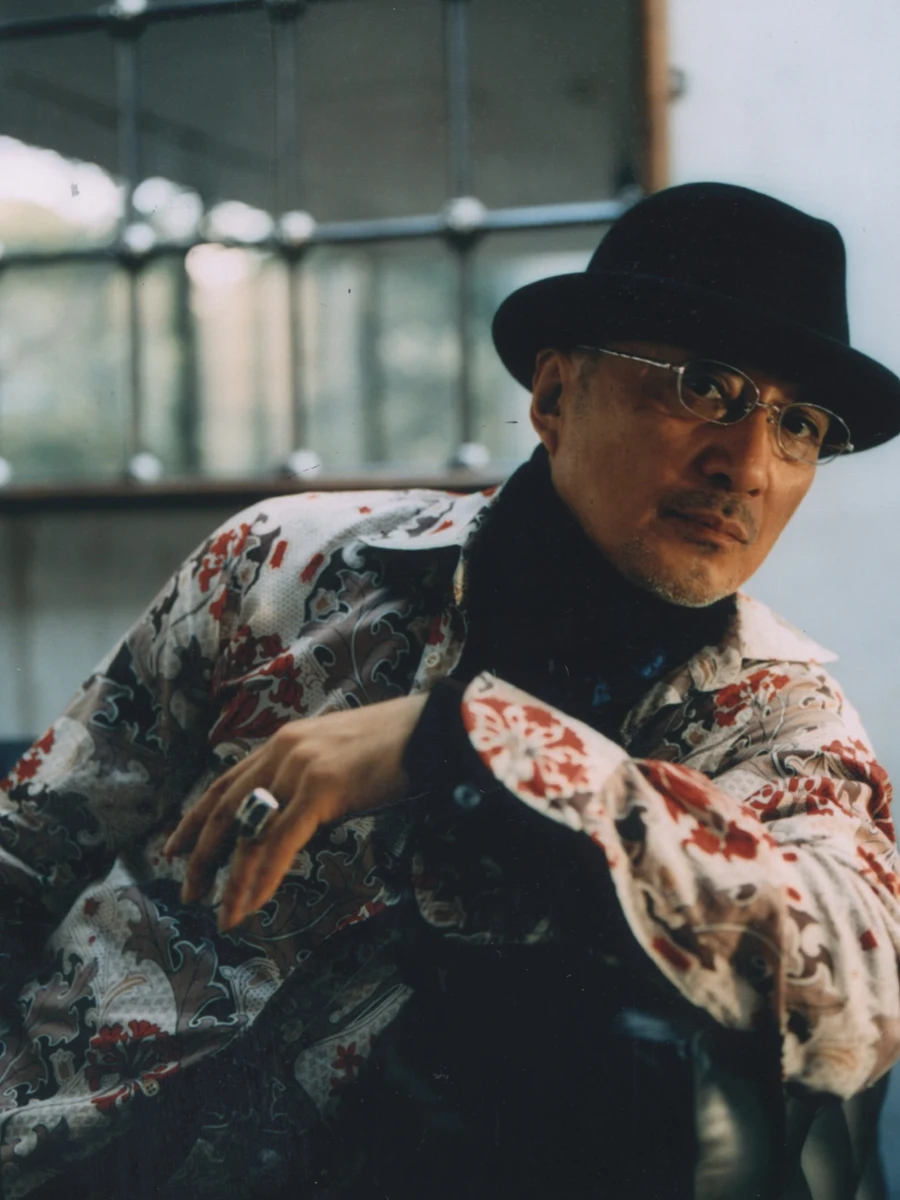
Takeo Kikuchi
Japanese designer who founded Men's Bigi and TAKEO KIKUCHI, returning as the label's creative director in 2012.
Takeo Kikuchi co-founded Bigi, established Men's Bigi and launched TAKEO KIKUCHI within World Co. in 1984. He left his namesake label's creative direction in 2004 and returned in May 2012; as of early 2025 he remained active in the role. That interrupted tenure matters because the brand continued producing clothes during his eight-year absence. (Mynavi News; Fashionsnap)
Across those companies, Kikuchi repeatedly moved closer to the wardrobe he wanted to wear himself: from bespoke womenswear to ready-to-wear, then from Bigi's mixed offering to a dedicated menswear business. (interbelle)
From custom tailoring to Bigi
Kikuchi was born on 25 May 1939 in Chiyoda Ward, Tokyo, one of ten surviving children in a well-off family whose father moved between politics and business. At five he fell from a tree and developed a severe chest infection; doctors treated it with penicillin, reportedly the second such case recorded in Japan, and warned the family he was unlikely to live past seven. He survived, and later described enduring the wartime firebombing of Tokyo as a still-bedridden child, alongside that illness, as forming a conviction that living itself was the larger achievement, ahead of any career that might follow it. (Fashionsnap)
He went on to the art department of Bunka Gakuin in Tokyo, initially intending to study painting, an ambition complicated when his father lost the family home to failed stock speculation while Kikuchi was still at school. Needing a steadier income, he submitted designs to a student showcase at Takashimaya's Nihonbashi store; they sold well, and a later student fashion show featuring his work was written up in The Japan Times, which he credited with turning fashion from a fallback into a commitment. He enrolled at the Hara Nobuko Academy of Dressmaking in 1961 and graduated the following year, having learned three-dimensional pattern cutting — the technique of shaping cloth directly over a form rather than working only from a flat drawing. (interbelle) He then spent short spells at two Ginza couture houses, Madame Miki and Mimosa, making made-to-order womenswear, before opening a home atelier with his wife in 1964, where the couple made bespoke garments for clients directly. A two-month trip to Europe and the United States in 1969, funded by a store owner who backed him, put Kikuchi in the middle of fashion's late-1960s upheaval and hardened his sense that custom tailoring for a small clientele could not reach the audience he actually wanted to dress. (interbelle)
In July 1970 he and Yūji Ōkusu founded Bigi, opening a flagship store in Omotesando and moving Kikuchi's own work from single commissions into ready-to-wear — clothing cut and produced in standard sizes for stock, rather than measured to one customer. The label reached well beyond the shops that carried it once its clothes appeared on screen: Bigi pieces worn by the actor Ken Hagiwara in the 1974 television drama Scarred Angels drew wide public attention to the brand. (Fashion Headline)
Men's Bigi and the DC boom
The menswear side of the business became a separate company, Men's Bigi, in 1975, with Kikuchi as founder and designer and a first store on Aoyama's Killer-dori. (interbelle) Some later profiles instead date his menswear venture to 1971 and treat it as a single continuous line rather than two companies five years apart. (Fashion Headline)
Men's Bigi became one of the labels associated with what the Japanese trade press called the DCブランド boom — shorthand for "designers' and characters' brands," the wave of labels built around a single designer's name and point of view that dominated Japan's domestic fashion market through the 1980s. Kikuchi pushed the label into an unconventional retail arrangement with the department-store chain Marui, selling clothes on instalment credit at a time when rivals in the industry dismissed the idea; it proved commercially decisive and let Men's Bigi expand into stores nationally. In 1978 the company opened Men's Bigi Europe in Paris, then withdrew the following year during a domestic business crisis, before recovering after a well-received 1981 show. (interbelle)
TAKEO KIKUCHI and London Pop
In 1984 Kikuchi left Men's Bigi for World Co., the Kobe-headquartered apparel group, having told its president, Shūzō Terai, that he wanted to design beyond clothing alone. World created TAKEO KIKUCHI as his eponymous label that same year, built around a concept the brand called London Pop — traditional British tailoring cut through with playful, youth-market detailing. (Fashion Headline; interbelle)
Kikuchi extended the label beyond garments early on. In 1986 he opened the TK Building in Nishi-Azabu, a single retail address combining the clothing shop with a barbershop and a snooker bar — an attempt, by his own account, at a complete 1980s lifestyle environment rather than a shop that sold only clothes. He described his working method from the period as never short of ideas: "I've never struggled with lack of ideas. Due to my restless nature, I'm already bored with works as they're being completed, thinking ahead to the next project." That same restlessness carried a cost he later admitted to: running the company and designing the collection at once left him swinging between conviction that a collection was his best work and conviction that it was his worst, independent of how it was actually received. (interbelle)
Stepping back, and the return at seventy-three
Kikuchi handed over creative direction of TAKEO KIKUCHI in 2004, after deciding, in his own account, that he could no longer sustain design and management together; some profiles instead give 2003 as his final year in the role. (interbelle; Fashion Headline) The following year he launched 40 CARATS&525, a line aimed at customers roughly his own age rather than the youth market he had spent three decades designing for, working as its director, designer and buyer. Of that shift he said he wanted the freedom "to make clothes for people close to my own generation" without answering to a younger house's expectations. (interbelle)
He returned to TAKEO KIKUCHI as creative director in May 2012, at seventy-three, sharing the design role with Hideki Fukuzono. (Fashionsnap) That November the brand opened a three-storey, glass-fronted flagship on Meiji-dori in Shibuya's Jingumae district, with Kikuchi's own atelier on the second floor above a ground floor of casual wear and a made-to-order suit floor stocked from an extensive range of cloths. The store's seasonal in-house feature, TAKEO knows, opened with hats — a piece the label had long treated as one of its signatures. (Mynavi News) He turned eighty-five in May 2024 and, as of early 2025, remained active in the role. (Fashionsnap)
Labels, dating and how to read the work
A TAKEO KIKUCHI label spans two Kikuchi tenures and an eight-year absence. Pieces from 1984–2004 fall within his first tenure; products dated from 2004 to May 2012 were made while he held no creative role; work after his return belongs to a shared creative direction with Hideki Fukuzono. Retail delivery can blur those boundaries, so use a printed season or original product record where possible. (Fashionsnap; Mynavi News)
Within Kikuchi's tenures, the London Pop idea joins British tailoring—herringbone, houndstooth and structured outerwear—with a playful or oversized accent, often a hat. It supports attribution but cannot date a piece: the concept spans both his first period and his return. (Mynavi News)
Keep Bigi and Men's Bigi separate after their 1975 split. A Men's Bigi piece from the Paris period around 1978 predates London Pop and must be dated through Men's Bigi records, not the later TAKEO KIKUCHI archive. (interbelle)
References
- “5月25日は菊池武夫の誕生日です.” Fashion Headline, 25 May 2014.
- “菊池武夫 (Takeo Kikuchi).” Fashion Headline. Accessed September 2026.
- “タケオキクチ創始者73歳でブランド復帰、世界を目指す.” Fashionsnap.com, 28 May 2012.
- “【連載ふくびと】第1話 菊池武夫——大病と戦争「生きる喜び」を知る.” Fashionsnap.com, 26 February 2025.
- “東京都渋谷区神宮前に、菊池武夫氏が手がけた「タケオキクチ」旗艦店.” Mynavi News, 26 November 2012.
- “トップクリエイターインタビュー肖像 菊池武夫 Vol.1.” SOW TOKYO, Interbelle.
- “トップクリエイターインタビュー肖像 菊池武夫 Vol.2.” SOW TOKYO, Interbelle.
- “トップクリエイターインタビュー肖像 菊池武夫 Vol.3.” SOW TOKYO, Interbelle.
- “トップクリエイターインタビュー肖像 菊池武夫 Vol.4.” SOW TOKYO, Interbelle.
- 生年
- 1939年5月25日
- 原語表記
- 菊池武夫
- 学歴
- Bunka Gakuin, Fine ArtHara Nobuko Academy of Dressmaking (1961–1962)
主な作品
該当する結果が見つかりませんでした
キーワードやフィルター条件を変更して再度お試しください。