
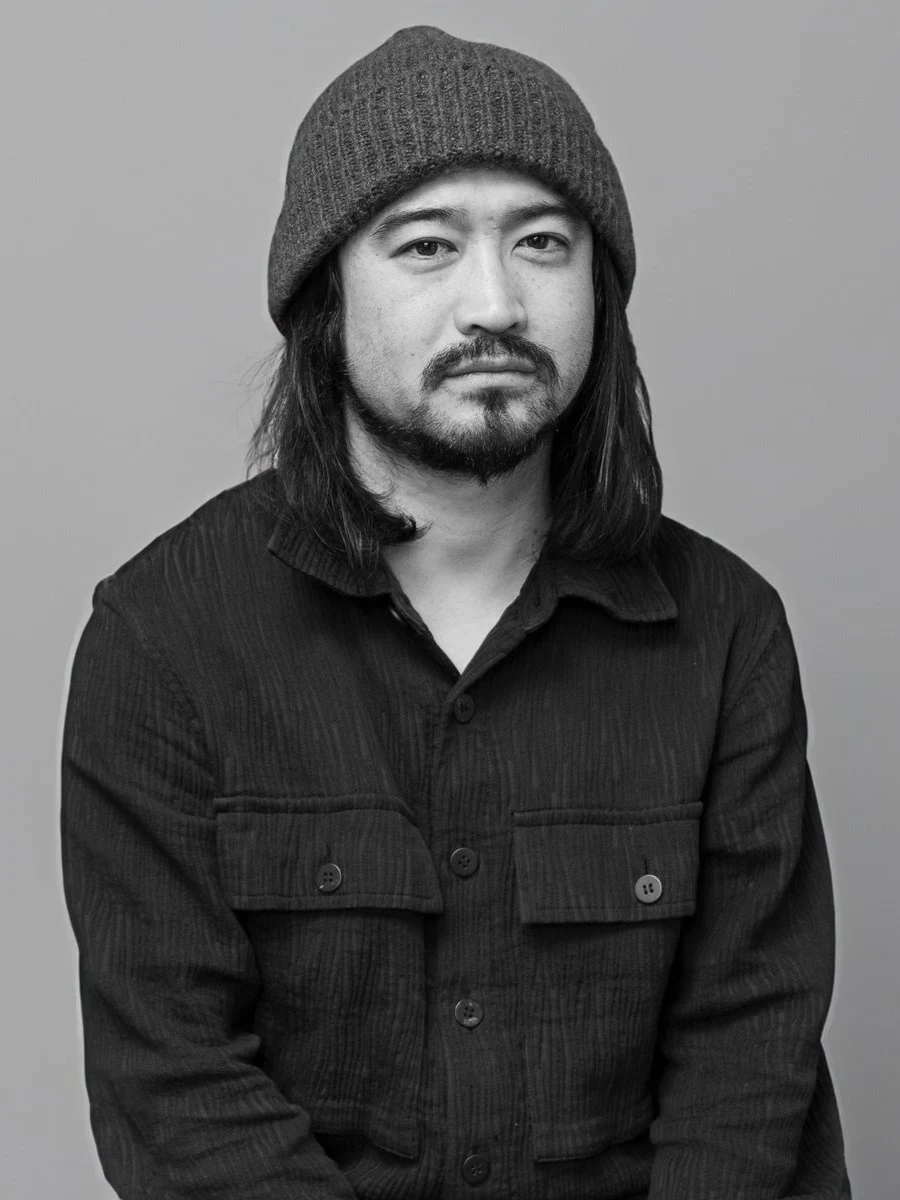
Takuya Morikawa
Japanese designer and founder of TAAKK, the Tokyo menswear label built on original textile development and shown in Paris since 2020.
Takuya Morikawa is the founder and designer of TAAKK, a Tokyo menswear label whose argument is made in the cloth rather than in the cut. Its garments are deliberately ordinary types—a tailored jacket, a shirt, an MA-1 flight jacket—made from fabrics developed specifically for them with Japanese mills, so the strangeness of a TAAKK piece sits in the weave rather than in an unusual silhouette. Morikawa has designed every collection since the label's debut and, as of September 2026, continues to show it on the Paris men's schedule. (FASHIONSNAP; TAAKK)
Two founding dates circulate, and both are correct about different things. Morikawa set up his design office, 森川デザイン事務所, and started the label in 2012; the first TAAKK collection was the Spring/Summer 2013 season. The Japan Fashion Week Organization's own profile carries both lines at once—"brand founded: 2013" above a career note reading "2012: established Morikawa Design Office, launched his own brand TAAKK"—which is why English listings disagree. Where a source says 2012 it means the business, and where it says 2013 it means the first collection. (Japan Fashion Week Organization; WWDJAPAN)
Kanagawa, Akita and a mother who made knitwear
Morikawa was born in 1982. Sources split on where: the profile published by Bunka Gakuen's industry-liaison body states that he was born in Kanagawa Prefecture and raised in Akita, while WWDJAPAN and FASHIONSNAP both describe him simply as being from Akita. (note / Bunka Gakuen; WWDJAPAN; Isetan Men's)
His first teacher was his mother, who made knitwear professionally and showed him how clothes were constructed and drafted while he was still at school in Akita. The relationship outlasted the lesson: four of the knits in TAAKK's Autumn/Winter 2014 collection were made by her hand. (Fashion Nouvelle Vague)
He entered Bunka Fashion College in Tokyo after leaving school, moving from the foundation course into the apparel design department, then taking a one-year course at the Bunka Fashion Business School, the institution that became Bunka Fashion Graduate University. His graduation piece there was a jacket made without sewing: raw wool needle-punched into cloth, then shrunk in a washing machine, the shrinkage calculated so that a circular pattern collapsed into a women's jacket. Needle punching drives barbed needles through stacked fibres to tangle them together, bonding materials without thread or adhesive; it reappears in his professional work a decade later. (Sumire-kai, Bunka Fashion College alumni association)
In 2000, while in his first year at Bunka, he saw the ISSEY MIYAKE MAKING THINGS exhibition at the Museum of Contemporary Art Tokyo and decided he wanted to work there. He had done no job-hunting as graduation approached; a tutor pointed him towards part-time work at Issey Miyake, which turned into the job. (WWDJAPAN; Isetan Men's)
Inside Issey Miyake
Morikawa's years at the company were spent in planning and design—the role that decides what a garment needs to be and in what material, before a design drawing is made. He moved through most of the house: Pleats Please Issey Miyake, then me ISSEY MIYAKE, then a spell as staff on Miyake's own exhibition work, then the ISSEY MIYAKE main collection planning team, and finally ISSEY MIYAKE MEN, working on Paris collections in both. For readers untangling that group of labels, see how the Issey Miyake lines differ from one another. (Matesen; note / Bunka Gakuen)
The turning point came in 2008, when he joined the production of Miyake's installation 21世紀の神話 for the XXIc. exhibition at 21_21 DESIGN SIGHT. The work was made in Echizen washi, a handmade Japanese paper, and Morikawa spent roughly a year away from garments, in a workshop, making it. Afterwards he weighed leaving; Miyake instead moved him onto the planning and design of ISSEY MIYAKE and ISSEY MIYAKE MEN. (Fashion Nouvelle Vague)
Morikawa left in spring 2012, at thirty. He usually describes his time at Issey Miyake as seven years, while TAAKK's English biography gives eight; neither account publishes his starting month. His arrival can therefore be placed around 2004–05, but not dated more precisely. (WWDJAPAN; TAAKK; NESTBOWL)
What he took with him was method rather than aesthetics: building the season from an image board of cut-and-pasted material before any drawing, and going to the factory floor. He attributes the second habit directly to Miyake—go and look, and if there is even a possibility in what you find, develop it. (WWDJAPAN; TOKION)
Starting the label with no money and other people's cloth
The first years were not a soft landing. He resigned in March or April 2012 with about a million yen saved, could not find the part-time corporate design work he had assumed would fund him, and took labouring jobs and paid clinical-trial work instead while building samples. He had never dealt with a sewing factory: at Issey Miyake he had been a planner, so he knew fabric suppliers and finishers but not makers. Samples were ready by August, an exhibition followed, and he won a place at DRAFT!, a Kobe programme for young creators, which brought the label its first account with Beams. He then took that account to a bank to borrow against it. (NESTBOWL; Matesen)
Poverty shaped the clothes. Weaving cloth from scratch was unaffordable, so for the first two seasons he bought existing fabrics and had them altered until they became something else—overlaying a check on the bias against the same check on the straight grain, then dissolving more than half of the bias layer so the two patterns interleaved, or needle-punching a wool herringbone into a taffeta check so the two patterns bled together. The finisher doing this work was one he had known at Issey Miyake. Original woven fabric began only in the third season, and by his own account it went badly at first: the ideas, the finishing techniques and the money ran out together, and he had to learn weaving. (TOKION)
Denim woven already worn, and cloth that changes its mind
TAAKK DENIM—the only part of the collection to carry the brand's name—began from an inversion. Denim is normally distressed after the garment is finished; Morikawa scanned real worn jeans, took data from the ヒゲ (hige), the whisker creases at the hip, the ハチノス (hachinosu) or honeycombs behind the knee and the fading, and had the whole pattern of wear woven in as a jacquard—a loom that controls individual warp threads and can therefore build a picture into the cloth's structure. It sold badly for years. He kept making it out of irritation until it became a permanent fixture, revised each season. (TOKION; FASHIONSNAP)
The gradient fabrics came out of the same habit of looking. Morikawa's routine includes visiting 機屋 (hataya), the weaving mills, and asking to see their archive rooms of old samples. He calls what he is hunting for a 原石 (genseki), a rough stone: something unimpressive in itself that implies a technique. One such sample, partly woven to look transparent, suggested that an MA-1 could be made to dissolve. The resulting cloth changes fibre as well as colour across a single panel—nylon becoming cotton shirting, linen becoming cotton—so that in the Spring/Summer 2024 collection a garment began as a flight jacket at the shoulder and finished as a shirt at the hem. The transition is woven, not printed. (TOKION; FASHIONSNAP)
Morikawa insists this is not virtuosity but the minimum. A designer who has not understood how a cloth falls, he argues, cannot brief a patternmaker accurately, so developing the fabric is simply the job. He is equally plain that the mills make it possible: ものづくり (monozukuri), literally the making of things, is for him a matter of relationships—phone calls, handwritten letters to a workshop, and craftspeople who ring up pleased with what they have managed. (TOKION; WWDJAPAN)
Tokyo, then Paris
Recognition came in stages. In June 2013 the Japan Fashion Industry Council selected TAAKK as one of ten labels for support through the Tokyo New Designer Fashion Grand Prix professional category, although a later organisation profile dates the award to 2014. The Tokyo Fashion Award 2017 followed, bringing stockists including Selfridges, 10 Corso Como and Opening Ceremony. TAAKK joined Amazon Fashion Week Tokyo in 2017 and began presenting in New York the following year. (The Fashion Post; Japan Fashion Week Organization; WWDJAPAN)
In October 2019 he won the third Fashion Prize of Tokyo, run by the Tokyo Metropolitan Government and the Japan Fashion Industry Council, which funds two Paris seasons. At the judging he had lost more than half his Spring/Summer 2020 samples to an airline accident and presented from image boards instead; the samples were never found. The first Paris outing followed on 16 January 2020, a presentation during the Autumn/Winter 2020-21 men's week, at which point the label was turning over roughly 100 million yen a year across thirty domestic and twelve overseas accounts. He returned to the official Paris men's show schedule in June 2022. He was named a semi-finalist for the LVMH Prize in 2021, and TAAKK showed its first women's collection for Spring/Summer 2023. (FASHIONSNAP; WWDJAPAN; Sumire-kai)
Reading and dating TAAKK
The label is pronounced taaku, written ターク in Japanese; “Taak” and “Taakk Tokyo” are resale transcriptions rather than official names. (TAAKK)
Season is the only reliable dating evidence, and the fabric is the best clue to it. Pieces from the first two seasons—Spring/Summer and Autumn/Winter 2013—use bought cloth reworked by a finisher: a check melted into another check, or two unrelated fabrics needle-punched together. Bespoke weaving starts in the third season, so a complex original jacquard or a woven gradient cannot belong to the debut year. (TOKION)
TAAKK DENIM is frequently mistaken for ordinary washed denim. It is not: the whiskers, honeycombs and fading are structural, so they repeat identically across cut panels, do not soften with washing, and appear on cloth that was never worn. Genuine wear on a TAAKK denim piece therefore sits on top of printed-in wear, which is the thing to look for. The gradient fabrics have the same tell in reverse—a printed gradient sits on the surface and leaves the hand of the cloth unchanged, whereas Morikawa's changes weight, opacity and often fibre across the transition. (TOKION; FASHIONSNAP)
Two hard boundaries help. TAAKK was menswear only until Spring/Summer 2023, so a women's-line garment cannot predate that season. And Paris runway imagery cannot be earlier than January 2020; Tokyo show material dates from 2017 onwards, with New York presentations in between. (FASHIONSNAP)
Because Morikawa has designed every TAAKK collection, its label settles authorship but proves nothing about date. His Issey Miyake years are the opposite case: he worked as one member of planning and design teams across several lines, so an Issey Miyake garment made around 2004–12 cannot be attributed to him personally from tenure alone. Date those pieces from the label itself — see how to date an Issey Miyake garment by its tag — without assigning individual authorship. (WWDJAPAN; TAAKK)
References
- Chikafumi Otsuka. "'TAAKK' ga hatsu no Paris-collé e: hatenkō na monozukuri de 'ōdō ni kamitsuku'." WWDJAPAN, 19 December 2019.
- "'TAAKK' to wa? — TAAKK ni tsuite." FASHIONSNAP. Last updated 10 April 2026.
- Ryo Todoroki. "Kiji kara tokiakasu 'TAAKK' no tetsugaku, zenpen." TOKION, 23 April 2022.
- "LINKS Vol.009: Morikawa Takuya." Sumire-kai, Bunka Fashion College alumni association.
- "Career story: TAAKK designer Morikawa Takuya." NESTBOWL, 31 July 2020.
- "Designer interview: TAAKK Morikawa Takuya." note, Bunka Gakuen International Fashion Industry-Academia Organization.
- "TAAKK: Morikawa Takuya." Fashion Nouvelle Vague.
- "Fashion designer Morikawa Takuya interview (TAAKK)." Matesen.
- "Interview: TAAKK designer Morikawa Takuya ga egaku surrealism no kaishaku." Isetan Men's.
- "'2013 Tokyo shinjin designer fashion taishō, pro bumon', 10-kumi no shien designer o kettei." The Fashion Post, 14 June 2013.
- "TAAKK winner profile." Tokyo Fashion Award, Japan Fashion Week Organization.
- "TAAKK winner profile." Fashion Prize of Tokyo, Japan Fashion Week Organization.
- "About." TAAKK. Accessed 11 September 2026.
- 原語表記
- 森川拓野
- 学歴
- Bunka Fashion CollegeBunka Fashion Business School
- 受賞
- Tokyo Fashion Award 2017Fashion Prize of Tokyo 2020