
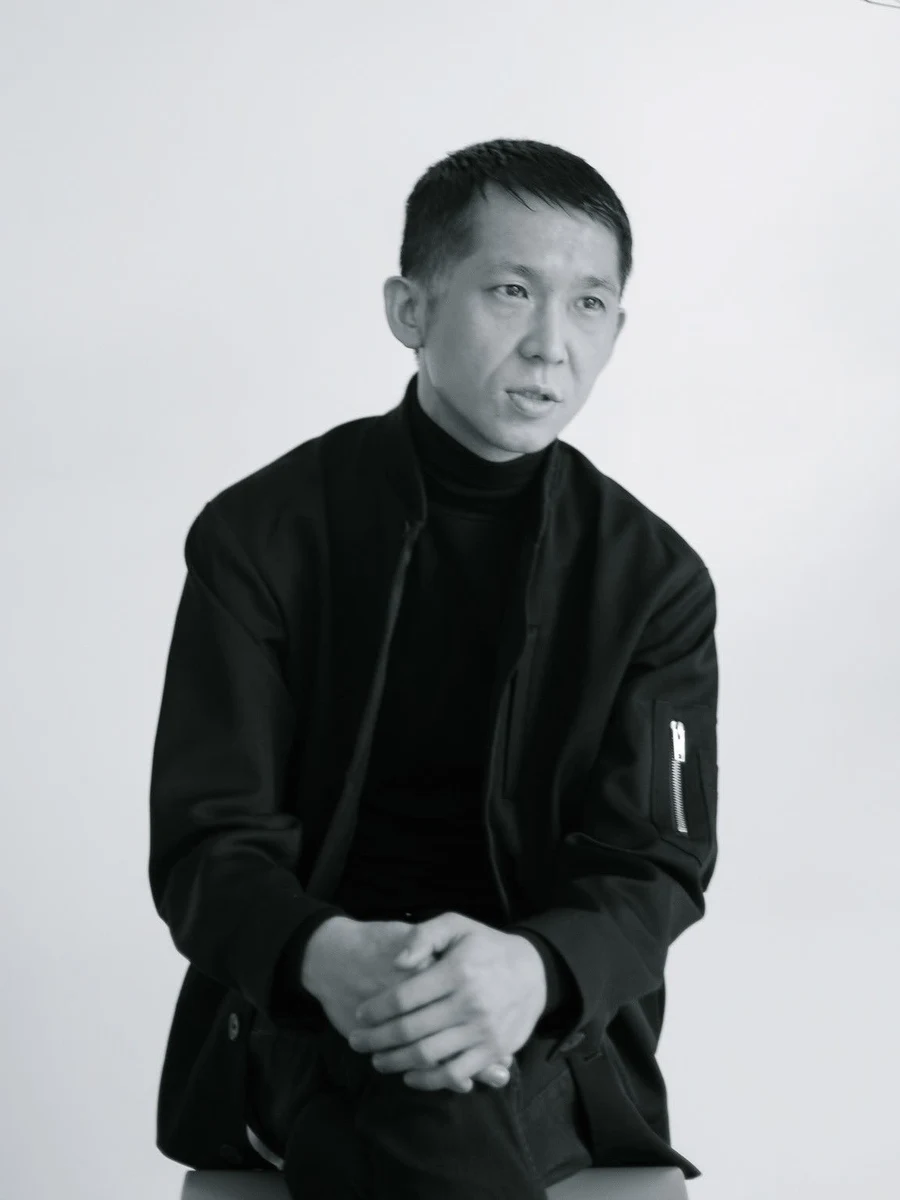
Taro Horiuchi
Japanese designer and Antwerp graduate who leads kolor from Spring/Summer 2026 while continuing the th products project.
Taro Horiuchi has been the creative director of kolor since 27 January 2025. His appointment followed founder Junichi Abe's final show, but it did not make the collection shown that weekend Horiuchi's work: his first fully authored kolor season was Spring/Summer 2026, presented in Paris on 28 June 2025. As of September 2026 he also continues the th products project. His earlier namesake label, TARO HORIUCHI, was combined with th products from Spring/Summer 2025 rather than simply proceeding as a separate runway brand. (WWDJAPAN; WWDJAPAN; Apparel-web)
This makes Horiuchi an unusual successor. He did not emerge from kolor's own studio and does not share Abe's patternmaking career, yet he had spent years studying how established design languages can be edited without becoming nostalgic. At th products he described himself less as a maker of constant novelty than as an editor or curator, selecting useful forms from military clothing, vintage garments and designer archives, then recalibrating them for another life. That method gave him a way to enter a house with twenty years of accumulated patterns without treating its history as a costume. (FASHIONSNAP; FASHIONSNAP)
Britain, Antwerp and an education through looking
Horiuchi was born in Tokyo in 1982 and left for Britain alone in his mid-teens. His recollections differ by a year—one says fourteen, another fifteen—so the exact age should not be made firmer than the sources allow. He initially went to study English, completed the equivalent of Japanese secondary education in Britain and moved towards art and photography. At Kingston University he studied photography or an art programme described more broadly in later profiles, before entering the fashion department of the Royal Academy of Fine Arts Antwerp in 2003. (Tomorrowland; Rakuten Fashion Week Tokyo)
Antwerp demanded that a collection be argued as well as made. Horiuchi developed research through images, music and art, and learned to connect a conceptual starting point to silhouette, fabric and presentation. While a student he helped with Raf Simons shows. In 2007 he graduated first in his class—WWDJAPAN describes this more specifically as completion of the master's course—and returned to Japan after further work in Europe. His graduation collection was also included in 21_21 DESIGN SIGHT's 2007 exhibition on emerging European designers. (WWDJAPAN; Vogue Japan)
The beginning of TARO HORIUCHI is reported with several dates that describe different events. Horiuchi established the project in 2008, while reliable profiles place the public collection debut at Spring/Summer 2010; a secondary chronology also records a presentation in 2009. The useful formulation is therefore “founded in 2008, first collection Spring/Summer 2010”, rather than choosing one date and making it perform both jobs. (Rakuten Fashion Week Tokyo; ZIPAIR)
Transparency, subtraction and the namesake label
Horiuchi's early work pursued what he called transparency: not literal see-through cloth alone, but a clear atmosphere able to cross fixed categories of age and gender. He often began with another creative work and translated its mood rather than illustrating it. Cutting by addition and subtraction—extending one plane, opening another or removing expected structure—gave restrained garments an internal tension. The Autumn/Winter 2010 collection Void, for example, put intricate hoods, coat details and geometric jewellery inside an otherwise cool, minimal field. (SHIFT; Rakuten Fashion Week Tokyo)
That label was primarily read as womenswear, but its discipline was never reducible to delicacy. Black, white and mineral neutrals could be cut into architectural panels; a precise jacket might be disrupted by an unexpected opening; jewellery established small points of hardness. Collaborations with RMK and artist Yuliya Gryaznova, as well as an early Diesel project reported at the time, extended this visual research across beauty, graphics and commercial product. In 2012 Horiuchi received the Mainichi Fashion Grand Prix's Newcomer Prize and Shiseido Encouragement Prize—the same year Abe received the main award. (SHIFT; FASHIONSNAP; WWDJAPAN)
In 2019 he designed the uniforms for the low-cost airline ZIPAIR. Instead of strongly separating pilots, cabin crew and ground staff through different ceremonial wardrobes, he created modular pieces workers could combine according to role and condition. Sneakers addressed mobility and fatigue. The project is a useful bridge between the atmospheric namesake collections and his later concentration on systems for ordinary use. (ZIPAIR)
After Autumn/Winter 2020, Horiuchi paused TARO HORIUCHI. He had become uncomfortable with the speed and prescribed novelty of womenswear trend cycles and concentrated on th products, which had begun in Autumn/Winter 2018–19 and added womenswear for Spring/Summer 2021. The namesake label returned with art director Karin Ohira for Spring/Summer 2023, but the revival was not permanent separation: from Spring/Summer 2025 the two projects were presented together. (FASHIONSNAP; Fashion Press; Apparel-web)
th products and clothing as an edited system
The letters th turn his initials into an intentionally impersonal name. The project seeks durable daily products across genders: clothes, but also rails, mirrors, tables, stools and hangers that shape the environment in which clothes are kept. Horiuchi researches military garments, twentieth-century designer pieces and anonymous vintage, then asks what remains structurally useful. An existing pocket or closure is not copied because it looks archival; its purpose is understood before it is moved, simplified or given another material. (FASHIONSNAP; FASHIONSNAP)
He describes fabric, silhouette and sewing as the conditions that let clothing withstand repair, changing owners and years of use. Much of th products appears in black, white and grey, yet grey functions as a wide interval between the two poles rather than a single corporate neutral. Fabrics are developed with specialist makers, while a permanent-line logic allows an item to continue beyond the pressure of one fashion calendar. The result can resemble a uniform, but the intention is flexible continuity rather than institutional sameness. (FASHIONSNAP; th products)
Learning kolor before changing it
Horiuchi and Abe had met in Paris in 2007 and encountered each other again through the 2012 Mainichi prizes. When Horiuchi was named kolor's new main designer in January 2025, Abe said he would remain in support, while the house passed creative responsibility to a designer with his own company and process. Later reporting uses “creative director”, the title that best describes Horiuchi's current responsibility. (WWDJAPAN; WWDJAPAN)
For Spring/Summer 2026 he began by drawing historic kolor looks to understand their proportions and silhouettes. He identified tailoring, uniforms and military clothing as the underlying structures, with Abe's humour appearing in the way unlike fabrics and garment fragments met. Where Abe often developed directly through clothes and pattern, Horiuchi assembled contextual research, a concept board and roughly twenty sketches, then worked with kolor's existing patternmakers. Patternmaking is the stage that turns an image into flat pieces able to produce three-dimensional volume; listening to the studio's pattern archive was therefore a form of learning the house from inside. (FASHIONSNAP)
The opening white jacket announced an initially “colourless kolor”. From there the collection moved among medieval tailoring and corsetry, nature, outdoor equipment and near-future surfaces. EYEVAN eyewear and Kijima Takayuki safari hats joined the looks. The collection retained composite construction without imitating a greatest-hits list of Abe devices: Horiuchi shifted the balance from sportswear towards outdoor systems and made historical research more explicit. (FASHIONSNAP; kolor)
Reading the three labels
Treat TARO HORIUCHI, th products and Horiuchi-era kolor as distinct records. The namesake label's first run spans Spring/Summer 2010 through Autumn/Winter 2020; it returned for Spring/Summer 2023 and was integrated with th products from Spring/Summer 2025. A neck label alone cannot resolve whether a later item belongs before or after the pause. Match its internal style code, fabrication and exact silhouette to a dated lookbook or authorised retail record. (FASHIONSNAP; Fashion Press; Apparel-web)
th products uses sequence names such as th001 through the current th016. These are collection numbers, not calendar years, so th010 should not be converted into 2010 or another guessed date. The official archive is the sound comparison point. Its controlled palette and military reference also recur, which means a black field jacket cannot be assigned to a season from appearance alone. (th products; FASHIONSNAP)
At kolor the authorship boundary is clearer: Spring/Summer 2026 is Horiuchi's first season. Recent product codes visibly begin with a two-digit year and S or W, but the company has not published a universal decoder for every internal segment. Compare the care label to the official collection archive. An Autumn/Winter 2025–26 retail delivery may have remained in shops after Horiuchi's appointment, yet it is still Abe's final design season; an executive date cannot redraft a garment already designed. (FASHIONSNAP; kolor)
References
- Kaname Murakami. “堀内太郎が語る「kolor」での挑戦.” WWDJAPAN, 30 June 2025.
- WWDJAPAN. “「kolor」の新デザイナーに堀内太郎.” 27 January 2025.
- FASHIONSNAP. “堀内太郎が手掛ける新生「kolor」.” 2025.
- Rakuten Fashion Week Tokyo. “堀内太郎.” 18 October 2014.
- Tomorrowland. “about th products vol.1.” 12 March 2021.
- SHIFT. “TARO HORIUCHI.” May 2010.
- FASHIONSNAP. “「TARO HORIUCHI」休止、堀内太郎が「th」に注力.” 9 October 2020.
- FASHIONSNAP. “th 堀内太郎インタビュー.” Accessed 10 September 2026.
- FASHIONSNAP. “デザイナーは編集者、堀内太郎が語るth products.” Accessed 10 September 2026.
- FASHIONSNAP. “th products.” Accessed 10 September 2026.
- th products. “Official collections and online store.” Accessed 10 September 2026.
- Apparel-web. “TARO HORIUCHI / th products 2025年春夏.” 2024.
- Fashion Press. “TARO HORIUCHI.” Accessed 10 September 2026.
- ZIPAIR Tokyo. “制服デザインを堀内太郎氏に決定.” 11 April 2019.
- Vogue Japan. “堀内太郎が見つめるデザインとアート.” 12 July 2018.
- kolor. “2026 Spring / Summer Collection.” Accessed 10 September 2026.
- 原語表記
- 堀内太郎
- 学歴
- Kingston UniversityRoyal Academy of Fine Arts Antwerp, Fashion (2007)
- 受賞
- Mainichi Fashion Grand Prix Newcomer Prize and Shiseido Encouragement Prize, 2012
主な作品
該当する結果が見つかりませんでした
キーワードやフィルター条件を変更して再度お試しください。