
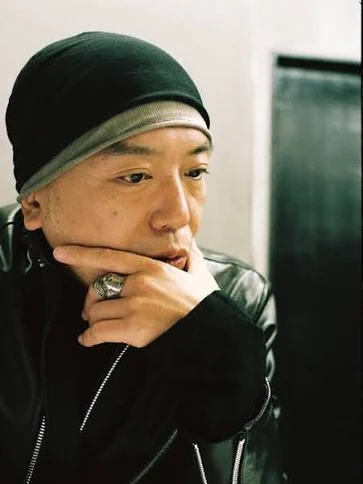
Tatsuro Horikawa
Japanese founder and designer of JULIUS, translating techno, sculpture and urban unease into experimental black clothing.
Tatsuro Horikawa is the founder and continuing designer of JULIUS, the Tokyo label whose black clothing is inseparable from techno, film, graphic design and the physical atmosphere of a city after dark. JULIUS began in 2001 as a platform for four media—clothing, film, graphics and music—and developed its clothing line in 2004. That beginning explains why a JULIUS collection is often organised like an environment before it is organised as a wardrobe. (JULIUS; Isetan Men's)
Black is the label's most visible constant, yet calling Horikawa a designer of “goth” clothing is too narrow. His work sets softness against armour, narrow legs against displaced volume and weathered natural surfaces against industrial hardware. The clothes can carry associations with military equipment, fetish dress and science fiction without resolving into costume. Horikawa's own terms are chaos and industrial: the first appears in twisting and disturbed form, the second in hard, reduced structure. (Isetan Men's; SSENSE Japan)
Graphics, sound and clothes for a crew
Horikawa came to clothing comparatively late. He told SSENSE Japan that he began making clothes at about twenty-three or twenty-four, after concentrating on music and graphic work. Around 1994 he made a group of pieces based on the science-fiction manga Genma Wars. He had been producing techno T-shirts, flyers and visual material, but wanted uniforms for the artists and crews around him that a printed T-shirt could not fully express. His first label, Nuke, emerged from that mid-1990s club culture. (SSENSE Japan)
In 1996 he established the graphic-design operation Third Stone and launched Nuke the following year. That background stayed active when JULIUS arrived. Horikawa continued to think as an art director: light, sound, typography and the body in a space were connected parts of one composition. As a visual jockey and event organiser he sometimes used flickering analogue televisions as the only illumination, resisting the expected lasers and strobes of a club. (Isetan Men's; SSENSE Japan)
JULIUS opened a Tokyo flagship in 2003 and presented its first runway collection for Spring/Summer 2005. The project had therefore existed for several years before the conventional fashion calendar became its principal public form. Its Paris presentations later gave the label an international audience while the studio remained in Tokyo. The chronology matters to collectors: “founded 2001” and “clothing launched 2004” describe different stages, not competing foundation dates. (JULIUS; Isetan Men's)
Black is structure, not an absence
Horikawa uses black and grey as materials with emotional and spatial weight. JULIUS describes them as symbols of madness and pain; in practice, their effect depends on surface. Oiled cotton catches light differently from washed leather, a compact wool holds a hard edge where rayon collapses, and several nominally black layers can separate into charcoal, blue-black, brown-black and dull ink. Horikawa has said that “black is colourful” because its tones vary. The restriction makes small differences in cut and finish more legible. (JULIUS; Fashion Headline)
Pattern cutting does much of the expressive work. A pattern is the set of flat shapes from which a garment is assembled; shifting a seam or rotating one of those shapes can make cloth spiral around the body. Horikawa describes the result as closer to sculpture than graphic decoration. Long torsos, dropped crotches, asymmetric closures and fabric gathered into irregular folds change the wearer's outline even when the palette is nearly colourless. (SSENSE Japan; Isetan Men's)
This severity does not exclude comfort. Horikawa has spoken about wanting the wearer to feel movement and protection, while stretch fibres and soft fabrics make apparently rigid shapes usable. The tension is essential: if the clothes were only armour they would become props; if they were only draped basics the industrial pressure would disappear. A successful JULIUS garment lets the body move while preserving the impression that its silhouette has been engineered. (SSENSE Japan; Fashion Headline)
The Gasmask cargo and a permanent vocabulary
The Gasmask cargo trouser is the label's clearest recurring object. Its enlarged gas-mask pocket, straps and adjustable points give military equipment a changeable proportion around the leg. Horikawa has returned to the design in wide, narrow, denim, coated-cloth and leather versions. It functions less like one famous product frozen in 2009 than a pattern repeatedly remixed, much as a producer might rebuild a track from recognisable components. (Ghost in the Shell official site; Nubian)
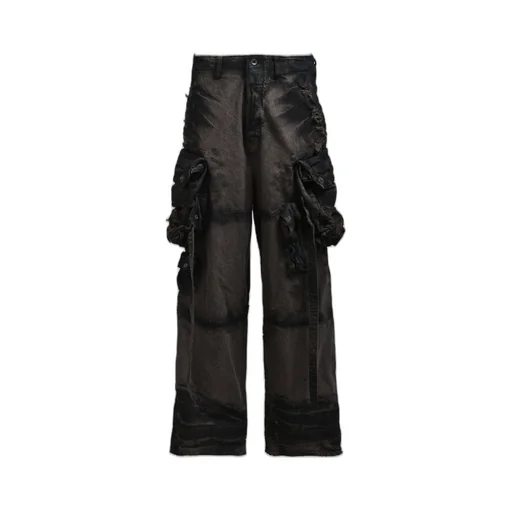
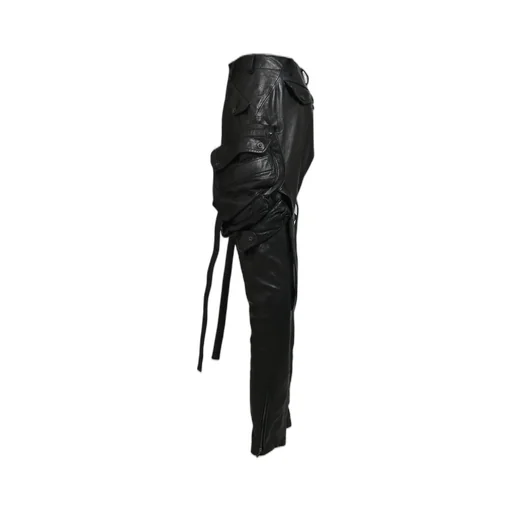
That recurrence became formal with PERMANENT_JULIUS, introduced for Autumn/Winter 2020. The line revisits standard and archival designs outside a new collection's theme, updating construction for the present. A Gasmask cargo sold in the Permanent line is therefore not an unsold original from an early runway and should not be dated from the design's first appearance. Reissue is part of Horikawa's practice, not evidence of the original production year. (JULIUS; Hypebeast)
The idea of uniform also persists. Horikawa's first clothes served a music community, and later JULIUS pieces still equip a body for an imagined social space: tall boots alter posture, a leather jacket makes a hard outer boundary, and a hanging strap records motion. These garments have acquired an online “archive” life, but their original logic concerns participation. They are built to change how someone occupies a room, not only how a rare object appears in a photograph. (SSENSE Japan)
Techno as a method
For Horikawa, techno supplies an operating principle as well as a soundtrack. He defines its spirit as opposition to nostalgia: repetition develops gradually, technology pushes a form forward and human irregularity prevents precision from becoming sterile. His collaborations with Regis and the Downwards label, and with Lotic for a collection informed by Cabaret Voltaire, joined runway sound to the same balance of machine rhythm and vulnerable body found in the clothes. (SSENSE Japan)
The Spring/Summer 2016 collection [ sefiroth; ] shows how widely that method can travel. After visiting Morocco, Horikawa worked from the Kabbalistic Tree of Life and from his encounter with Tuareg people, setting technology against what he called tribal or natural forces. He arranged white and black, civilisation and landscape, organic drape and engineered form without pretending to recover an untouched past. The cultural references should be named rather than treated as anonymous “ethnic” atmosphere. (OPENERS; Qetic)
Science fiction supplies a related language for the urban present. Horikawa has cited Akira, William Gibson's Neuromancer and the particular futuristic sensation of Tokyo and Hong Kong. He is not illustrating those works character by character. Their dense cities and unstable relations between human beings and systems offer a way to think about garments as protective shells, information and resistance. (SSENSE Japan)
Lines, labels and dating JULIUS
The main JULIUS collection should be separated from MA_JULIUS, the quieter dress line that began as JULIUS MA in 2008, and NILøS, launched in 2015 as a more open project Horikawa compared to dark hip-hop rather than JULIUS's techno. PERMANENT_JULIUS is an archive-oriented continuing line. Retail listings frequently collapse all four under “Julius”, but their labels and purposes are not interchangeable. (Isetan Men's; JULIUS)
Do not date a garment from its silhouette alone. Gasmask cargos, high boots, twisted tops and leather jackets have been revised repeatedly, and the Permanent line deliberately returns to earlier forms. Record the full product code from the care label, material, colour notation, country of manufacture and any line name; then compare those details with a season's official lookbook or retailer record. A seller's phrase such as “2009-style” can describe a cut without proving that the garment was made in 2009. (JULIUS; Nubian)
Horikawa's longevity comes from this controlled revision. JULIUS has a strong silhouette and a narrow palette, but neither requires it to repeat one historical darkwear moment. The continuous work is to make black reveal another structure, and to let an apparently familiar uniform register the pressure of the present city. (Fashion Headline; SSENSE Japan)
References
- JULIUS. “About.” Accessed September 2026.
- Adam Wray. “JULIUSのインダストリアルな感覚.” SSENSE Japan, 2016.
- Isetan Men's. “Creators VOICE #5|堀川達郎〈JULIUS〉.” 21 October 2015.
- Makoto Kajii. “デザイナーが解説する「ユリウス」2016年春夏コレクション.” OPENERS, 28 July 2015.
- Fashion Headline. “SENSE守谷編集長が9ブランドとリレートーク.” 5 March 2014.
- Qetic. “人と人、音楽で紡ぐプレイリストリレー Vol.3 堀川達郎.” 24 June 2020.
- Ghost in the Shell official site. “Ghost in the Shell The Exhibition: JULIUS Collaboration.” 2 July 2026.
- Jake Silbert. “JULIUS' SS21 Permanent Collection Revives Archival Military Styles.” Hypebeast, 2021.
- 原語表記
- 堀川達郎
主な作品
該当する結果が見つかりませんでした
キーワードやフィルター条件を変更して再度お試しください。