
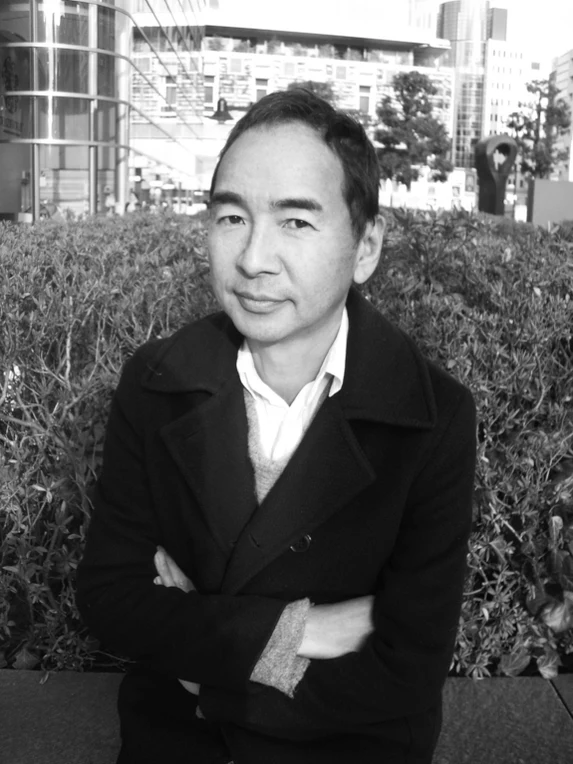
Yoshiki Hishinuma
Japanese designer known for the Kite Clothes and Air Clothes lines and the 1996 Mainichi Fashion Grand Prix.
Yoshiki Hishinuma is known for heat-set synthetic garments that hold volume without wire, boning or an internal frame. His Kite Clothes and Air Clothes use wind, compression and permanent textile memory differently from the close pleating associated with his former employer Issey Miyake. Construction, rather than a single wordmark chronology, is therefore the most useful first clue when reading his work. (Gaijin Paris)
Hishinuma received the Mainichi Fashion Grand Prix's newcomer prize in 1983 and its Grand Prize in 1996, placing his independent textile research within a wider generation trained through Miyake's studio. (Fashionsnap)
From Sendai to the atelier
Hishinuma was born in Sendai, in Miyagi Prefecture, in 1958. He studied at Bunka Fashion College in Tokyo, the school that has trained most of the designers of his generation, but did not complete the course. (Gaijin Paris)
He entered the industry through the Miyake Design Studio, the workshop built around Issey Miyake's own label, before moving into freelance work as a costume and stage designer. That freelance period gave him a different training from a conventional ready-to-wear apprenticeship: a stage costume has to read from a distance, survive repeated wear under lights, and often needs a shape that a normal pattern cannot produce, which pushed him toward construction methods borrowed from outside fashion. (Gaijin Paris)
In 1983 he won the New Designer Award at the first Mainichi Collection Grand Prix, the Mainichi Shimbun-backed prize that has tracked emerging Japanese talent since the early 1980s. (Fashionsnap)
Kite Clothes and Air Clothes
Hishinuma founded his namesake label, Yoshiki Hishinuma, in 1992 and presented the debut collection in Paris. The label became known for a construction he called Kite Clothes and, in a later development of the same idea, Air Clothes — garments cut and heat-set so that they hold an inflated, kite-like volume of their own, independent of a body inside them. Where a conventional garment is designed to describe the wearer's silhouette, a Kite Clothes piece keeps its shape as an object in its own right, closer to a piece of rigging than a piece of tailoring. (Gaijin Paris)
Heat-setting fixes a thermoplastic fibre such as polyester into a new form as it cools. Hishinuma used that property to create hollow, buoyant volumes that stand away from the body, often through shapes derived from kites and sails. The result differs from a compressed pleat: the fabric holds the garment outward without boning, wire or padding. (Gaijin Paris)
Shibori, updated
Hishinuma's other recurring method is shibori (絞り), resist dyeing created by binding, stitching, folding or clamping cloth before colour is applied. He transferred that hand-worked logic from its traditional natural-fibre context to synthetic cloth and combined it with heat-setting, allowing surface pattern and permanent texture to emerge from the same process. (Nylon)
An evening dress from his autumn/winter 1996 collection, in red and black shibori-dyed polyester, entered the permanent collection of the Museum at FIT in New York as a gift from Hishinuma himself; the museum catalogued it as 2007.33.1. FIT later included the piece in Reinvention and Restlessness: Fashion in the Nineties, a 2022 exhibition surveying how designers of the decade recycled historical techniques — shibori among them — through new materials and technology. (Nylon)
Grand Prize and a museum gallery
In 1996 Hishinuma received the Grand Prize at the Mainichi Fashion Grand Prix, the fourteenth edition of Japan's most established annual design award, three years after his newcomer prize at the same institution's earlier collection award. (Fashionsnap)
In 1999 the Gemeentemuseum in The Hague — now the Kunstmuseum Den Haag — devoted an exhibition in its Fashion Gallery to his work, reportedly only the second exhibition the gallery had given to a single fashion designer, after Madeleine Vionnet, and the first given to a living one. The accompanying catalogue documented his training, his time at Miyake's studio, and his working methods and design philosophy in his own words, alongside photographs of the studio and the garments themselves. (Filter Store)
Hishinuma also published Clothes by Yoshiki Hishinuma in 1986, Yoshiki Hishinuma Here & There in 1992 and a later photography collaboration with Nobuyoshi Araki. (Filter Store)
MAYUPO: a robot as a fashion project
In 2009 Hishinuma presented a project called EVE, which he later described as the origin of a longer collaboration with the photographer Yoshihito Sasaguchi and the make-up artist Rika Matsui. Working together, they spent several years developing MAYUPO, a fictional female humanoid robot, completed in 2014 and set in an imagined Tokyo district in the year 2060. The project treated MAYUPO's appearance — her costume, her face, her surface — as a single design problem rather than separating "robot design" from "fashion design," using the robot as a way of asking what clothing and beauty ideals might look like if an artificial being had feelings equal to or beyond a human's. (The Fashion Post)
The project premiered as a short film, MAYUPO: A Robot Dreams of Apple Trees, at the Padiglione Visconti in Milan's Tortona district, running from 14 to 19 April 2015 as part of "ABLE&PARTNERS TOKYO DESIGN WEEK in MILANO 2015" alongside that year's Salone del Mobile. It was self-funded, and the team used crowdfunding to cover roughly one million yen of production costs — a modest budget for a project built around a full animatronic figure, which the team treated as consistent with the project's spirit of working outside a commercial fashion-house structure. (The Fashion Post)
Reading and dating the work
Begin with construction. Kite Clothes and Air Clothes use heat-set cloth to retain sculptural volume without wire, boning or another internal frame. That behaviour is consistent with Hishinuma's method, but it should be checked against the label and a documented example rather than treated as authentication by itself. (Gaijin Paris)
Shibori is a second clue, not proof. The technique long predates Hishinuma and appears across Japanese textile traditions; its combination with heat-set synthetic cloth is more characteristic of his 1990s work than shibori on a natural fibre. (Nylon)
The Yoshiki Hishinuma mainline began presenting in Paris in 1992, which supplies a lower boundary for runway-labelled ready-to-wear. Earlier stage or costume work belongs to a different commission history. For a likely 1990s piece, look for heat-set volume and synthetic-fabric shibori together, then compare the silhouette and label with a dated museum or catalogue example. (Gaijin Paris)
The Museum at FIT's red-and-black shibori polyester dress, 2007.33.1, is a firm Autumn/Winter 1996 comparison point because Hishinuma donated it himself. The 1999 Gemeentemuseum catalogue documents further early garments and studio methods. These anchors can support a range; they do not create a complete label chronology. (Nylon; Filter Store)
References
- Gaijin Paris. "Yoshiki Hishinuma." Accessed September 2026.
- Fashionsnap. "「毎日ファッション大賞」40年の歴史を振り返る." 3 September 2022.
- Filter Store. "Yoshiki Hishinuma in the Fashion Gallery of the Gemeentemuseum, The Hague: Meji Hishinuma and Otsuka, 1999." Accessed September 2026.
- Nylon. "Museum At FIT's New Exhibit Explores The Biggest Trends Of The '90s." Accessed September 2026.
- The Fashion Post. "ロボット「マユポ」が主役の短編映画、ミラノサローネにて公開." Accessed September 2026.
- 原語表記
- 菱沼良樹
- 学歴
- Bunka Fashion College
- 受賞
- Mainichi Collection Grand Prix, New Designer Award, 1983Mainichi Fashion Grand Prix, 1996
主な作品
該当する結果が見つかりませんでした
キーワードやフィルター条件を変更して再度お試しください。