
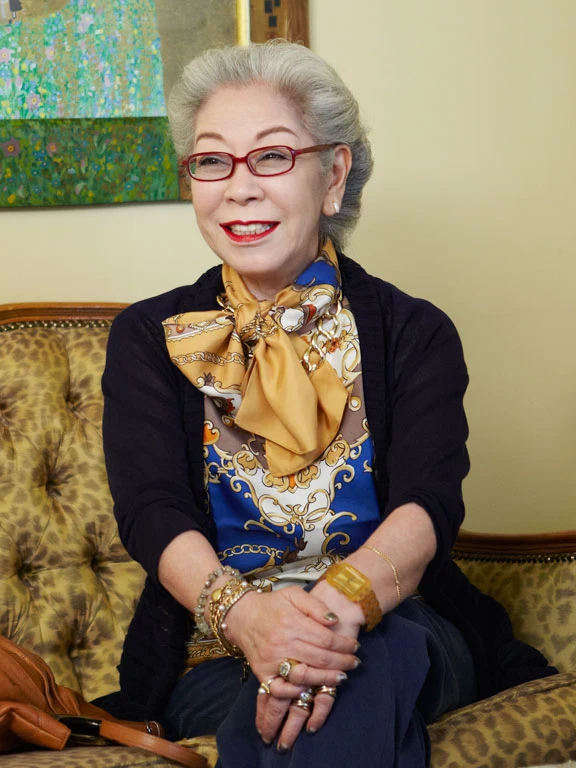
Yuki Torii
Japanese designer behind YUKI TORII, who showed in Paris from 1975 to 2008 across a three-generation family fashion house.
Yuki Torii is the third generation of a Tokyo fashion family and presented collections in Paris from 1975 to 2008. The current department-store label, known for original floral prints and occasion dressing, continues the same family business rather than licensing a historical founder's name. (Fashion Press; AFPBB News)
For a buyer, the useful distinctions are between the early family firm's トリヰ name, Torii's Paris-era work and the parallel YUKI TORII INTERNATIONAL and YUKI TORII lines. Prints recur across decades, so the label and construction need to be read together. (Fashion Press; Yuki Torii)
A postwar dressmaking shop in Ginza
Torii was born in Tokyo on 3 January 1943. Her grandmother, Mitsu, and her mother, Kimiko, opened a Western-clothing shop (洋装店) together after the war ended—the venture that grew into the family firm still trading as Torii today—and the business took a storefront in Ginza in 1950. (Fashion Press)
Torii's own training began inside that business rather than outside it. At fifteen she was already handling textile design for a fabric-manufacturing company her grandmother ran, work that put her in front of looms and print samples years before she touched a pattern block. (Fashion Headline) She went on to the fine arts department of Bunka Gakuin, graduating in 1961, and afterwards studied cutting and design illustration at the Itō Sumako Design Institute—the technical training, distinct from her academic degree, that gave her the pattern-cutting vocabulary the family business required. (Fashion Headline; Yuki Torii)
She made her first public appearance as a designer in 1962, at nineteen, showing her own pieces inside her mother Kimiko's collection rather than a collection of her own. (Fashion Press) The family manufacturing company was incorporated as Torii Co., Ltd. (株式会社トリヰ) in 1971—the name written not in the kanji 鳥居 but in the older kana spelling トリヰ, using the archaic character ヰ, a detail that still shows up on vintage labels and shopfronts. (Fashion Press)
A meeting that opened Paris
Torii's move from a Ginza family business to an internationally shown collection turned on a single relationship. A meeting with Jean-Jacques Picard led directly to her first Paris collection in 1975, presented under her own name, "ユキ トリヰ"—YUKI TORII. (Fashion Headline; Fashion Press) She kept a Paris presentation on the calendar every season for more than thirty years, and in 1985 opened a boutique in the Galerie Vivienne, one of the covered arcades near the Palais-Royal that has long housed small, independent fashion and design shops rather than the maisons of the Golden Triangle. (Fashion Press)
The run was marked at its thirtieth year with a dedicated anniversary show at the National Yoyogi Gymnasium in 2005, in front of roughly four thousand spectators—a scale closer to a public sporting event than to a Paris atelier presentation, and evidence of how large the brand's domestic following had grown even while Torii kept showing abroad. (Fashion Headline) The Paris seasons continued for three more years before Torii closed that chapter with a collection presented in Shanghai in October 2008, ending the unbroken run rather than any single Paris show marking its close. (Fashion Press)
Torii herself has described the 1975 Paris debut as the pivotal turn of her career rather than any moment in Tokyo, saying that establishing a base in the industry's home city let her "learn through direct experience and absorb crucial lessons" that no amount of work in Japan alone could have supplied. (AFPBB News)
Kasuri in a Parisian cut
What travelled with her to Paris was a specific way of putting Japanese textile ideas inside Western tailoring rather than inside a kimono. Torii became known for a bold use of 絣 (kasuri)—a resist-dyeing technique in which yarn is bound and dyed before weaving, producing threads that shift position slightly during the weave and leave the finished cloth with a characteristically blurred, feathered pattern edge—alongside large Japanese floral motifs, both worked into fitted Western silhouettes rather than traditional dress. French Elle took note of the approach during her Paris years, treating it as a distinct visual signature rather than a novelty import. (Fashion Headline)
The house describes its own design position, largely unchanged across decades, as a "modern style that is comfortable to wear, simple and elegant, while staying close to women's real lives," built around Torii's own original prints and a stated attachment to flowers and plants as motif. (Yuki Torii) Where a maison-scale label might treat a signature print as one motif among many rotated by season, Torii's prints function closer to a personal vocabulary reused and varied across forty-odd years of collections—useful context for anyone trying to date a print rather than assume it belongs to a single, narrow period.
A wider stage, and a second line
Between 1994 and 2000, YUKI TORII ran a menswear collection alongside the womenswear, staffed on the runway not by professional male models but by a rotating cast of writers, journalists, businesspeople and sportsmen—a casting choice that framed menswear as a real man's wardrobe rather than a runway abstraction. (Fashion Press)
Recognition ran alongside the Paris years rather than after them: the FEC Award, from the Fashion Editors Club, in both 1976 and 1988; the FEC Topic Award together with the Mainichi Fashion Grand Prize in 1995; and the Mainichi Fashion Special Award in 2005, the same year as the Yoyogi anniversary show. (Fashion Press) In 2006, Newsweek Japan named her to its list of "100 Japanese People Respected by the World," a domestic-media honour that placed her alongside figures well outside fashion. (Yuki Torii)
After the Paris years
The end of the Paris seasons in 2008 was not a retirement. In October 2011, Torii marked fifty years as a designer and her hundredth collection with a show at Tokyo Dome City Hall built around the theme "Enjoying Life" (人生をエンジョイする). The evening opened with a Yuki Torii International Spring/Summer 2012 ready-to-wear presentation, then moved into a haute-couture-styled second half in which actresses Shima Iwashita and Mariko Kaga and singer Judy Ongg walked in emerald-green and scarlet evening gowns, before actor Katsunori Takahashi led Torii onto the stage for a finale in front of roughly two thousand guests. (AFPBB News)
Her husband, Takao Torii, who had served as president of Torii Co., Ltd., died in September 2021. She has continued to publish under her own name since—YUKI TORII STYLE BOOK in 2014 and the essay collection 80歳、ハッピーに生きる80の言葉 ("Eighty Years Old: Eighty Words for a Happy Life") in 2023—and the company has continued trading two lines, the ready-to-wear-scaled YUKI TORII INTERNATIONAL and the occasion-focused YUKI TORII, through a Ginza flagship, the Paris boutique and roughly sixty department-store concessions nationwide. (Fashion Press; Yuki Torii)
That department-store footprint has been contracting: concessions at Takashimaya Yonago, Usui, Entetsu and Isetan Urawa all closed between April and August 2026. Against that, the Accessory Museum in Yutenji opened a dedicated retrospective exhibition, drawing on original design sketches and archived garments, running from 1 September to 20 December 2026—a museum treatment of the archive rather than a closing-down notice, and, as of September 2026, Torii is still listed as the house's designer. (Yuki Torii)
Reading a YUKI TORII label
Start with the complete name. The family company uses the older kana spelling トリヰ, while Torii's internationally shown collection appears as YUKI TORII. Her Paris run lasted from 1975 to 2008, but fine construction cannot by itself place a garment inside that period because the house maintained formal and occasion lines outside the runway calendar. (Fashion Press)
Next, separate the current lines. YUKI TORII INTERNATIONAL is ready-to-wear; YUKI TORII is the more formal occasion line. A listing that omits the line or shows no legible label is under-described, not dated. Original florals and the blurred woven edge of kasuri can support an attribution, but Torii has revisited these motifs for decades, so neither identifies an exact season. (Yuki Torii; Fashion Headline)
References
- Fashion Press. "ユキ トリヰ." Brand profile. Accessed September 2026.
- Fashion Headline. "1月3日は鳥居ユキの誕生日です." 3 January 2014.
- AFPBB News. "<インタビュー>ユキトリイ、人生の転機と走り続けた日々." MODE PRESS, 22 December 2011.
- AFPBB News. "アーカイブとともに振り返る「ユキトリイ」の50年." MODE PRESS, 22 December 2011.
- AFPBB News. "ユキトリイ、デザイナー50周年記念ファッションショー." MODE PRESS, 22 December 2011.
- WWD Japan. "【東コレ】「ユキトリイ」はパステルトーンで彩るエレガンス・カジュアルを提案." 17 October 2012.
- Yuki Torii. "Official site." Accessed September 2026.
- Wikidata. "Yuki Torii (Q11674875)." Accessed September 2026.
- 生年
- 1943年1月3日
- 原語表記
- 鳥居ユキ
- 学歴
- Bunka Gakuin (1961)Itō Sumako Design Institute
- 受賞
- FEC Award, 1976FEC Award, 1988FEC Topic Award, 1995Mainichi Fashion Grand Prize, 1995Mainichi Fashion Special Award, 2005
主な作品
該当する結果が見つかりませんでした
キーワードやフィルター条件を変更して再度お試しください。