
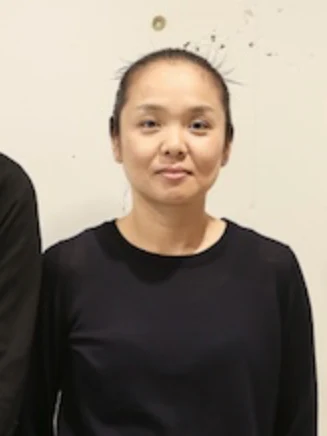
Yukiko Ode
Japanese designer who co-founded green and HYKE with Hideaki Yoshihara, jointly designs the collections, and leads HYKE's product development.
Yukiko Ode co-founded green and HYKE with Hideaki Yoshihara and remains one of HYKE's two designers. Both plan and design the collections. Ode's additional responsibility is the product itself: fabric selection, work with patternmakers, construction decisions and dialogue with sewing factories. Describing her only as a co-founder's wife or the operational half of someone else's creative direction would get the partnership backwards. (Parigot; Numéro Tokyo)
Her work begins from close attention to garments made for other lives—men's workwear, American military clothing, naval uniforms and outdoor equipment—then asks how their precision can produce womenswear without merely shrinking the originals. A pocket retains the memory of what it carried; a flight-jacket sleeve retains its demand for movement. Ode changes proportion and material after learning those reasons. (T Japan; Vogue Japan)
Kiryu, a sewing family and menswear archives
Ode was born in Kiryu, Gunma, in 1969. The city is one of Japan's historic textile centres, and her family operated a sewing factory. She later graduated from Vantan Design Institute. Japanese interviews describe a serious interest in American men's vintage clothing from adolescence, at a time when the garments were objects to hunt, compare and wear rather than a ready-made mood board supplied by digital archives. (AFPBB News / Senken; Vogue Japan)
That background gave her two kinds of knowledge. Collecting taught her to see the minute differences among apparently standard uniforms: pocket angle, cloth weight, fastener, reinforcement and the way use changes a surface. A family connected to sewing made those details manufacturing questions. Patternmaking determines how flat parts become volume; sewing specification determines how they are joined, strengthened and finished. HYKE's restraint depends on both. (Vogue Japan; T Japan)
In 1997 Ode and Yoshihara opened the Daikanyama vintage shop Bowles. They began green as its original line in 1998, then developed it into an independent maker and brand. Ode's collection of menswear did not lead to replicas. green took exact military and work structures into womenswear, finding femininity in the line of a body, the fall of cloth and the relationship between a substantial coat and what sat beneath it. (AFPBB News / Senken; Vogue Japan)
The label presented runway collections from Autumn/Winter 2005 through Spring/Summer 2009. It then paused so Ode could concentrate on childbirth and childcare, and its directly operated store closed that June. This was a creative and domestic decision made by the two designers, not a disappearance later rebranded as a marketing hiatus. Accounts call the interval three or four years; the documented seasons place green's end in Spring/Summer 2009 and HYKE's beginning in Autumn/Winter 2013. (Rakuten Fashion Week Tokyo; Numéro Tokyo)
Product as the centre of HYKE
The return came under a new name and a revised phrase. green had used FUNCTIONALITY + BEAUTY; HYKE adopted HERITAGE AND EVOLUTION. Yoshihara has said the underlying values remained close, but the new structure reduced the need to build each season around a grand theme. The pair begin instead with an inspiration source—a specific vintage object or functional system—and let research produce the collection. (Numéro Tokyo; Parigot)
Ode leads the product process while continuing to design jointly. She selects cloth, works directly with patternmakers and discusses details with factories rather than handing a finished sketch to an anonymous production chain. The distinction is material. A silk-like polyester may be chosen because it gives the appearance and movement wanted while surviving daily wear more reliably; an oversized coat succeeds only if its balance remains controlled when open, closed and in motion. (T Japan; Numéro Tokyo)
Archive research often means taking garments apart. A military liner, field jacket or naval smock can be studied through its seams, interlining and concealed reinforcement. HYKE may preserve a functional closure while translating hard cloth into transparency, or enlarge an outerwear pattern until it creates a new relationship with a long skirt. This is evolution in a practical sense: not a vague mixture of “old and new”, but a chain of decisions in which the source remains accountable. (T Japan; Vogue Japan)
Recurring products include trenches, denim jackets, military liners, field coats, MA-1 and CWU-derived flight jackets and deep-pocketed outerwear. Black, navy, khaki and beige make a controlled base, while pleats, sheer cloth and a changed hem or shoulder produce tension. Because these forms recur, no one olive bomber can stand for “the HYKE look” or identify a collection; the work is in the exact version. (T Japan; FASHIONSNAP)
The pair have also spoken about scale as a product decision. They declined to rebuild a permanent shop network that would make family life and close development harder, even as HYKE retained its own online sales. Growth is not rejected, but it is not allowed to force the design into constant assortment expansion. That choice helps explain why familiar forms return for refinement rather than being abandoned once photographed. (Numéro Tokyo)
What collaboration changes
HYKE's collaborations place Ode's method next to specialist manufacturers. Mackintosh × HYKE, from 2014, brought military reference into the company's outerwear construction. adidas Originals by HYKE followed in 2015, while Beautiful Shoes × HYKE began in Spring/Summer 2017 and developed as a continuing footwear relationship. The question in each is not how prominently two logos can coexist, but which construction or technology the partner makes newly available. (Vogue Japan; HYKE)
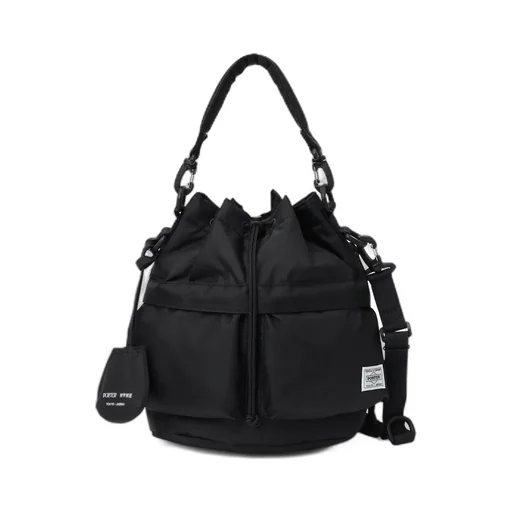
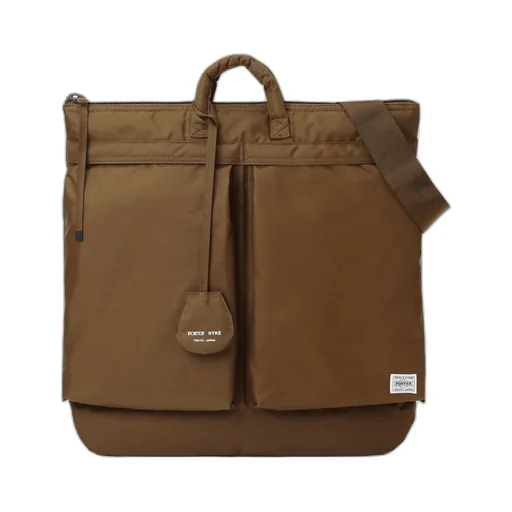
The North Face × HYKE ran from Spring/Summer 2018 through Autumn/Winter 2019, then returned as the trail-focused TNFH THE NORTH FACE × HYKE before concluding in Autumn/Winter 2025. Moncler Genius in 2021 dealt with insulation and enlarged down silhouettes. Porter × HYKE, begun in 2022, translated HYKE's utility pockets and controlled colour into bags, including helmet, tool and bonsac forms. (FASHIONSNAP; HYKE)
In 2017 Ode and Yoshihara jointly received the 35th Mainichi Fashion Grand Prix. The same period included HYKE's first Tokyo collection runway for Autumn/Winter 2017–18. Some secondary summaries misname the recognition as a Tokyo Fashion Award, but the contemporary award report and Tokyo fashion-week record agree on the Mainichi prize. (Vogue Japan; Rakuten Fashion Week Tokyo)
Autumn/Winter 2025 returned HYKE to a runway with an audience after ten seasons. Utility construction was layered with transparent pieces, and the final TNFH collection sat alongside Porter, E5 eyevan, End Custom Jewellers and Beautiful Shoes. The current Autumn/Winter 2026 offer continues to credit both designers and revisits MA-1 and Nordic-knit sources. Continuity here is active research, not a claim that a heritage object is timeless without alteration. (FASHIONSNAP; J'aDoRe Jun Online; HYKE)
Dating the garment, not the reference
The first division is between label eras. green was active from 1998 through Spring/Summer 2009; HYKE begins in Autumn/Winter 2013. A resale listing that says “green HYKE” may be connecting the designers' history, but it should not be copied as the garment's official brand. Read the neck label exactly and record green as green. (Rakuten Fashion Week Tokyo; AFPBB News / Senken)
For HYKE, the internal care label and complete product number are the strongest starting point. Official pages pair codes with exact collection looks: Autumn/Winter 2025 includes 17521 for a plaid coat, while Autumn/Winter 2026 includes nearby 17614 for a cropped trench. Those examples show why the number cannot be converted into a year from its first digits. Use the full code to find an exact authorised image, then compare material, silhouette and construction. (HYKE, Autumn/Winter 2025; HYKE)
The archive reference cannot date the piece. CWU and MA-1 flight clothing, M-43 field garments, military liners, trenches and naval smocks recur across collections. Collaboration co-branding can narrow the window, but should be checked against the partner release. No reliable Japanese source publishes a universal neck-label colour or typography chronology for green or HYKE. Uncertainty is better recorded as a range than resolved by a fashionable olive pocket. (United Arrows; HYKE, Autumn/Winter 2025)
References
- Numéro Tokyo. “HYKE 吉原秀明・大出由紀子インタビュー.” 2023.
- Parigot. “HYKE: Heritage and Evolution.” Parigot 2020 Winter.
- Senken Shimbun / AFPBB News. “「green」から「HYKE」へ.” 2013.
- Mitsuko Watanabe. “編集長×気鋭デザイナー対談 HYKE.” Vogue Japan, 25 November 2015.
- Rakuten Fashion Week Tokyo. “HYKE.” Accessed 10 September 2026.
- Vogue Japan. “第35回毎日ファッション大賞、HYKEが大賞を受賞.” 29 November 2017.
- T Japan. “HYKE、服の歴史を解体し進化させる.” Accessed 10 September 2026.
- HYKE. “Official online store and collections.” Accessed 10 September 2026.
- HYKE. “2025 FW Collection.” 2025.
- FASHIONSNAP. “HYKE 2025年秋冬コレクション.” 2025.
- United Arrows. “HYKE 2025年秋冬コレクション.” 2025.
- J'aDoRe Jun Online. “HYKE 2026 FALL & WINTER.” 2026.
- 原語表記
- 大出由紀子
- 学歴
- Vantan Design Institute
- 受賞
- Mainichi Fashion Grand Prix, 2017
主な作品
該当する結果が見つかりませんでした
キーワードやフィルター条件を変更して再度お試しください。