
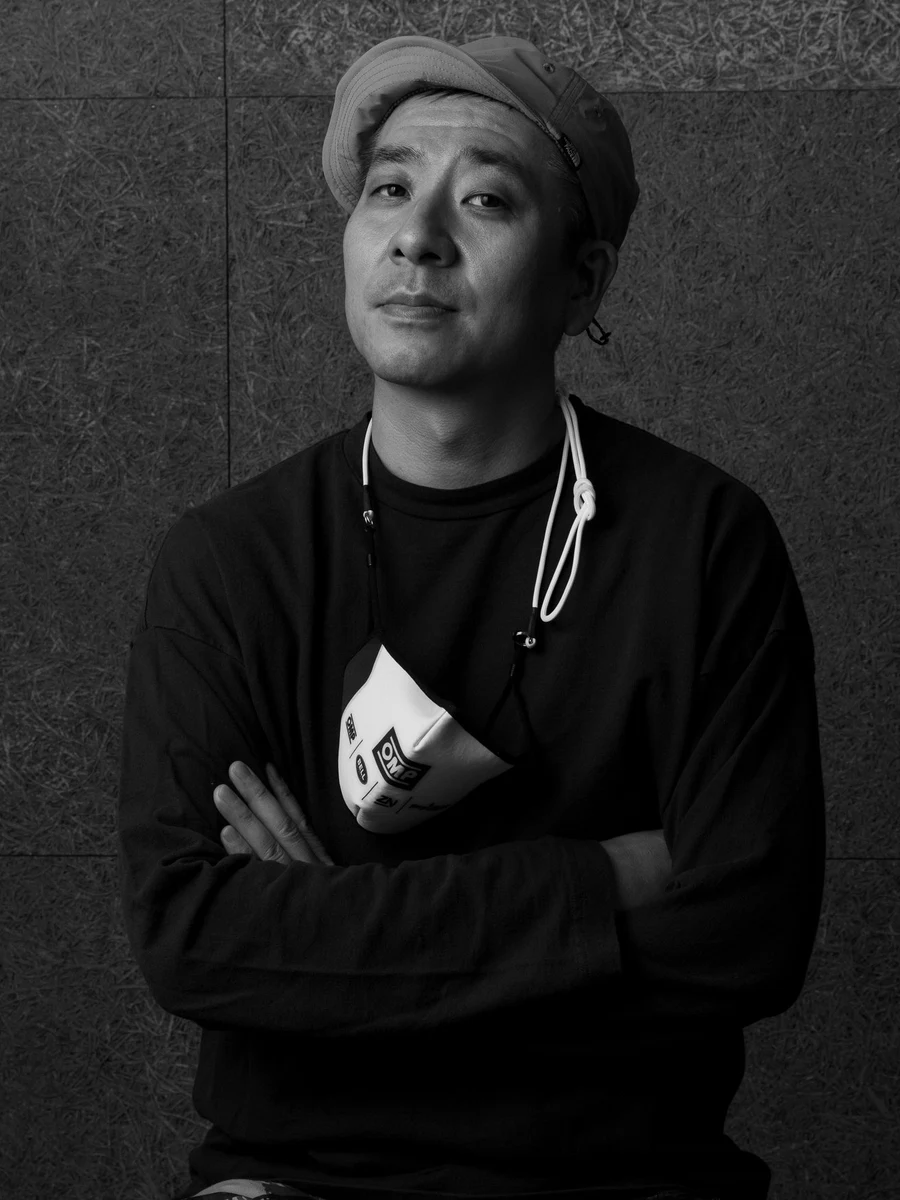
Daisuke Obana
Japanese designer and founder of N.HOOLYWOOD, reworking sourced vintage and military garments into original collections since 2002.
Daisuke Obana is the founder and designer of N.HOOLYWOOD. The brand is often dated to 2000, and that date is not wrong so much as incomplete: 2000 is when Obana opened Mister Hollywood, a Harajuku vintage shop selling remade archive pieces under a single house tag. The N.HOOLYWOOD label followed inside that shop in 2001, and the first full, runway-shown collection — titled 再生 (Saisei, "Regeneration") — was presented at a late-night club event for Tokyo Collection Spring/Summer 2002. (Fashion Press; GSC RINKAN; FASHIONSNAP)
That sequence — shop, label, then runway — also describes Obana's method. He begins by buying and handling existing garments, not by assembling distant references on a mood board. Sourcing is the first stage of the design work. (FASHIONSNAP)
From vintage buyer to Mister Hollywood
Obana was born on 28 January 1974 in Kanagawa Prefecture. He became interested in military-surplus and vintage clothing as a teenager, during Japan's shibukaji (Shibuya casual) period, visiting a military-surplus shop in Machida to build his knowledge of the garments. He enrolled at a Tokyo men's fashion vocational school in 1991 and withdrew within months, moving instead into vintage retail — first as a buyer at a shop in Shimokitazawa, then from 1993 at the Harajuku store Voice, where he made his first overseas buying trip, to Los Angeles. (GSC RINKAN)
At nineteen he pursued the same work more seriously, flying to the United States to source pieces at scale. (FASHIONSNAP) That period led to go-getter, a vintage select shop mixing archive finds with newly made pieces, which Obana helped establish in 1996; a remade pea coat he produced there later appeared in the television drama Beautiful Life and became a sought-after piece in its own right. (PARCO出版; FASHIONSNAP)
The nickname "Mister Hollywood" came from these years, earned on repeated buying trips to Hollywood, California. In December 2000 Obana used it as the name of his own shop, opened in Harajuku: a vintage and remake store that stripped garments of their original labels and re-tagged them under the Mister Hollywood name, selling a rare 1940s piece and a recent recut at the same flat price rather than pricing by age or rarity. (Oceans; FASHIONSNAP)
Regeneration: the first N.HOOLYWOOD collection
The uniform pricing was already an argument: that a garment's value lay in how it was made and how it could be remade, not in a date on a tag. The PARCO archive of Obana's buying-trip photographs and hand-drawn supplier maps from the go-getter years — assembled decades later for a 2024 Shibuya installation, Record of Distress (苦痛の記録) — documents the discipline behind that argument, and Obana has described the period as the point where he began to doubt the vintage trade's assumption that age alone establishes worth. (PARCO出版)
The habit behind that archive was instilled rather than chosen. Obana has said a mentor from his buying days ordered him to photograph what he found every day on an instant camera, with no stated purpose and no visible goal — a discipline he kept up for years before it became roughly 3,000 photographs and a set of hand-drawn maps made without GPS, later compiled into a 752-page retrospective book of the same title as the installation. Read against the rest of his career, the archive reads less as memorabilia than as an early version of the method he still uses: record the object accurately first, and let the design conclusion come later, if it comes at all. (PARCO出版)
In 2001 that doubt became a label. Obana began producing original garments inside Mister Hollywood under the N.HOOLYWOOD name — the deliberate misspelling of "Hollywood," dropping one L, distinguishes the brand from the shop and the city it is named for. A trademark conflict over the straightforward spelling is understood to be part of why the name changed; N.HOOLYWOOD's own account of the period, told through a friend's needling remark, frames the choice as settled quickly rather than agonised over. (FASHIONSNAP)
The Spring/Summer 2002 collection — Regeneration — was shown at a late-night club event rather than a conventional runway slot, and its clothes made the shop's logic explicit: vintage silhouettes and military reference points, reworked and reassembled into pieces sold as new. (FASHIONSNAP) N.HOOLYWOOD has shown a collection every season since.
Buying, dissecting, re-engineering
Obana's design process has stayed close to his years as a buyer. He sources original garments — vintage workwear, military surplus, sportswear — for their construction as much as their look, then works with individual pieces in the atelier rather than treating a reference archive as a mood board to be summarised. He has described handling each garment "as if speaking to them one by one," extracting a detail — a colour, a fabric hand, a way a seam is finished — and carrying it into a new pattern rather than reproducing the original piece. (ISETAN MEN'S net)
This is closer to patternmaking research than to homage. WWDJAPAN's account of the brand's design language notes that the vintage clothing Obana grew up around treated tears, fraying and repair as ordinary, and that N.HOOLYWOOD's collections accept that same wear and asymmetry as a "flavour" (味, aji) found nowhere in a garment made to a single clean spec. (WWDJAPAN) A collection therefore tends to concentrate on one reference world at a time — mountaineering equipment, US military fatigues, a specific decade of American workwear — worked through construction rather than illustrated through print or graphic.
Obana has also been explicit that the method is not meant to produce archivist's replicas or one-off concept pieces. Discussing the brand's twentieth year, he said his aim was clothing "people can wear daily, not self-indulgent, conceptual pieces" — a service-facing instinct he traces to his own retail background, describing himself less as an artist than as a designer who has to understand "business equations and financial flows" alongside cut and cloth. (ISETAN MEN'S net; WWDJAPAN)
New York: presentation to runway
N.HOOLYWOOD showed in Tokyo for its first decade, moving its Harajuku store to nearby Jingumae in September 2004 and adding a dress line shown at Paris Collection in July 2007. In 2010 the brand shifted its collection presentation base from Tokyo to New York, showing Spring/Summer 2011 there in presentation rather than runway format. (GSC RINKAN)
The first true New York runway show followed for Fall/Winter 2011, staged during a severe cold snap that left roughly a metre of snow on the ground — conditions Obana later said he cast the show in himself, wearing outdoor gear against the weather the clothes were about to reference. The collection, titled around Yosemite's Half Dome, drew on early-to-mid-twentieth-century mountaineering dress. (Mastered) N.HOOLYWOOD went on to become one of the longest-running presenters at New York Fashion Week: Men's, returning briefly to a Tokyo runway slot in 2018 after an eight-year absence before settling back into its New York rhythm. (Fashion Press)
From Spring/Summer 2021 Obana made a further, deliberate change: he consolidated the label's output around two lines, Exchange and Compile, and dropped the conventional runway show in favour of film and lookbook presentation — a decision he has framed as predating the pandemic disruption that affected the same season, not a response to it. (ISETAN MEN'S net)
Alongside N.HOOLYWOOD, Obana has taken on design-director roles outside his own label, including for MUJI's MUJI Labo menswear line, and in 2019 he was responsible for design supervision of the uniforms worn by torchbearers in the Tokyo 2020 Olympic and Paralympic torch relay. (WWDJAPAN)
Labels, lines and how to read the work
An N.HOOLYWOOD garment's tag is the fastest way to place it inside the brand's structure, which has grown more layered as the label has aged. The mainline — called Collection in some retail listings — carries a white tag; an earlier dress line, shown separately from 2007, used a black tag. UNDER SUMMIT WEAR is the brand's dedicated base-layer and underwear range, its name a play on "undershirt" that also nods to the mountaineering references running through the main collection. From Spring/Summer 2021 the label runs primarily as two lines, Compile — reworked formalwear — and Exchange, its military-leaning line continuing the original buy-and-rebuild logic in a more systematic form. In 2024 Obana added N.HOOLYWOOD FR, a workwear-focused line. (Fashion Press; GSC RINKAN)
Collaborations are frequent and generally carry a co-branded tag rather than a plain N.HOOLYWOOD one: Wrangler, Levi's, Lee, Converse (Obana became the brand's creative director in 2015), Diesel and G-SHOCK all appear across the archive, alongside earlier group projects such as the Quadrophenia select-shop concept run with Undercover, Number (N)ine and Hysteric Glamour in 2008. (GSC RINKAN; Fashion Press)
Two details help when dating a piece. The misspelling is deliberate: a tag reading the correct "Hollywood" is not an N.HOOLYWOOD mainline label. The city of presentation is less conclusive. The move from Tokyo to New York took place across the 2010–11 collections, and the label briefly returned to a Tokyo runway in 2018, so venue can narrow the possibilities but cannot settle a season. Line name, tag colour and collaboration branding are better evidence. Nor can resemblance to vintage workwear or military surplus supply a date; Obana has drawn on those sources throughout the label's history. (Fashion Press; ISETAN MEN'S net)
References
- Fashion Press. "N.ハリウッド(ミスターハリウッド) : N.HOOLYWOOD." Accessed 11 September 2026.
- GSC RINKAN. "エヌハリウッド(N.HOOLYWOOD)の概要と歴史." Accessed 11 September 2026.
- GSC RINKAN. "デザイナー 尾花大輔." Accessed 11 September 2026.
- Oceans. "これが本当の定番。尾花大輔が語る「頭をゼロにして着られる服」とは?" 16 April 2020.
- ISETAN MEN'S net. "【インタビュー】ブランド創設20年の集大成から、21年目の新境地へ──尾花大輔が語る<N.HOOLYWOOD>の現在地." Accessed 11 September 2026.
- PARCO出版. "「N.HOOLYWOOD」デザイナー・尾花大輔のルーツを辿るインスタレーション Daisuke Obana『Record of Distress 苦痛の記録』が10月19日より渋谷PARCOにて開催." Accessed 11 September 2026.
- FASHIONSNAP. "【連載ふくびと】第2話 N.ハリウッドと尾花大輔――19歳で夢の古着バイヤーに." Updated 21 October 2020.
- FASHIONSNAP. "【連載ふくびと】第3話 N.ハリウッドと尾花大輔――ミスターハリウッド誕生." Accessed 11 September 2026.
- FASHIONSNAP. "【連載ふくびと】第4話 N.ハリウッドと尾花大輔――「なに勘違いしてんだ!」" Accessed 11 September 2026.
- Mastered. "2011年秋のブランド大特集 VOL.01:『N.HOOLYWOOD』." 2011.
- Otsuka Kazufumi. "「N.ハリウッド」と尾花大輔の19年 ルーツを貫き通すことでにじむ強さ." WWDJAPAN, 1 September 2019.
- Born
- January 28, 1974
- Native name
- 尾花大輔
Selected works
No results found
Try adjusting your filters or search terms.