
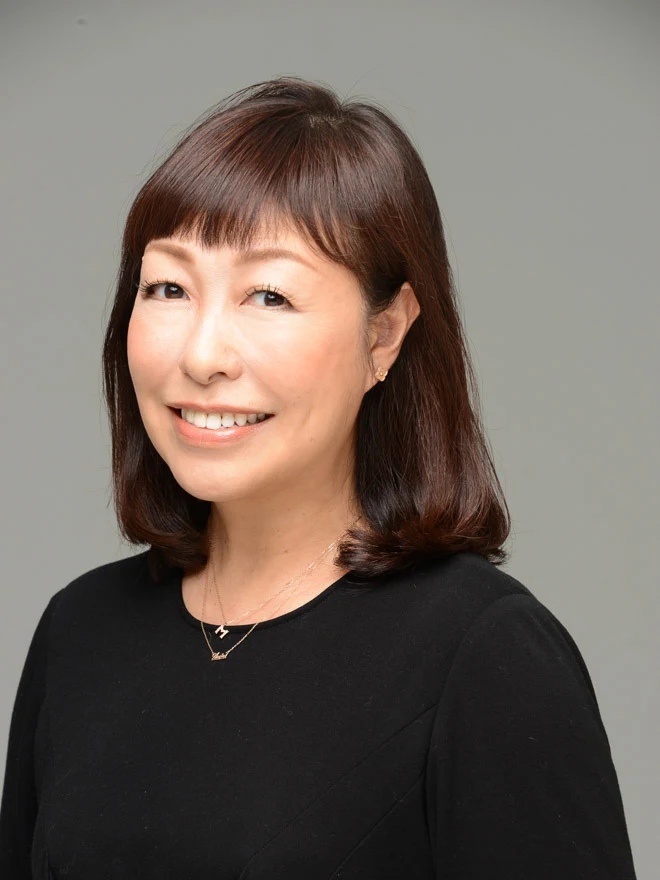
Hiroko Koshino
Japanese designer and painter, founder of HIROKO KOSHINO in 1964 and its chairman and chief designer since 2016.
Hiroko Koshino opened her Osaka atelier in 1964 and remains chief designer of HIROKO KOSHINO. Her younger sisters, Junko Koshino and Michiko Koshino, built separate companies: the family name does not make their garments part of one archive. (Wikidata)
Koshino moved from company president to chairman in September 2016, allowing her elder daughter, Yuka, to take the presidency while she concentrated on creative work. Her younger daughter, Yuma, became vice president and also designs under her own name. The handover changed the company's leadership, not the authorship of Hiroko Koshino's collections. (WWD Japan)
From Kishiwada to Shinsaibashi
Koshino was born on 15 January 1937 in Kishiwada, a port city in Osaka Prefecture. (Fashion Headline; Wikidata) While still a student at Bunka Fashion College in Tokyo, she won first prize in the N.D.C. Design Competition, run by the Japan Designers' Club, in 1957. (HIROKO KOSHINO; Fashion Headline)
After graduating in 1961, Koshino worked as an in-house designer in the young ladies' section of the Ginza Komatsu department store. In 1964 she left to open her own haute couture atelier — a workroom producing made-to-measure garments individually fitted and finished for a single client — in Osaka's Shinsaibashi shopping district, and established the label that still carries her name. (HIROKO KOSHINO; Fashion Headline)
Her mother, Ayako Koshino (1913–2006), was also a fashion designer, and both of Hiroko's younger sisters, Junko and Michiko, went on to found their own labels; Japanese press has long referred to the three as the Koshino sisters. Each sister's company has operated independently of the others for the whole of Hiroko Koshino's career, a point resale sellers frequently miss when a garment is labelled simply "Koshino." (Wikidata)
Tokyo, Rome and Paris: building an international calendar
Koshino joined the Tokyo Collections in 1977 and showed there twice yearly afterwards, at a point when a regular presence on Tokyo's own calendar was still a relatively new idea for Japanese designers rather than an established career path. The following year she became the first Japanese designer to show in Rome's Alta Moda, the city's haute couture collection, a debut Italian press covered closely. (HIROKO KOSHINO; Fashion Headline)
In 1982 she began showing twice-yearly prêt-à-porter — ready-to-wear, cut and produced in standard sizes rather than fitted to one client — in Paris, established Hiroko Koshino International Inc., and started licensing the Hiroko Koshino name to other manufacturers the same year. The move from a single Osaka atelier to an international, licensing company changed the shape of the business as much as the move into Paris did: once the name could appear on goods Koshino had not cut herself, identifying and dating any one piece came to depend on checking the specific line and manufacturer behind it, not the name on the tag alone. Two years later, in 1984, she became the first Japanese designer to present a collection in Shanghai. (HIROKO KOSHINO; Fashion Headline)
Koshino stopped showing in Paris in 1993, after ten years on the calendar there, and did not return until 2009. Around the same time she was made an honorary professor at Taiwan's Shih Chien University. (HIROKO KOSHINO)
Founding the Osaka Collection
In 1987 Koshino initiated what became the Osaka Collection, working with the city and prefecture to establish an organised showcase for Kansai-based design outside Tokyo's collection calendar. It gave her main line a third fixed point on the yearly calendar, alongside Tokyo and, for a decade, Paris, and was part of a broader effort — in which Koshino was a leading figure — to give Osaka's fashion and textile industry a platform independent of the capital. (HIROKO KOSHINO)
Design as public work
Alongside her seasonal collections, Koshino has repeatedly taken on design commissions with a civic or public dimension rather than a private client. Japanese press accounts of her career note commissions for school uniforms and for a professional baseball team's on-field uniform, work that put her designs in front of an audience far larger than a runway audience. (Fashion Headline)
In 2005 she served as producer of the Cool Biz Collection, a Ministry of the Environment initiative that asked Japanese office workers to set aside jackets and ties for lighter clothing through the hottest months, so that workplaces could run air conditioning at a higher, less energy-intensive setting. Putting a couture-trained designer behind a mass dress-code campaign was itself unusual: the project treated everyday office wear, rather than a runway show, as the thing worth designing well. (HIROKO KOSHINO)
In 2021, Koshino designed the uniform graphics for INAC Kobe Leonessa, the women's football club, working with kit supplier Hummel. She said she had paid particular attention to the socks, reasoning that spectators watching a match from the side mostly see players' legs in motion, and wanted the design to read as fashion rather than as sponsorship space alone. INAC Kobe went on to win the first-ever championship of Japan's professional women's league, the WE League, and in May 2022 Koshino appeared as a surprise guest at the club's title celebration at Tokyo's National Stadium, presenting the players with her original artwork for the kit. (WWD Japan)
Painting, galleries and later years
Painting came before fashion in Koshino's own account of her ambitions: as a child, she wanted to become a painter, and continued to draw and paint alongside her design work throughout her career rather than taking it up later as a retirement pursuit. (Fashion Press)
Koshino has increasingly presented herself as a visual artist as well as a clothing designer. In September 2012 she moved her Tokyo flagship store to Ginza's Namiki-dōri and opened an adjoining art gallery, KH Gallery, where she shows her own paintings on a rotating, seasonal basis. (HIROKO KOSHINO; Fashion Headline)
In 2018 she was appointed honorary director of the Kobe Fashion Museum. (HIROKO KOSHINO) Three years later, the Hyogo Prefectural Museum of Art in Kobe staged a retrospective, "HIROKO KOSHINO EX・VISION TO THE FUTURE," running from 8 April to 20 June 2021, and billed her as a designer who had "engaged in clothing creation before the terms fashion and design became established" (「ファッションやデザインという言葉が定着する以前から服作りに携わってきたデザイナー」). The show placed roughly 250 of her garments alongside some 200 paintings and works made in collaboration with younger artists, organised into fourteen sections named for onomatopoeia rather than by date — one section, "きらきら" (kirakira, "sparkle"), was built around paper-dress installations using origami and light. (Fashion Press)
Koshino has summed up her own approach to the work in similar terms: "ファッションに携わる人は、過去を振り向くのではなく常に前を向いているもの。これからも自分の感じることを正直に表現して、地球人としてのファッションデザイナーでありたい" — those in fashion should always look forward rather than back, she has said, and she wants to go on expressing what she feels honestly, as a fashion designer for the whole human race rather than for one nationality. (HIROKO KOSHINO)
Understanding the labels
Identify the complete line name before trying to date or value a garment:
- Hiroko Koshino is the seasonal ready-to-wear mainline.
- Hiroko Koshino Couture covers made-to-order and semi-couture work.
- Trunk Hiroko Koshino is the casual travel and off-duty line.
- Hiroko Bis is the more accessible diffusion line.
- Hiroko Koshino Homme is menswear. (HIROKO KOSHINO; HIROKO KOSHINO)
The shared surname creates two kinds of confusion: between Hiroko's parallel lines, and between the independent companies run by Hiroko, Junko and Michiko. A listing shortened to "Koshino" does not identify either the sister or the product tier. Silhouette alone is also weak evidence because several Hiroko lines have run in parallel and can revisit similar forms years apart. (HIROKO KOSHINO; Wikidata)
The 2016 leadership change can help date company paperwork, but not the garment's design. Material issued before September 2016 may name Hiroko as company representative; later documents name her elder daughter, Yuka, as president. Hiroko nevertheless remained chief designer, while her younger daughter, Yuma, continued her own design work. (WWD Japan; HIROKO KOSHINO)
References
- HIROKO KOSHINO. "デザイナー / DESIGNER." HIROKO KOSHINO official site. Accessed September 2026.
- HIROKO KOSHINO. "ブランド / BRANDS." HIROKO KOSHINO official site. Accessed September 2026.
- Editorial Department. "1月15日はコシノヒロコの誕生日です." Fashion Headline, 15 January 2014.
- Masako Osugi. "ヒロココシノの新社長に長女の小篠由佳氏." WWD Japan, 1 September 2016.
- Hanami Isogimi. "日本女子プロサッカーリーグ初代チャンピオンのINAC神戸をコシノヒロコもお祝い." WWD Japan, 23 May 2022.
- Fashion Press. "コシノヒロコ展が兵庫県立美術館で──洋服の代表作約250点や絵画作品など、"オノマトペ"と探る全貌." Fashion Press, 10 May 2021.
- Wikidata. "Hiroko Koshino (Q11302044)." Accessed September 2026.
- Born
- January 15, 1937
- Native name
- 小篠弘子
- Education
- Bunka Fashion College (1961)
- Awards
- Mainichi Fashion Award, 1997
Selected works
No results found
Try adjusting your filters or search terms.