
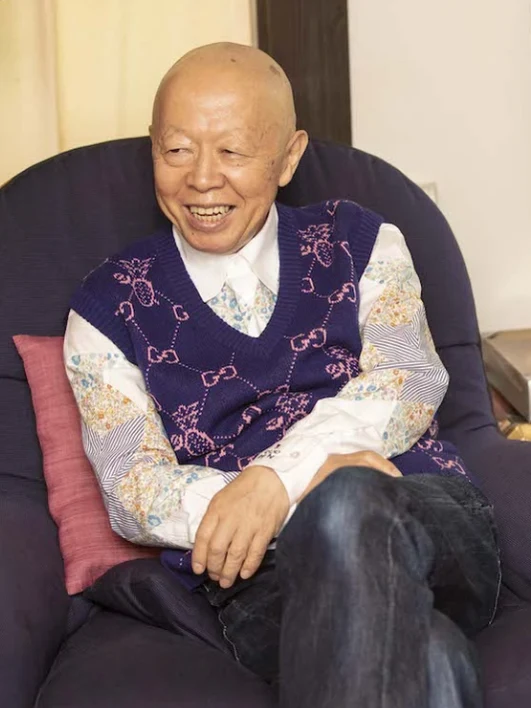
Hiromichi Nakano
Japanese fashion designer who has led his namesake HIROMICHI NAKANO label since founding it in 1984.
Hiromichi Nakano has designed HIROMICHI NAKANO continuously since 1984. The label began inside Sanei-International, became independent under Nakano's own design office in 1991 and was still releasing seasonal collections in September 2026. That 1991 ownership change is important for interpreting company details on older labels, but it does not divide the clothes between two designers. (hiromichi nakano; Fashion Headline)
From Miyagi to the pattern floor
Nakano was born on 10 November 1951 in Iwanuma, a city in Miyagi Prefecture in northern Japan. (Miyagi Prefecture; Fashion Headline) He did not go on to a fashion college. After finishing at Sendai's Miyagi Prefectural Sendai Third High School, he moved directly into the apparel trade, joining the womenswear company Nicole and later Bigi, learning the business on the production and sales floor rather than in a design studio. (Fashion Headline)
In 1981 he moved again, to Sanei-International, described in period coverage as a specialist womenswear manufacturer, where he was placed in the company's VIVAYOU division. Three years later, in 1984, Sanei-International established a collection under his own name: HIROMICHI NAKANO. The brand therefore began life as a division within someone else's company, built around one designer's identity rather than a house style the firm already owned; VIVAYOU itself, rather than the wider Sanei-International name, was the specific business unit that carried it. (Fashion Headline)
Not long after the label launched, Nakano received the Mainichi Fashion Award's prize for new designers. (Fashion Headline)
Becoming his own company
In 1991 Nakano incorporated Hiromichi Nakano Design Office, taking ownership of the brand that Sanei-International had created around him seven years earlier. From that point the label's design, production and licensing ran through a company he controlled rather than through his former employer. (Fashion Headline) The Miyagi prefectural government's own biographical note on Nakano, issued when it named him one of its "Miyagi Kizuna" prefectural ambassadors — one of 106 named in that term — records the company under that same name, giving independent confirmation of the 1991 restructuring. (Miyagi Prefecture)
The move to independence preceded the label's move onto the international runway calendar. In 1998, HIROMICHI NAKANO made its debut on the Paris collections schedule. The reception there fixed a description of Nakano's design language that has followed the brand since: a "コケティッシュ" (coquettish) style, playful and knowingly feminine rather than severe, which found a receptive audience in Paris in a way his earlier, more domestic Tokyo collections had not been positioned to test. (Fashion Headline) The following year, 1999, he was awarded the Special Prize at the 42nd Japan Fashion Editors Club (FEC) Award. Where the Mainichi prize is a newcomer's award, the FEC Award is given by the working press that covers the industry — a recognition from the journalists and editors who had by then been writing about his collections for over a decade. (Fashion Headline)
A second business in uniforms
Alongside the runway label, Nakano built a parallel, less visible practice: designing uniforms for Japanese schools. In 1994 he entered a partnership with Tombow, a manufacturer of school uniforms, to produce uniform ranges under his design direction. (Fashion Headline) This work sits outside the seasonal collection entirely — a uniform is chosen by a school administration for its students to wear for years, not by an individual customer choosing a runway look — and it means a much larger number of people have worn a Hiromichi Nakano design, in the most literal sense, than have ever bought from his boutiques or his Paris-facing collections. The uniform business and the ready-to-wear label are both credited to Nakano personally rather than treated by the company as separate brands.
Uniforms and seasonal fashion place different demands on the same design skill. One must remain durable and recognisable across an entire school; the other must sustain a house identity while fabrics and silhouettes change. Nakano's work in both fields is marked more by continuity than by a single landmark collection.
What the current collections look like
The brand's own shop gives the clearest available picture of what "coquettish" means in practice today. Recent seasons have run to knitwear carrying small repeated motifs — dots and butterflies among them — colour-blocked panels, intarsia patterning, and striped T-shirts in both long- and half-sleeve lengths, sold across women's, men's and unisex ranges that include outerwear, dresses, tops, bottoms and accessories such as scarves, gloves and beanies. (hiromichi nakano) The brand's Instagram account, which was still posting seasonal product and lifestyle images as recently as August 2026, shows the same register continuing into the present rather than a legacy label coasting on archive reissues alone: recent posts pair product shots with still-life images — ivy and angel's-trumpet flowers in one, a toy, a purse and a briefcase grouped together in another — closer in tone to a lifestyle magazine spread than to a straightforward product catalogue. (Instagram)
Reading and dating a HIROMICHI NAKANO garment
Two structural facts do most of the work in placing an undated piece.
First, check the company name. From 1984 to 1991, HIROMICHI NAKANO operated inside Sanei-International's VIVAYOU division. From 1991, it operated through Nakano's own design office. A care tag naming Sanei-International or VIVAYOU supports the earlier period; the absence of either name proves nothing because some tags show only the brand. (Fashion Headline)
Second, the 1998 Paris debut is a business and presentation boundary, not a proven change in the clothes themselves. It cannot date an undocumented piece by silhouette. Compare the garment's label, construction and print with dated brand material instead. (Fashion Headline)
The brand's current shop, archive category and Instagram provide dated comparison material for construction, labels and prints. These references can support a match, but a resemblance to current dot, stripe or butterfly knitwear cannot establish a vintage season by itself. (hiromichi nakano; Instagram)
A smaller but practical note for anyone searching a resale marketplace or an archive rather than reading a physical tag: the brand's current online presence — its shop domain and its Instagram handle alike — renders the name as one lowercase word, "hiromichinakano", where earlier press coverage renders it as two capitalised words, "HIROMICHI NAKANO" or "Hiromichi Nakano". Searching only one form risks missing listings filed under the other. (hiromichi nakano; Instagram)
School uniforms are separate from the seasonal line. They were commissioned through the Tombow partnership for individual schools, so a specific uniform must be dated through school or manufacturer records rather than a fashion season. (Fashion Headline)
References
- Fashion Headline. "11月10日はファッションデザイナー中野裕通の誕生日です." Fashion Headline, 10 November 2013.
- Miyagi Prefecture Public Relations Division. "みやぎ絆大使 44 中野裕通." Miyagi Prefecture. Accessed September 2026.
- hiromichi nakano. Official brand shop. Accessed September 2026.
- Hiromichi Nakano. Official Instagram, @hiromichinakano_official. Accessed September 2026.
- Born
- November 10, 1951
- Native name
- 中野裕通
- Awards
- Japan Fashion Editors Club (FEC) Award, Special Prize, 1999