
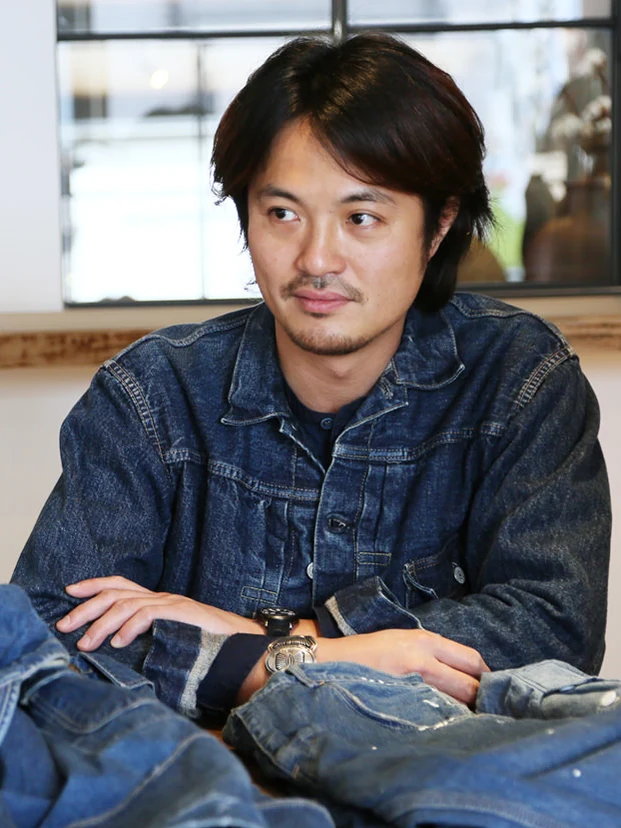
Ichiro Nakatsu
Japanese designer, founder of orSlow in 2005 and still its designer, reproducing American workwear and military patterns from Nishinomiya, Hyōgo.
Ichiro Nakatsu is the founder and designer of orSlow, the label he established in 2005 and still directs. orSlow is routinely filed alongside Japan's Okayama denim industry, but that is where Nakatsu trained, not where the company sits: orSlow is operated by 有限会社ベースデニムプロダクツ (base denim products Inc.) from 6-13 Wakamatsu-chō, Nishinomiya, in Hyōgo prefecture, on the Hanshin corridor between Osaka and Kobe. (orSlow; Bshop)
The founding date needs one correction. Nakatsu told Kinarino that in 2004 he launched slowdenim, the brand that preceded orSlow; in Bshop's interview he says plainly, 「2005年にorSlowを立ち上げました」 — I set up orSlow in 2005. Both statements can be true, and the 2005 date is the one the company itself counts from: a February 2019 announcement describes the coming spring as 「14年目を迎えるオアスロウ」, orSlow entering its fourteenth year. Where a listing gives 2004, it is most likely reaching back to slowdenim. (Kinarino; Bshop; orSlow)
An overall, Amerika-mura, and a year and a half in the United States
The brand's own account begins with a garment rather than a career. Nakatsu was given a denim overall as a small child and was caught by the way the indigo shifted as it aged — 「その色落ちして表情を変えていくデニムの魅力」, the appeal of denim that loses colour and changes expression. By his school years he was buying American vintage in Osaka's アメリカ村 (Amerika-mura), the Shinsaibashi quarter that has sold imported and second-hand American clothing since the 1970s, and noticing that jeans from different decades faded differently. (orSlow; Kinarino)
After leaving school he spent roughly eighteen months in the United States working through vintage shops, and came back with an ambition he has since repeated in interviews: 「ジーンズを集めているうちに、自分で作れるようになりたいなと思うようになった」 — while collecting jeans, he began to want to be able to make them himself. He then took a vocational fashion course and went to work in product planning at a jeans manufacturer in Kojima, Kurashiki, in Okayama prefecture — the district generally credited with the first domestically made Japanese jeans. By his own account it was the same company that had made his childhood overall. (Kinarino; Bshop)
That is an unusual training route for a designer. Planning at a denim mill is not sketching: it is specifying fabric, fit, wash and cost against a factory's real capability. Nakatsu left after about five years, and for the first seasons of his own label bought a handful of industrial jeans machines and sewed every sample himself — 「はじめの数年はジーンズ専用の工業用ミシンを数台揃え、サンプルをすべて自分で縫製していました」. (Kinarino; Bshop)
What the name argues
orSlow's own gloss on its name is a sentence, not a story: 「originalityのある服を吟味しもの創りする。めまぐるしい速さで流れていくファッションの世界で、ゆっくりと進みながら自分らしさを見つめ直していく」 — to examine and make clothes with originality, moving slowly through a fashion world that runs at a dizzying speed. The or is originality; the Slow is the antithesis. (Kinarino; orSlow)
The brand states its position on reproduction with equal directness. Mass production, it argues, delivered jeans to everyone while sacrificing something latent in them — 「本来ジーンズが持つ潜在的な魅力が犠牲にされてきたのではないか」 — and the work is therefore to hold respect for the old thing while looking for a new finished form, not to counterfeit a dead one. Nakatsu's frame of reference is narrow and stated: work and military garments of the nineteenth and twentieth centuries, with denim of the 1950s to 1970s at the centre. (orSlow; orSlow)
The machines are the method
orSlow's reproductions are defined less by pattern research than by the equipment used to execute it. The atelier runs roughly twenty vintage American sewing machines across sixteen types, including a Union Special — a small chain-stitch machine, long out of production, used for hemming. Chain stitch is a looped single-thread seam; as the denim shrinks around it, the hem draws up into the rippled edge Japanese denim buyers call パッカリング (puckering). Fabric comes from old 力織機 (rikishokki, shuttle looms), which the brand says produce around fifty metres a day, alongside Singer machines of the same period. (Kinarino; orSlow)
The same logic runs through the non-denim staples. orSlow's crew-neck sweatshirts and hooded sweats are knitted on 吊り編み機 (tsuri-amiki, loopwheel machines) — slow circular knitting machines hung from the ceiling that knit under almost no tension; the brand describes the resulting cloth as soft and reading like vintage of more than fifty years ago. Fabrics for the jeans themselves are developed originally, after analysis of deadstock 1950s denim, rather than bought in as generic selvedge. (orSlow; Bshop)
Two 2018 releases show how far that method travels from denim. In June the brand issued original T-shirts spun with VOLTEX air-spinning, a yarn process that traps air in the thread, finished with an embroidered map of Japan; a month earlier it had published an orSlow book at ¥2,800, bound with a denim spine, documenting five years of product development. A house that publishes its own development record is making an argument about provenance as much as about clothes. (orSlow)
Two fits, then an army
The line is built on a small number of numbered patterns that persist across years. 105 STANDARD is the anchor, based on an early-1960s Levi's 501; 107 IVY FIT is the narrower cut, tapering to the hem, and has sold well to women as well as men. A third denim pattern, 105W 1990'S STANDARD, was introduced in March 2020 from a different reference entirely: non-selvedge denim of the 1990s, 「No selvedge(耳無し)の1990年代ごろのデニムからインスピレーションを受け企画した」. (Bshop; Kinarino; orSlow)
Around those sit the military and work patterns that now make up most of the catalogue: 5002 US ARMY FATIGUE PANTS and its slim sibling 5032, 513 US NAVY UTILITY PANTS, V5361 VINTAGE FIT ARMY TROUSERS, 6010 US ARMY TROPICAL JACKET, 8045 US ARMY SHIRTS, the 001 US NAVY HAT in denim and in herringbone twill, plus French and American work patterns — 5000 FRENCH WORK PANTS, 1002 NEW YORKER, 512 PAINTER PANTS, the 6140 1950'S COVERALL and 6150 1940'S COVERALL. (orSlow)
Nakatsu has described his aim in this material as universal rather than period-accurate: drawing on vintage work and military items while expressing 「プロダクトの普遍的なかっこよさ」, a product's timeless rightness. (HOUYHNHNM)
Hyōgo, Paris, and the collaborations
Staying in Hyōgo has shaped the work in at least one documented case. For Autumn/Winter 2017-18 orSlow joined the HYOGO JAPANESE LEATHER PROJECT, a prefectural scheme pairing local tanners — Hyōgo accounts for roughly 70 per cent of Japan's cow leather and 80 per cent of its horse leather — with brands showing abroad, and exhibited during Paris men's fashion week. It was orSlow's first leather outerwear; Nakatsu said the collection 「全体的に高評価を得た」, was well received overall. Paris remains part of the business: the company's own recruitment notice, posted in March 2026, describes a Nishinomiya-based sales role with twice-yearly trips to Paris. (WWDJAPAN; orSlow)
Nakatsu describes the progression deliberately rather than opportunistically: set an objective at each stage of a life and act on it — his own ran from launching a brand, to establishing it domestically, to selling abroad. The same exactness shows in the premises. He specified the Hanshin-area office in detail, down to evenly spaced windows and cast concrete carrying a wood-grain texture, choosing each panel himself. (Bshop)
Collaborations are occasional and usually retailer special-makes rather than co-signed lines. The most recent documented one, released on 1 May 2026, is with Beams: two US Army fatigue patterns — pants at ¥23,980 and shorts at ¥21,780 — cut to the baggy silhouette of orSlow's SUPER DAD'S denim in an original reverse satin, sold only through Beams stores and its online shop. (WWDJAPAN)
Reading and dating an orSlow garment
Start with the number, not the label. orSlow's catalogue number — 105, 107, 5002, 6140 — identifies the pattern and is stable for years, so it is the first thing to match against the brand's own product pages. The retail SKU adds two blocks around it: a two-digit prefix and a fabric or finish suffix. Two pairs listed as 01-5002-J61 and 01-5002-16 are therefore the same fatigue pattern in different cloth, and 01-5002 versus 01-5032 is regular-fit button fly versus slim-fit zip. A listing that quotes only "orSlow fatigue pants" has discarded the part that identifies the garment. (orSlow; PHEB)
The one clean date marker is the tab. In February 2019 orSlow announced that from spring 2019 the small woven tabs would be removed from its jeans and jackets, with tabbed stock remaining only until shops sold through — 「2019年春より、これらのタブを取り去ることになりました」. A tabbed pair is therefore produced before that change, and an untabbed one after it, with a season or two of overlap on the shop floor. As always, retail delivery outlives a production change, so a tab dates the making, not the sale. (orSlow)
Two further cautions. First, do not read a pale, ropey, selvedge-edged pair as automatically "the classic orSlow": since 2020 the 105W has deliberately reproduced non-selvedge 1990s denim, so an absent selvedge ID can be the design rather than a downgrade. Second, verify where a garment was sold. In April 2026 orSlow issued a notice that it does not operate any direct-to-consumer online store and warned about an impersonating site at orslow.org, noting that others may exist; several domains trading on the name in English-language search results are not the brand. The only official site is orslow.jp. (orSlow)
Nakatsu's own collecting is a fair guide to what the clothes are reaching for — he keeps a 1905 Levi's 501 whose lower legs are destroyed, probably burnt for light in a mining camp, and a first-model jacket he bought from a beachcomber in Los Angeles for a hundred dollars — objects valued for the story stored in them. As of September 2026 he remains orSlow's designer. (Bshop)
References
- Shiori Hasegawa. "vol.73 orSlow・仲津一郎さん — 目指すは「年代物」。デニムへの想い" Kinarino, 17 November 2017.
- "(前編) orSlowを知る10のコト." Bshop BRAND NOTE.
- "(後編) orSlowを知る10のコト." Bshop BRAND NOTE.
- "Ichiro Nakatsu (orSlow Designer)." HOUYHNHNM, Cover all of Gregory interview 39, 23 June 2016.
- "兵庫レザーを世界に発信 「マスターピース」や「オアスロウ」とコラボ." WWDJAPAN, 15 February 2017.
- "ビームスと「オアスロウ」がコラボ バギーシルエットのファティーグパンツ2型を発売." WWDJAPAN, 29 April 2026.
- "BRAND STORY." orSlow. Accessed 11 September 2026.
- "ABOUT." orSlow. Accessed 11 September 2026.
- "COMPANY." orSlow. Accessed 11 September 2026.
- "NEWS." orSlow. Accessed 11 September 2026.
- "MEN'S BASIC." orSlow. Accessed 11 September 2026.
- "orSlow." PHEB INTERNATIONAL. Accessed 11 September 2026.
- Native name
- 仲津一郎