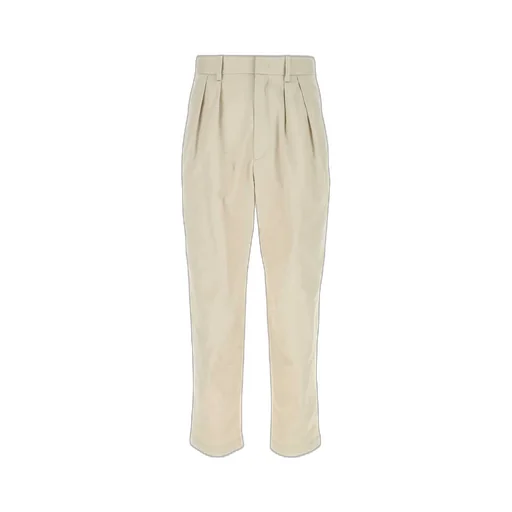
Isabel Marant
French designer whose Parisian-bohemian signature built Isabel Marant; in October 2025 she passed creative direction to Kim Bekker.
Isabel Marant built Isabel Marant around the kind of clothes she wanted to wear: low boots, easy dresses, sturdy jackets and a little deliberate disorder. She founded the label in the 1990s and stepped back from creative direction after its Spring/Summer 2026 show, when Kim Bekker took the runway bow alone. (FashionNetwork; WWD)
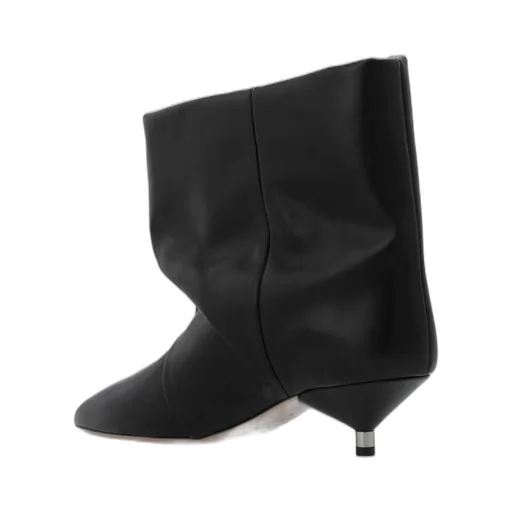
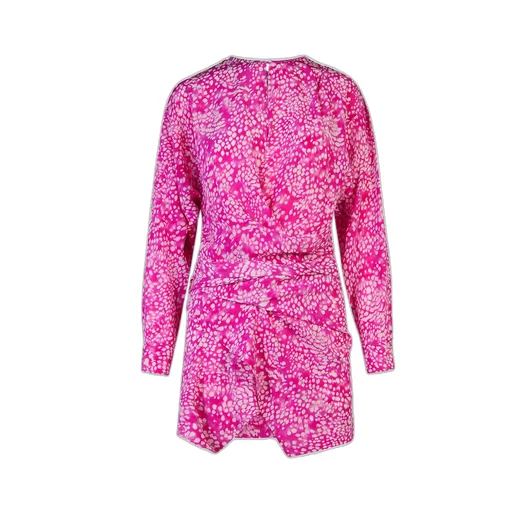
Her clothes made a persuasive case for comfort without losing attitude. A ruffled blouse might be worn with a short skirt and battered-looking boots; a high-top trainer hid a wedge heel. The Dicker boot and Bekett trainer became widely copied because they solved small, everyday questions of how to finish a look. (WWD)
From Studio Berçot to her own label
Marant was born on 12 April 1967 in Boulogne-Billancourt, on the western edge of Paris, and grew up in the wealthier suburb of Neuilly-sur-Seine. Her father worked as a company manager; her mother, Christa Fiedler, was a German former model who had moved into knitwear design and would later become Marant's business partner. (Wikidata; The Gentlewoman)
She trained at Studio Berçot, a small, well-regarded Paris fashion school, from 1985 to 1987; a piece of advice from the school — never design anything you would not wear yourself — stayed with her for the rest of her career. She then spent several years working for other designers, including Michel Klein, Chloé, Martine Sitbon and Yohji Yamamoto, before starting her own label. In 1990, aged twenty-three, she and her mother launched a small jersey and knitwear line; run initially under the name Twen, it was renamed Isabel Marant in 1994. (Business of Fashion; FashionNetwork)
Marant has long lived in Belleville with her husband, the accessories designer Jérôme Dreyfuss, and their son. She has described the family’s spare weekend cabin in Fontainebleau as a counterweight to the constant demands of the fashion business. (The Gentlewoman)
Founding a house built to be worn
Marant showed her first collection under her own name in 1995, an improvised affair with no meaningful press and an audience made up mostly of friends. Recognition built slowly rather than arriving with a single show: Marant has dated the real turning point to around 2009, when she began working with the French editor Emmanuelle Alt and arrived at the ruffled top, mini-skirt and low studded boot combination that read, in retrospect, as the moment her silhouette became legible to the wider industry. She opened her first boutique on rue de Charonne, near Bastille, in 1998, and launched the more casual, lower-priced Isabel Marant Étoile line in 2000. (Isabel Marant; WWD)
She has been consistent about what she was not trying to do. "I'm more like a Coco Chanel or a Sonia Rykiel — women who dressed several generations during their lives," she said in 2013, drawing a line between her own ambition and a runway spectacle built around a single season's story. That practicality carried a cost inside the industry: Marant has acknowledged that a focus on wearability sometimes read, even to her, as less ambitious than the conceptual work shown elsewhere on the Paris schedule, while maintaining that "each one is a talent." (The Gentlewoman; WWD)
The uniform: boots, wedge sneakers and a decade of imitators
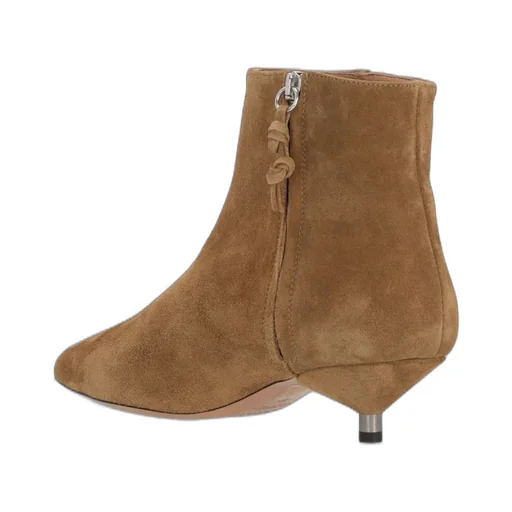
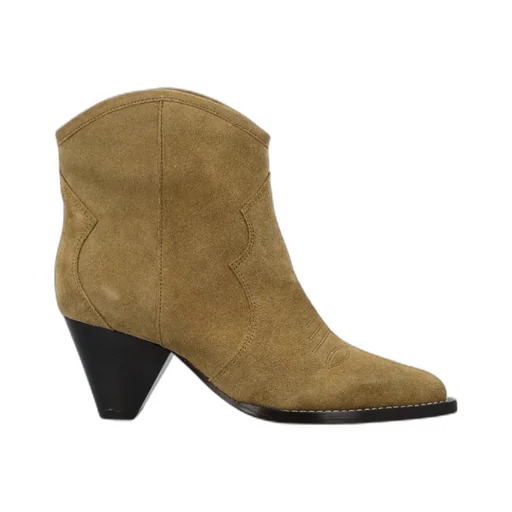
Marant's most recognisable products are shoes, and both grew from the same instinct. "Footwear is really ending the silhouette and giving attitude," she has said of how she finds a season's key piece. The suede Dicker ankle boot, with its low Cuban heel and Western-inspired panelling, became a fixture of the early 2010s uniform worn by Kate Bosworth, Jessica Biel and Diane Kruger, among others. (WWD)
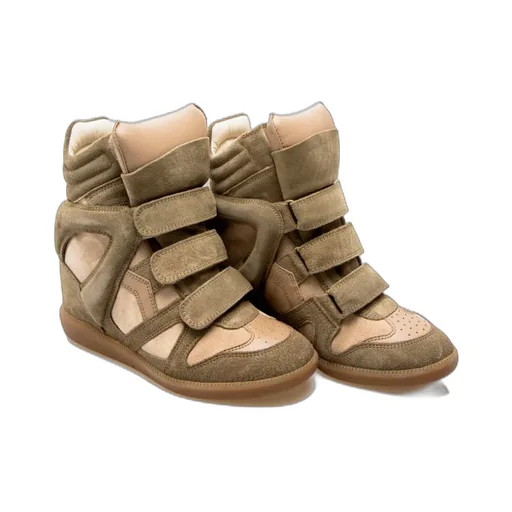
The Bekett, a high-top trainer with a concealed wedge heel, followed in 2010 and became a bigger phenomenon still: reproduced by fast-fashion retailers within a season, and later a fixture in Beyoncé's 2011 video for "Love on Top," which sent the style into a run of celebrity adoption and season-long waiting lists. Marant reissued it in 2022 as the Balskee. The scale of the imitation was itself a kind of proof — Marant had designed something closer to infrastructure than a trend piece. (Isabel Marant; WWD)
Her 2013 H&M collaboration brought that wardrobe to a far wider audience. It went on sale in November, sold out rapidly and overwhelmed the retailer’s website. The demand showed how easily Marant’s mix of Western boots, soft knitwear and relaxed tailoring could travel beyond her own boutiques. (Drapers)
Ownership, growth and a public apology
The business scaled well beyond the small studio Marant had started it in, in the Marais. She launched a menswear collection under design lead Barnabé Hardy in 2018, followed it with an eyewear line produced under licence by the Italian group Safilo in 2020, and opened an online resale platform, Isabel Marant Vintage, in 2021. In 2016, she had already sold a 51 percent stake in the company to the private equity firm Montefiore Investment, a decision she later explained as wanting "a backer to expand the brand all around the world, with help from people who have the knowledge of it." By April 2024 the house operated 85 stores worldwide under chief executive Anouck Duranteau-Loeper, with revenue split roughly evenly between the runway collection, pre-collection and Étoile. (FashionNetwork; Isabel Marant; WWD)
Growth brought at least one public reckoning. In November 2020, Mexico's secretary of culture, Alejandra Frausto Guerrero, publicly accused Marant of appropriating a Purépecha textile design from Michoacán for a cape in the Fall 2020 Étoile collection. Marant and Duranteau-Loeper responded with a written apology, saying they were "enormously" saddened that a garment intended to pay tribute to a craft tradition had been read as appropriation, and pledging to credit source communities in future collections. (WWD)
A measured handover
The move to Kim Bekker was not sudden. Bekker, a graduate of the Arnhem Academy of Art and Design — whose alumni also include Viktor & Rolf and Iris van Herpen — had worked at Isabel Marant once before, from 2008 to 2018, helping define the house's style, before roughly three years as design director for pre-collections at Saint Laurent. She returned to Isabel Marant in March 2021, and the house named her creative director that September — the first time it had formally given anyone but Marant a top creative title. (Grazia; FashionNetwork; FashionNetwork)
The two then worked side by side for several seasons. According to Vogue Business, Marant had Bekker design the entire Autumn/Winter 2025 collection and sent her out to take the bow alongside her; by the following season, Spring/Summer 2026, Bekker bowed alone, and the house confirmed the shift in title from artistic to creative director shortly afterward. Marant described Bekker, at their thirtieth-anniversary dinner in Los Angeles in April 2024, as still her "right hand" — a partnership built over four years rather than announced overnight. (FashionNetwork; WWD)
Reading the labels: two lines, and two eras of authorship
A garment's woven neck label carries the first piece of information: ISABEL MARANT for the runway and pre-collections, ISABEL MARANT ÉTOILE for the more casual line introduced in 2000. The two are related but not interchangeable — Étoile has always run at a lower price point and a more relaxed register, and its pieces are not simply cheaper mainline design. (Isabel Marant)
Authorship is a separate question from the label, and now a harder one to answer than it used to be. Kim Bekker had a hand in the house's design from 2021 onward, working alongside Marant for years before any collection was credited to her alone; her first fully independent collection was Spring/Summer 2026, shown in October 2025. A piece carrying an earlier season code should be read as Marant's design even if it reached shops after the handover, since retail delivery regularly lags a season or two behind the runway; a piece from Spring/Summer 2026 onward is Bekker's. The house's 2023 update to its visual identity offers a rougher marker for dating a piece to before or after that year, though it says nothing about who designed it. (Isabel Marant; FashionNetwork)
References
- FashionNetwork. "Isabel Marant formalises transfer of creative direction to Kim Bekker." 6 October 2025.
- FashionNetwork. "Isabel Marant appoints Kim Bekker as artistic director." 20 September 2021.
- Grazia. "Kim Bekker and Isabel Marant might have staged the smoothest transition of power in fashion." 2025.
- WWD. "Isabel Marant Spring 2026 Ready-to-Wear Collection." 2 October 2025.
- Booth Moore. "For Isabel Marant, Boho Never Stopped Being in Style." WWD, 11 April 2024.
- WWD. "Isabel Marant Apologizes to Mexico for Its Indigenous-Inspired Designs." 17 November 2020.
- Drapers. "H&M's website crashes over Isabel Marant collection." 14 November 2013.
- The Gentlewoman. "Isabel Marant." Issue n° 7, Spring & Summer 2013.
- Business of Fashion. "Isabel Marant." BoF 500 profile.
- Isabel Marant. "History." Official brand page.
- Isabel Marant. "Timeline." Official brand page.
- Wikidata. "Isabel Marant (Q440616)."
- Born
- April 12, 1967
- Education
- Studio Berçot (1985–1987)
- Awards
- Award de la Mode, 1997Elle Style Awards, Contemporary Designer of the Year, 2014