

Jack McCollough
American designer who co-founded Proenza Schouler and, with Lazaro Hernandez, has served as Loewe creative director since April 2025.
Jack McCollough is one of the two creative directors of Loewe, sharing the role with Lazaro Hernandez since 7 April 2025. For the previous twenty-three years they designed Proenza Schouler, the New York label that began as their joint student collection and grew into a serious argument for American luxury based on custom textiles, experimental construction and useful bags. McCollough and Hernandez are also partners in life; neither designer's mature career can be separated cleanly from the other, but their individual routes into the partnership are worth preserving. (Associated Press; Parsons)
McCollough was born in Tokyo and spent his first five years in Japan before growing up in Montclair, New Jersey. As a teenager he sewed his own clothes, wore dreadlocks and followed the Grateful Dead; before fashion school he studied glassblowing. That material education is not a decorative biographical detail. Glass teaches through heat, timing and the point at which a rigid substance becomes fluid—concerns that later recur in Proenza Schouler's moulded leathers, bonded textiles and apparently liquid dresses. (Interview; Vogue; W)
Two people, one collection
McCollough met Hernandez at the Manhattan nightclub Life in 1998, when both were about to study fashion at Parsons. Their temperaments and backgrounds were visibly different: McCollough described himself as a hippie who made clothes, while Hernandez had arrived from Miami after beginning a medical path. At Parsons, McCollough interned with Marc Jacobs and Hernandez with Michael Kors. They eventually chose to make one senior thesis rather than compete with separate collections. (Vogue; Vogue Italia)
They called it Proenza Schouler, combining their mothers' maiden names: Proenza from Hernandez's family and Schouler from McCollough's. The name was often mispronounced and never functioned as a founder's public persona; that slight distance helped the pair speak as a house rather than two celebrity signatures. Barneys New York bought the entire 2002 thesis, an extraordinary beginning that turned a school project directly into a business. Their first commercial runway followed in 2003. (Parsons; Interview)
Success came before they had much infrastructure. They received the CFDA's emerging-talent award in 2003 and won the inaugural CFDA/Vogue Fashion Fund in 2004, followed by Womenswear Designer of the Year awards in 2007, 2011 and 2013 and an accessories award in 2009. The honours matter because they place Proenza inside a specific New York moment: an industry worried about its next generation chose two recent graduates as evidence that technically ambitious fashion could still be built in the city. (Proenza Schouler; Parsons)
The partnership does not operate by assigning sleeves to one designer and skirts to the other. Hernandez once explained that when one wants black and the other white, the result is neither but the grey produced by argument. That negotiation is the authorship. McCollough may come across in interviews as the drier and more materially analytical voice, but it would be misleading to label him “the fabric designer” and Hernandez “the silhouette designer.” Their work was conceived, edited and credited jointly. (Interview; W)
Proenza Schouler: American clothes made the difficult way
Early Proenza Schouler joined the pragmatic pieces of an American wardrobe—school jackets, narrow trousers, T-shirts, day dresses—with techniques more often associated with European luxury production. Rather than apply an unusual print to a standard dress, the studio commissioned jacquards, pleated cloth, bonded layers and engineered patterns that changed how the garment held the body. Contemporary art supplied methods and colours rather than images to copy. Richard Serra, Helen Frankenthaler, Frank Stella and Isa Genzken entered collections as questions about weight, surface or construction. (Le Monde; Parsons)
Spring 2010 is an accessible example. Surfing and skate culture led to fluorescent tie-dye, scuba closures, loose trousers and a skirt that looked like a wetsuit peeled down around the hips. The references were youthful, but the textiles and cutting were not casual. Pre-Fall extended the experiment through Japanese 絞り (shibori), a family of resist-dyeing methods in which cloth is bound, folded or compressed before dyeing. These collections show why “downtown cool” is an incomplete description: apparent ease depended on deliberate fabric development. (Vogue Runway; Vogue)
The PS1, launched with the house's first bag collection in 2008, translated that intelligence into a practical object. It resembled a softened school satchel or document case, with straps, compartments and deliberately quiet hardware. At the height of obvious “It bags”, its anonymity became its identity. The PS1 provided the business with a durable accessories anchor; later bags, including the PS11 and sculptural ruched totes, shifted between harder geometry and collapse. (CFDA; Associated Press)
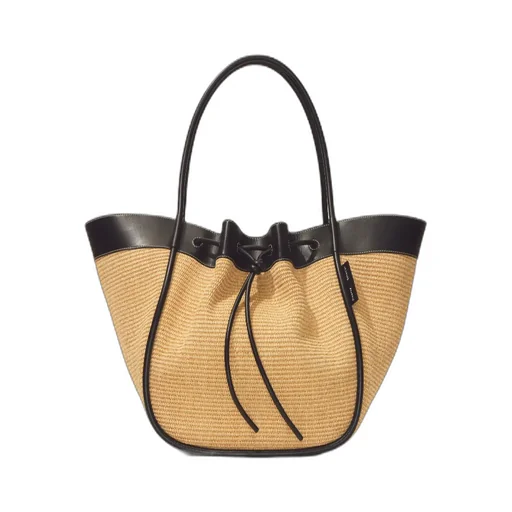
Proenza never followed a simple upward line. The designers took minority investment, moved their runway to Paris for two seasons in 2017 and 2018, then returned to New York and bought back control with private investors. Paris increased their access to specialised featherwork, lace and macramé, but the return clarified that the label's social and creative world belonged in New York. The lower-priced White Label, introduced in 2018, separated everyday denim and knitwear from the technically intensive main collection without disguising the distinction: its labels were white, while the collection line used black. (Vogue; W)
Their final runway as creative directors, Spring 2025, returned to house codes of pleating, fringe and scarf construction. They stepped down on 15 January 2025, before the Fall 2025 lookbook was released, though they had helped organise its shoot and remained shareholders and board members. Rachel Scott became creative director that September. The distinction matters for attribution: Fall 2025 belongs to a transition led through the long-serving studio, not simply to the founders because their names remained attached to the company. (Vogue Runway; Vogue Runway; Proenza Schouler)
Loewe: a larger workshop
Loewe appointed McCollough and Hernandez after Jonathan Anderson's eleven-year tenure. They moved from New York to Paris, where the creative studio is based, and began travelling regularly to the leather workshop in Getafe near Madrid. For McCollough, the striking change was scale: at an independent label, a designer habitually asks whether an experiment is possible; at Loewe, the useful question became how far the craftspeople could take it. (Associated Press; El País Semanal; SPUR)
Their Spring 2026 debut used Ellsworth Kelly's Yellow Panel with Red Curve as a threshold to an emphatic palette. Parkas, jeans, bombers and striped knits brought American sportswear into dialogue with precise leather and Spanish heat. They described three foundations for the new Loewe: Spanish sensuality without folkloric shorthand, East Coast American ease, and craft pushed far enough to make one material resemble another. The collection did not try to imitate Anderson's surrealism or become ceremonially “French” after the move to Paris. (LVMH; W)
The Amazona 180 reworked Loewe's structured 1975 bag for the house's 180th year. Its long zip and single-sided handle allow the mouth to fall open, turning luggage-like order into controlled slouch. The Flamenco Ondas placed waves of leather around another established Loewe form. These are useful demonstrations of the duo's current method: respect the recognisable object, then make its construction visibly misbehave. (Loewe; Vogue)
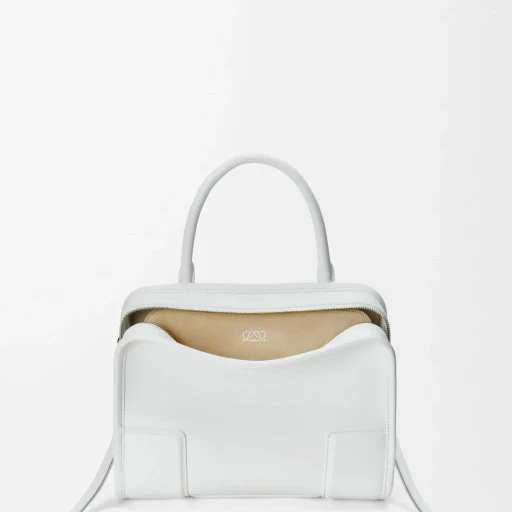

Fall 2026, their second main collection and first complete menswear statement, confirmed that bright colour and humour would coexist with technical seriousness. As of September 2026, McCollough remains Loewe's creative director alongside Hernandez. They no longer design Proenza Schouler, though their shareholding means that “founder” and “current designer” must not be treated as synonyms. (GQ; LVMH)
Reading and dating the work
A Proenza Schouler label gives joint credit: there is no responsible way to authenticate a dress as “by Jack rather than Lazaro.” Mainline black labels and White Label's white labels identify different product tiers, while a runway season, care label and retailer record can narrow the date. The founders' last runway is Spring 2025; the studio-produced Fall 2025 collection sits between their departure and Rachel Scott's first fully directed season.
For Loewe, Spring 2026 is the clean starting point for McCollough and Hernandez's shown work. Older Puzzle, Flamenco and Amazona bags belong to the house and its previous designers; new names such as Amazona 180 or Flamenco Ondas identify their transformations more precisely. A product sold after April 2025 is not automatically theirs, because Anderson-era stock continued through the transition.
References
- Associated Press. “Jack McCollough and Lazaro Hernandez named creative directors at Loewe.” 24 March 2025.
- Parsons School of Design. “Jack McCollough and Lazaro Hernandez.” Alumni profile.
- Hamish Bowles. “Inside the Rustic Retreat of Proenza Schouler's Jack McCollough and Lazaro Hernandez.” Vogue, 17 October 2019.
- Interview. “Proenza Schouler's Jack McCollough and Lazaro Hernandez Answer Questions About Smells.” 2018.
- Lauren Collins. “At Loewe, Jack McCollough and Lazaro Hernandez Write Their Next Chapter.” W, 16 February 2026.
- Vogue Italia. “Proenza Schouler.” June 2010.
- Chloë Sevigny. “Proenza Schouler.” Interview, 22 February 2011.
- Proenza Schouler. “About Us.” Current company history.
- Nicole Phelps. “Proenza Schouler Spring 2010 Ready-to-Wear.” Vogue Runway, 16 September 2009.
- Vogue. “A Look at Pre-Fall 2010: Proenza Schouler.” 2009.
- CFDA. “Lazaro Hernandez.” Member biography.
- Olivia Singer. “Proenza Schouler returns to New York Fashion Week.” Vogue, 2018.
- Karin Nelson. “Proenza Schouler White Label.” W, 2018.
- Nicole Phelps. “Proenza Schouler Spring 2025 Ready-to-Wear.” Vogue Runway, 4 September 2024.
- Nicole Phelps. “Proenza Schouler Fall 2025 Ready-to-Wear.” Vogue Runway, 13 February 2025.
- Proenza Schouler. “Creative Director.” Rachel Scott appointment.
- LVMH. “A burst of colorful creativity for Loewe Spring-Summer women's collection.” 6 October 2025.
- El País Semanal. “Lazaro Hernandez y Jack McCollough, directores creativos de Loewe.” 25 April 2026.
- SPUR. “Interview with Jack McCollough & Lazaro Hernandez.” 21 August 2026.
- Loewe. “Spring Summer 2026 campaign.” 2026.
- Laird Borrelli-Persson. “The Best Loewe Handbags of 2026.” Vogue, 2026.
- Samuel Hine. “Meet the 'Loewe Boys' Who Wowed Paris With Their First Menswear Collection.” GQ, 7 March 2026.
- Education
- Parsons School of Design
- Awards
- CFDA/Vogue Fashion Fund, 2004CFDA Womenswear Designer of the Year, 2007CFDA Accessory Designer of the Year, 2009CFDA Womenswear Designer of the Year, 2011CFDA Womenswear Designer of the Year, 2013
Selected works
No results found
Try adjusting your filters or search terms.