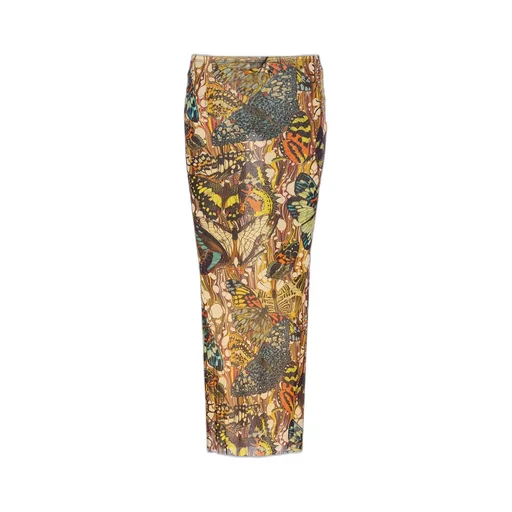
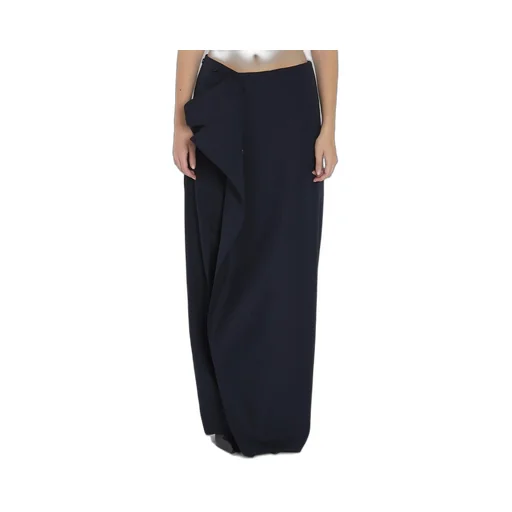
Jean Paul Gaultier
French couturier behind sailor stripes and the cone-bra corset; Hermès womenswear creative director, 2003–2010; retired from his own runway in 2020.
Jean Paul Gaultier retired from the runway on 22 January 2020, closing a fifty-year career built on the Breton sailor stripe, a corset meant to be worn as outerwear, and a standing argument that fashion's rules about gender and class were there to be broken. Since April 2025 the house that carries his name, Jean Paul Gaultier, has had its first permanent creative director since his departure: the Dutch designer Duran Lantink, whose debut ready-to-wear collection showed in Paris in September 2025 and whose first couture collection followed in 2026. (FashionUnited; Euronews)
Gaultier trained inside the most orthodox houses in Paris and then spent four decades turning their own techniques against their conventions: he put men in skirts, built corsetry designed to be seen rather than hidden, and dressed a pop star's chest in two cones of satin that became one of the most reproduced images in fashion. He did it as a self-taught outsider, undiplomatic by temperament, which is a large part of why the press settled early on calling him fashion's "enfant terrible" and never really stopped. (Gulf News)
Arcueil, Pierre Cardin and a self-taught eye
Gaultier was born on 24 April 1952 in Arcueil, a suburb south of Paris, and had no formal design training. Pierre Cardin hired him at eighteen after seeing sketches he had sent unsolicited, and over the next several years he moved between the era's grandest Paris houses, working for Cardin, Jacques Esterel and Jean Patou before he was twenty-five. (Wikidata; Biography.com) He showed his first individual collection under his own name in 1976, the year the Fédération de la Haute Couture et de la Mode now dates the house to, and he has run it under his own name ever since. (FHCM; Biography.com)
Stripes, skirts and a corset built to be seen
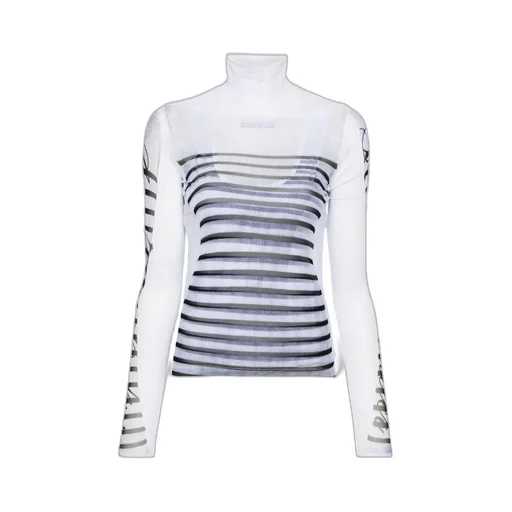
By the early 1980s Gaultier had assembled a vocabulary he would return to for the rest of his career. He adopted the marinière, the striped jersey of the French navy, as a personal uniform and a recurring motif across both his womenswear and menswear, showed a corset dress cut to be worn as outerwear in 1983, and put men in skirts on the runway in 1985 — a generation before "gender-fluid" became a marketing term. He wore the striped jersey and a kilt himself often enough that in interviews the designer and the design read as the same argument. (Biography.com)
The corset returned in 1990 as the cone-shaped bra he designed for Madonna's Blond Ambition World Tour: two rigid points sitting over a structured, boned bodice, immediately legible and endlessly reproduced since. Because the tour was among the most photographed events in pop music that year, the piece did more than any runway show to fix Gaultier's name — and the pairing of corsetry with underwear-as-outerwear — in an audience well outside fashion. (Biography.com)
A couture line, and a name that outgrew the runway
Gaultier's debut haute couture collection, in Spring 1997, folded his own wardrobe into the presentation: a wasp-waisted trucker jacket embroidered by the house of Lesage was built from denim he had actually worn. Couture gave him a slower, more expensive register for ideas ready-to-wear could not carry, and he kept both lines running in parallel for years afterward. (W Magazine)
His reach also extended past clothing altogether. He designed costumes for Jean-Pierre Jeunet's The City of Lost Children (1995) and Luc Besson's The Fifth Element (1997), and later for several Pedro Almodóvar films, including Bad Education (2004) and The Skin I Live In (2011). (Biography.com) That readiness to work outside a runway season — costume, stage, television — became as much a part of his public identity in the 2000s and 2010s as any single collection.
Ownership: from Hermès's stake to Puig's
His commercial success drew in outside capital long before it drew in a permanent successor. Hermès held a stake in the Gaultier fashion house through the 2000s, and on 3 May 2011 it sold that entire 45 percent holding to the Spanish group Puig for €16 million, plus repayment of €14 million in loans, alongside a further stake sold by Gaultier himself; the deal gave Puig majority control. (Moodie Davitt Report) Puig went on to take direct control of the fragrance business too: from 1 January 2016 it absorbed the Jean Paul Gaultier perfume licence that had been managed since the 1990s by Shiseido's Beauté Prestige International. (Global Cosmetics News) Puig remains the house's parent company today.
A parallel decade at Hermès
Alongside his own label, Gaultier spent 2003 to 2010 as Creative Director of women's ready-to-wear at Hermès, a house built on restraint rather than spectacle. His final collection for Hermès, Spring/Summer 2011, was staged in a riding arena with live horses, mixing black leather and lizard-skin corsetry with the equestrian references at the core of the Hermès identity. Coverage of the tenure described his gift there as a "precarious balance between opposites" — bringing sensuality and theatrical drama to a brand previously defined by minimalism without breaking its restraint. He was succeeded by Christophe Lemaire. (NSS Magazine)
Retirement, guest couturiers and a permanent hand again
Gaultier stepped back from ready-to-wear first. On 15 September 2014 he announced he would stop producing seasonal prêt-à-porter after thirty-eight years, showing his final ready-to-wear collection on 27 September that year; he said commercial pressure and the pace of collections left no time to "find fresh ideas and to innovate," and that he intended to focus on haute couture, perfume and other projects instead. (France 24)
He kept the couture runway for six more years. On 22 January 2020, at the Théâtre du Châtelet in Paris, he staged a fiftieth-anniversary retrospective show, more than two hundred looks deep, and announced it as his last: "This show celebrating 50 years of my career will also be my last." (Refinery29; W Magazine) Rather than name an immediate successor, Gaultier opened the couture house to a rotating cast of guest designers, each given one season to reinterpret his archive: Chitose Abe of Sacai (Autumn/Winter 2021), Glenn Martens of Y/Project (Spring/Summer 2022), Balmain's Olivier Rousteing (Autumn/Winter 2022), Haider Ackermann (Spring/Summer 2023), Julien Dossena (Autumn/Winter 2023), Simone Rocha (Spring/Summer 2024), Nicolas Di Felice of Courrèges (Autumn/Winter 2024) and Ludovic de Saint Sernin (Spring/Summer 2025). (FashionUnited)
That experiment ended on 15 April 2025, when the house named the Dutch designer Duran Lantink its first permanent creative director since Gaultier's own departure, with responsibility for both couture and a revived ready-to-wear line. Gaultier himself endorsed the choice, saying he saw in Lantink "the energy, audacity and playful spirit through fashion that I had at the beginning of my own journey." Lantink had shown his own upcycled, boundary-pushing label on the official Paris calendar since 2023 and had already won the ANDAM Special Prize, LVMH's Karl Lagerfeld Prize and the Woolmark Prize. (Euronews; Dazed)
Lantink's debut ready-to-wear collection for the house, shown in Paris on 25 September 2025 and titled Junior, referenced the Junior Gaultier diffusion line Gaultier ran from 1988 to 1994 rather than the mainline archive, pairing it with imagery from a photography book on Amsterdam's late-1980s club scene; he described the aim as building "a fantasy world" rather than restaging old collections outright, and the result split critics between calling it disrespectful and admitting it provoked a reaction few debuts manage. (Dazed; W Magazine) His first couture collection, Tech Couture, followed on 9 July 2026 and drew more directly on the archive: an upcycled-denim trucker jacket echoed Gaultier's own Spring 1997 couture debut, and a cone-spiked, armour-like dress reworked guipure lace from the house's Fall 2008 "Cages" collection, rather than leaning on the more obvious marinière stripes or cone bras. As of September 2026 he remains the house's creative director for both lines. (W Magazine)
Reading the labels: five different hands under one name
A vintage or resale listing marked simply "Jean Paul Gaultier" can now mean any of five distinct creative periods, and the label alone rarely tells them apart. Ready-to-wear from 1976 through the final Spring/Summer 2015 collection is Gaultier's own solo design, spanning both his mainline and diffusion lines from the 1980s and 1990s. Anything from his years at Hermès, 2003 to 2010, carries an Hermès label and Hermès season codes, not a Gaultier one, even though the hand and sometimes the silhouette are recognisably his. Haute couture from 1997 through his final show in January 2020 is again solo Gaultier, and the most consistent showcase of the vocabulary — stripes, corsetry, tailoring cut like couture engineering — that defines him. Couture from 2021 through early 2025 belongs to eight different guest designers working inside the Gaultier archive for a single season each, so a Sacai-era or Y/Project-era Gaultier couture piece reflects Chitose Abe's or Glenn Martens's authorship as much as the house's; the season and the guest's name, not the Gaultier label, are what actually date and attribute the piece. And anything from September 2025 onward belongs to Duran Lantink's tenure, the first design language at the house that is neither Gaultier's own nor a single season's guest arrangement. Fragrances sit outside all of this: Puig has owned and continuously produced the Gaultier fragrance line since 2016 regardless of who is designing clothes, so a bottle's date says nothing about who was creative director when it was released.
References
- Wikidata. "Jean-Paul Gaultier" (Q242868).
- Biography.com Editors. "Jean-Paul Gaultier: Fashion, Perfume & Facts." Biography.
- Fédération de la Haute Couture et de la Mode. "Jean Paul Gaultier." House page.
- France 24. "Jean Paul Gaultier to Stop Making Ready-to-Wear Collections." 15 September 2014.
- Gulf News. "Jean Paul Gaultier to Stop Making Ready-to-Wear." 30 September 2014.
- NSS Magazine. "When Jean-Paul Gaultier Was Creative Director of Hermès."
- Moodie Davitt Report. "Puig Bolsters Portfolio with Jean Paul Gaultier Acquisition." 3 May 2011.
- Global Cosmetics News. "Jean Paul Gaultier Fully Integrated into Puig Fragrance House." January 2016.
- Refinery29. "Jean-Paul Gaultier's Last Couture Show Featured An Iconic Cast Of Models." 23 January 2020.
- W Magazine. "Jean Paul Gaultier Talks Last Couture Show: 'It's the End, but It's Not the End.'" January 2020.
- FashionUnited. "In Pictures: Jean Paul Gaultier's Eight Guest Designers Lined Up." 15 April 2025.
- Euronews. "Jean Paul Gaultier Names Dutch Designer Duran Lantink as Permanent Successor." 15 April 2025.
- Dazed. "Duran Lantink Is Jean Paul Gaultier's New Creative Director." April 2025.
- W Magazine. "Duran Lantink Debuts a Daring New Jean Paul Gaultier at Paris Fashion Week." October 2025.
- W Magazine. "Duran Lantink Won't Rest on Nostalgia at Jean Paul Gaultier Couture." July 2026.
- Born
- April 24, 1952
- Also known as
- Jean-Paul Gaultier