
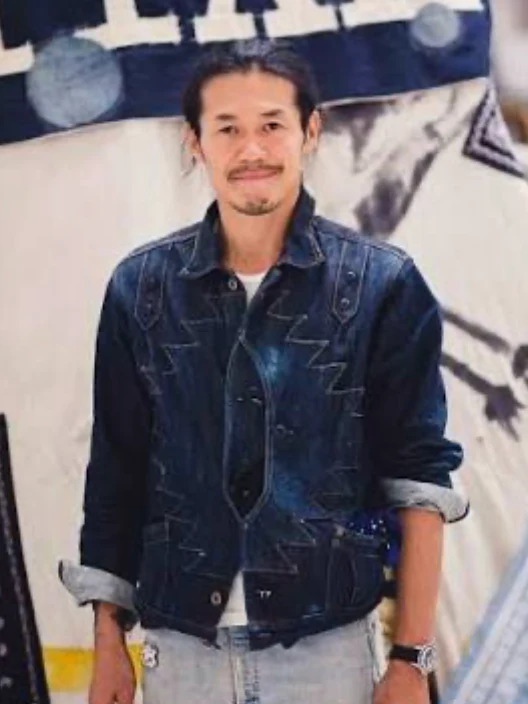
Kiro Hirata
Japanese president and creative director of KAPITAL, turning Kojima denim, repair, travel and humour into an unruly material language.
Kiro Hirata, whose Japanese name is Kazuhiro Hirata, is the president and creative director of KAPITAL. He joined the family business in 2002 and transformed its command of reproduction denim into something more unruly: workwear collaged with folk dress, rigorous textile development next to cartoon bones and smiley faces, and new garments repaired as if they had already travelled through several lives. KAPITAL is based in Kojima, Okayama, not Tokyo, and that physical connection to Japan's denim industry remains fundamental. (KAPITAL; GQ)
The label is frequently described as an anonymous Japanese craft collective, partly because Hirata gives few interviews and the company explains little in conventional press language. It is nevertheless a family and factory history with identifiable authors. His father, Toshikiyo Hirata, established the denim business in the 1980s and mastered production; Kiro introduced an art-school eye, wide cultural research and a refusal to stop at faithful American reproduction. Toshikiyo died in April 2024, and Kiro now appears on KAPITAL's own company information as representative director. (GQ; KAPITAL)
Leaving denim country to discover denim
Toshikiyo encountered American jeans while teaching karate in the United States. Back in Kojima, his wife’s hometown and an important centre of Japanese uniform and denim production, he learned fabric development and pattern cutting and established Capital Inc. in 1984. The early operation manufactured and reproduced mid-century American denim before opening its own retail business. The name KAPITAL plays on Kojima's status as a denim capital. (GQ; GOAT)
Kiro initially wanted to leave that environment. At nineteen he went to the United States to study art, where vintage clothing made him see denim differently. After returning to Japan he worked as a designer for 45RPM, now known as 45R, a label whose careful textiles and dyeing offered another education in Japanese casualwear. In 2002 he left to join his father's company. The partnership joined Toshikiyo's technical understanding of manufacture to Kiro's image-making and design. (GQ; GOAT)
This sequence corrects an easy founding myth. Kiro did not create the original factory in 1984, and the KAPITAL label did not arrive fully formed in that year. Toshikiyo built the manufacturing base; the family retail and label identity developed later; Kiro's arrival in 2002 produced the recognisable contemporary direction. Those dates describe different layers of one company rather than one clean “brand launch”. (GQ; KAPITAL)
Beyond perfect reproduction
Japanese denim makers became internationally respected by studying the yarn, weave, hardware and sewing of historic American jeans. Hirata values that knowledge but saw exact reproduction as his father's completed problem. His question was what their generation could add. He described the oldest surviving Levi's as roughly a century old and wanted KAPITAL to make something for the next hundred years, rather than repeat an already perfected copy. (GQ)
Century Denim is the most concentrated answer. Its variations combine indigo and other dyestuffs—including persimmon tannin and sumi ink—with visible sashiko-like reinforcement and cloth engineered to change dramatically through wear. Persimmon tannin, or 柿渋 (kakishibu), can give fibre a dry brown cast; sumi deepens it towards grey-black. The resulting jeans are not artificially frozen as “old”. Abrasion, laundering and the wearer's body expose new contrast over time. (KAPITAL; KAPITAL/TRANSIT)
The programme keeps changing. A 2023 release placed 真田紐 (sanada-himo), a narrow woven cord associated with binding and armour, along the crease of Frisko trousers; other editions explore mud, sumi and regional colour. KAPITAL now operates a dedicated Century Denim shop in Ginza while continuing to develop the line from Okayama. “Century” therefore names an ongoing textile project, not one fixed fabric or fit. (KAPITAL; KAPITAL)
Repair as process—and as image
KAPITAL's KOUNTRY work concentrates overdyeing, patching, distressing, embroidery and reconstruction. The line may begin with a newly made base garment, a previous KAPITAL piece or cloth assembled to evoke successive repair. Its strongest objects make the labour readable: another patch crosses an old seam, dense stitches stiffen a weak area, or several shades of faded indigo show that no surface has one visual age. (KAPITAL; GQ)
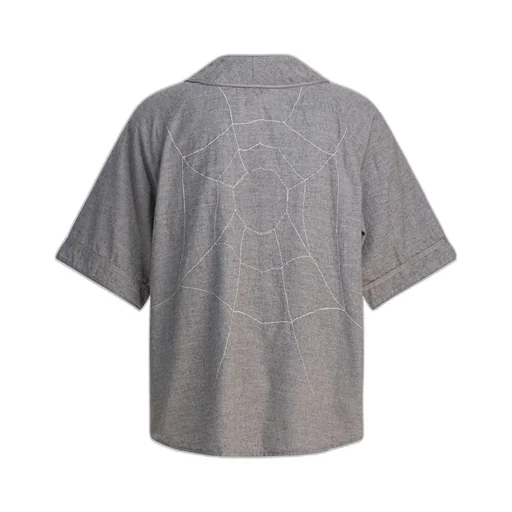
The word 襤褸 (boro) needs care. Historically, it refers to repeatedly patched, heavily used cloth preserved through necessity, especially among people who could not discard scarce textile. A newly manufactured, expensively distressed KOUNTRY jacket may cite the appearance and techniques of such cloth, but it does not share that social history. Calling every patchworked KAPITAL product “authentic boro” turns poverty and conservation into a vague luxury adjective. Product records should use KAPITAL's actual title and processing description. (Victoria and Albert Museum; KAPITAL)
Sashiko deserves the same specificity. 刺し子 (sashiko) is functional reinforcement stitching with many regional forms and histories; rows of visible white stitches on indigo can refer to it without making a garment a preserved folk textile. Hirata's contribution is not the invention of repair or sashiko. It is placing those material ideas into a contemporary system of denim factories, experimental finishing and global image-making. (Victoria and Albert Museum; KAPITAL)
A travelling culture clash
Hirata's collections range far beyond Japanese textile reference. American military clothing, Southwestern jewellery, cowboy dress, reggae, hippie imagery, European folk costume and workwear pass through KAPITAL alongside kimono forms and local dyeing. The result is sometimes described as “East meets West”, but that smooth phrase hides the label's actual method. Sources collide, scale changes and humour interrupts reverence; a skeleton can cover an entire fleece, or a bandanna can become a sculptural down jacket. (GQ)
Those references should be named responsibly. “Native”, “tribal” and “ethnic” are not adequate descriptions for identifiable Indigenous American forms, nor does Japanese manufacture make a borrowed cultural motif neutral. KAPITAL's clothes are best documented by stating what is visible and what the company calls it, without inventing a sacred meaning or an artisan partnership for which there is no evidence. The distinction is especially important in resale listings, where romance easily outruns provenance. (GQ)
Hirata works as an image-maker as well as a clothing designer. His long-running catalogues with photographer Eric Kvatek turn each season into a location story populated by musicians, craftspeople, friends and surreal characters. KAPITAL's Kojima complex similarly joins offices and factory space to several unlike shops, a book room and Hirata's bandanna collection. Official SOHO Books listings credit him as the author of publications on bandannas and found objects, making collecting and editing part of his recorded practice. (GQ; KAPITAL SOHO Books)
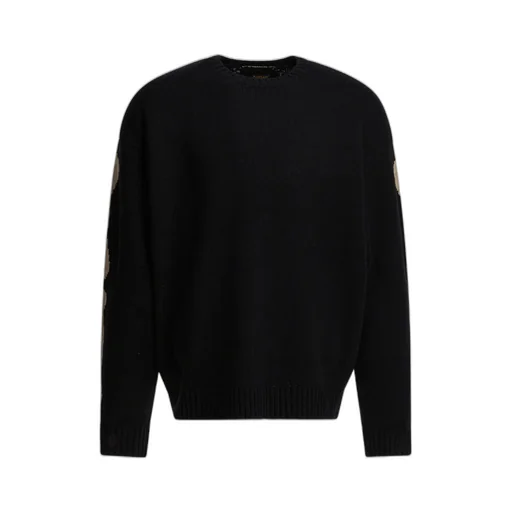
The humour matters. Smileys, peace signs and the oversized Bone skeleton brought KAPITAL a much larger streetwear audience, but they do not replace the textile work. A bone-printed knit and a nearly plain pair of Century Denim jeans are two registers of the same house: one broadcasts an image, the other lets dye and abrasion construct it slowly. Hirata has resisted being reduced to the smiley-face brand because no single emblem contains that range. (GQ)
Keeping production close
KAPITAL's official company record lists four sewing facilities and a dedicated KOUNTRY dyeing and processing factory. Keeping design, sewing, dye and repair within a connected regional operation makes small experiments possible and allows a garment to move back through another process. It also distinguishes the company from a label that simply orders a distressed surface from an anonymous supplier. Not every KAPITAL item involves the same amount of handwork, however, and “made in Japan” should be checked on the individual care label. (KAPITAL)
The shops extend this approach. In Kojima, KAPITAL uses a former civic building for its SOHO store and book space, while other locations occupy a traditional house or purpose-built rustic environments. The national shop list includes stores with specific functions—Legs, Century Denim, SOHO and Bazaar—rather than one repeated luxury template. A store visit is therefore part retail, part archive and part explanation of how Hirata groups objects. (KAPITAL SOHO Books; KAPITAL shop list)
Reading and dating KAPITAL
First distinguish ordinary KAPITAL, heavily processed KOUNTRY work and the Century Denim programme, while recognising that the boundaries can overlap. A KOUNTRY label indicates a processing context, not that the base cloth is antique; Century Denim identifies a family of fabrics and treatments, not one cut. Ring coats, bone graphics, bandanna pieces and smileys recur, so a familiar motif cannot date an item. (KAPITAL; KAPITAL)
Photograph the full care label, size, fibre composition and product code. Numeric KAPITAL sizes do not map consistently across its very wide range of cuts, and processing can change measurements. Compare the exact title and code with the company's seasonal catalogue; its official site preserves catalogue material back through many years. Natural-looking fading, repair and irregular stitching may be intentional, but they do not by themselves prove age or authenticity. (KAPITAL; KAPITAL SOHO Books)
Finally, use the official domains carefully. KAPITAL's Japanese information site is kapital.jp and its linked webshop is kapital-webshop.jp. A polished page using the brand name in another domain is not automatically authorised. For a house whose demand, elaborate processing and limited documentation have encouraged both counterfeits and mistaken descriptions, a complete label record is more useful than a seller's story. (KAPITAL; KAPITAL Webshop)
References
- Noah Johnson. “A Rare Visit to Kapital, Japan's Denim Paradise.” GQ, 9 September 2019.
- KAPITAL. “会社情報・お問い合わせ.” Accessed September 2026.
- KAPITAL. “SOHO Books.” Accessed September 2026.
- KAPITAL. “New Century Denim Pre Order.” 25 March 2023.
- KAPITAL. “KOUNTRY Month Tomorrow!!” 27 April 2023.
- KAPITAL. “TRANSIT × KAPITAL vol.3.” 16 September 2023.
- KAPITAL. “2026 Locomotive + Century Denim.” 2026.
- GOAT. “Kapital: Past Meets Present in Japan's Iconic Cult Brand.” Accessed September 2026.
- Victoria and Albert Museum. “Make your own: Japanese ‘Boro’ bag.” Updated 17 April 2024.
- Native name
- 平田和宏