
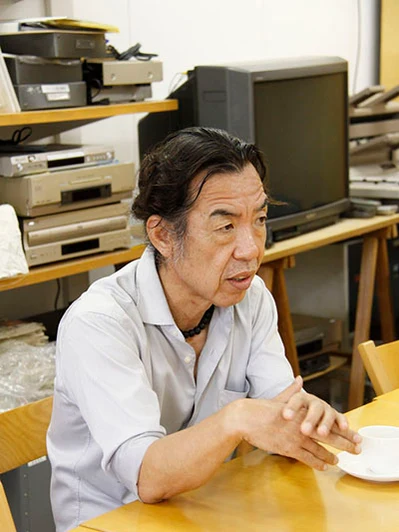
Kosuke Tsumura
Japanese designer behind FINAL HOME, and professor of fashion design at Musashino Art University since 2008.
Kosuke Tsumura created FINAL HOME around a nylon parka whose forty-four pockets could carry belongings or be stuffed with newspaper for insulation. He developed the project after working at Miyake Design Studio and later taught fashion design at Musashino Art University. New FINAL HOME stock stopped around 2020 because Issey Miyake's agency, rather than Tsumura, controls the trademark. (Sabukaru; Musashino Art University)
The coat answered a direct question: what could clothing provide after war, disaster or homelessness had stripped away conventional shelter? Museum examples and the instructions printed on surviving garments make the answer unusually legible, but later reproductions, dead stock and unauthorised uses of the name require separate checks. (Sabukaru)
From Saitama to the Miyake Design Studio
Tsumura was born in Saitama Prefecture in 1959. At twenty-three he won the Soen Award, a competition run by the magazine Soen for emerging designers, for a white coat with corduroy embroidery inspired by the pattern of electrical wiring — the same award that had earlier gone to Yohji Yamamoto. The win led directly to a job: in 1983 he joined Miyake Design Studio as an assistant designer under Issey Miyake. (Sabukaru; Musashino Art University)
He has described the years that followed as an education in treating clothing as something with a job to do beyond covering the body — a studio culture built on textile research and construction problem-solving rather than seasonal decoration. That instinct, carried whole into his own project a decade later, is the throughline between Issey Miyake's research-driven studio and the parka Tsumura eventually built around a single practical question. (Sabukaru)
Designing for the end of the world
Tsumura has traced the idea for FINAL HOME to a mixture of apocalyptic science fiction — Blade Runner, Star Wars, Akira — London's punk and streetwear scenes, and a private thought experiment: design for a survivor after nuclear war, left with almost nothing. "I stimulated a situation that the world came to an end because of a nuclear war," he has said, describing the exercise that produced the brand's first coat. (Sabukaru)
Tsumura's own faculty biography dates the launch of the FINAL HOME project to 1992; the label is more widely remembered by its first Paris presentation in 1994, made with the support of Miyake Design Studio, and its first London Fashion Week appearance followed in 1997. That year, 1994, is also when The Museum of Modern Art commissioned a twenty-piece capsule collection from the label, the commission that produced its signature garment. (Musashino Art University; The Museum of Modern Art)
That garment, since referred to as Home 1 or simply the 44-pocket parka, took its structure from a pillow rather than a conventional coat: Tsumura treated the space between the front and back panels as one continuous cavity, closed by rows of zips into forty-four separate compartments, rather than sewing on pockets one at a time. Stuffed with newspaper, the coat becomes insulation; filled with water, food or a torch, it becomes a survival kit. The nylon shell was produced in three colourways with distinct practical logic — orange for visibility, khaki for concealment outdoors, black for the city — and every coat carried a card asking the owner to return it once it was no longer wanted, so it could be redistributed through NGOs to homeless people and refugees. Tsumura has glossed the brand's name, read literally in Japanese, as something closer to "the ultimate shelter." (FINAL HOME; Sabukaru)
Tsumura has also said plainly that he came to reject the industry's two-collections-a-year rhythm, arguing it wears designers out for no design reason, and that FINAL HOME's slower, question-first way of working was in part a response to that pace. (Sabukaru)
The choice of material followed the same logic. Synthetic fabrics such as nylon are usually criticised in fashion for not decaying; Tsumura has treated that same resistance to decay as the point, choosing plastics and nylon precisely because a garment built for a crisis needs to outlast one, rather than return gracefully to the earth once the season ends. (Sabukaru)
Function displayed as art
FINAL HOME's later work moved as often through gallery walls as through stores. At the Mori Art Museum's 2008 anniversary exhibition, Tsumura inserted objects — fashion magazines, stones, ice packs — into transparent coats, using the FINAL HOME pocket system to ask what a garment could carry across a full year of changing conditions. A collaboration with Panasonic reworked the same zip-pocket structure around the era's memory-card technology, treating a removable pocket as a container for data rather than only for objects. For a project titled Seeds in Jacket, he sealed corn and kenaf seeds between two layers of fabric, proposing the coat as a source of emergency food and fibre as well as a comment on divides between American and Islamic worlds. At Nanzuka Underground's Mode Dress Code exhibition he built garments from electrical cords and data cables, and at the 21st Century Museum of Art in Kanazawa he presented acrylic museum display cases wrapped in bubble wrap, turning the language of protective packaging back on itself. (Sabukaru)
Tsumura has named the artists Joseph Beuys, whose own survival-kit-like works he has cited directly, and Christian Boltanski, who used clothing as material in his installations, as reference points for treating a wearable object as an argument rather than a product. His own account of the boundary is characteristically blunt: designers, he has said, are not chosen as artists, they choose to become artists, "and that is why I am one." (Sabukaru)
He has nonetheless resisted being reclassified as a fine artist rather than a fashion designer, describing himself as the latter even while accepting that museums and galleries increasingly present his work as the former. What he has said he wants is not to leave fashion for art, but for the definition of "fashion designer" to widen enough to hold what he does inside it. (Sabukaru)
FINAL HOME's exhibition record also runs through more conventional institutional venues: the Venice Biennale of Architecture in 2000, a further presentation of work at The Museum of Modern Art in 2005, and Documenta 13 in Kassel in 2012. In 2008 Tsumura was appointed professor in the Department of Scenography, Display and Fashion Design at Musashino Art University, a post he continues to hold as of 2026, alongside membership of the Japan Culture Design Forum and jury service for the Kobe Fashion Award. (Musashino Art University)
A trademark without a brand
By his own faculty biography, Tsumura became independent of Miyake Design Studio's structure in 2015, continuing FINAL HOME under his own direction. That independence did not extend to the brand's name: as of 2020, the FINAL HOME trademark remained the property of Issey Miyake's corporate agency rather than Tsumura himself, and the label had by then stopped producing and selling new stock under it. Tsumura has continued designing and exhibiting since, but FINAL HOME as a functioning retail brand is, for now, dormant rather than active. (Musashino Art University; Sabukaru)
The idea outlasted the company that could no longer sell it. Moreno Ferrari's Urban Protection line for C.P. Company and the founders of the London label Vexed Generation have both been named, in coverage of FINAL HOME, as designers working the same seam — technical, security-conscious streetwear built from a real anxiety about the city — that Tsumura opened in the mid-1990s. (Sabukaru)
Reading FINAL HOME: colour, card and dead stock
Most FINAL HOME pieces now offered are resale or dead stock because new production stopped around 2020. For the Home 1 parka, check the forty-four-pocket construction and original instruction card against museum examples. Orange, khaki and black corresponded to visibility, outdoor concealment and city use, but colour alone cannot authenticate or precisely date a coat. (The Museum of Modern Art; Powerhouse Museum; Seattle Art Museum)
Treat 1992 as the project's beginning and 1994 as its Paris and museum breakthrough, not as competing launch dates. A garment needs to be tied to FINAL HOME's active production rather than to a later exhibition or collaboration that reused its ideas. The trademark position also means Tsumura's continuing design practice should not be mistaken for continuing FINAL HOME production. (Musashino Art University; Sabukaru)
References
- Adrian Bianco. "The Story of FINAL HOME and Kosuke Tsumura." Sabukaru, March 2020.
- Musashino Art University. "津村耕佑 (Kosuke Tsumura), Faculty Profile." Department of Scenography, Display and Fashion Design. Accessed September 2026.
- FINAL HOME. "About." Accessed September 2026.
- The Museum of Modern Art. "Kosuke Tsumura. Final Home 44-Pocket Parka. 1994." Accessed September 2026.
- Powerhouse Museum (MAAS). "Coat, by Kosuke Tsumura." Accessed September 2026.
- Seattle Art Museum. "Future Beauty: 30 Years of Japanese Fashion — Credits." Accessed September 2026.
- Wikidata. "Kosuke Tsumura (Q55219906)." Accessed September 2026.
- Native name
- 津村耕佑
- Awards
- Soen Award, 1982Mainichi Fashion Grand Prix (New Talent Prize), 1994Oribe Award, 2001
Selected works
No results found
Try adjusting your filters or search terms.