
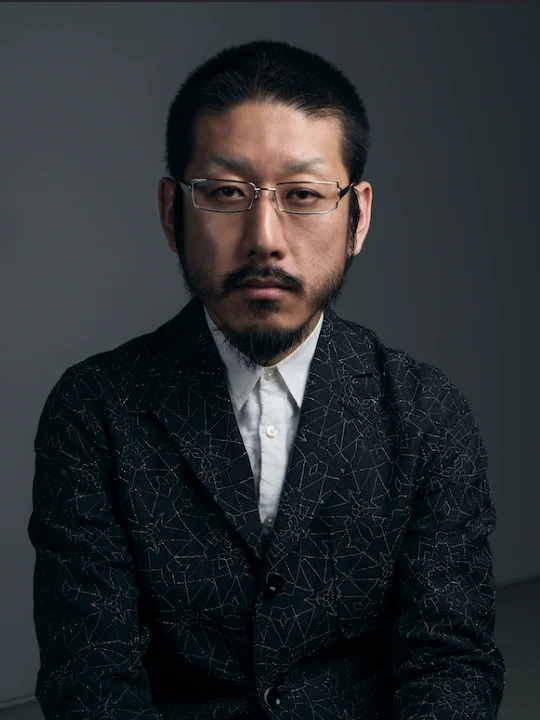
Kunihiko Morinaga
Japanese designer and ANREALAGE founder who uses light, geometry and responsive materials to move clothing between real and unreal.
Kunihiko Morinaga has designed ANREALAGE since establishing it in 2003. The name joins A REAL, UN REAL and AGE, and the opposition is more than a slogan: Morinaga repeatedly makes one garment occupy two states. A dress appears blank until ultraviolet light develops its pattern; a dark surface returns a hidden image under a camera flash; a flat circle or square becomes clothing only after it is placed on a body. (ANREALAGE; Maison de la culture du Japon à Paris)
Technology attracts much of the attention, but it is not the origin of the practice. ANREALAGE began with laborious patchwork and with Morinaga's belief that “God is in the details.” Light-responsive compounds, reflective textiles, three-dimensional scanning and augmented reality arrived as new ways to pursue the same problem: how close looking can make an ordinary object disclose another reality. (Vogue Japan; ANREALAGE)
Two schools at once
Morinaga was born in Kunitachi, Tokyo, in 1980. He studied social sciences at Waseda University while also attending Vantan Design Institute to learn clothes-making. He has cited Keisuke Kanda, another Waseda student working across university and fashion school, as an important example of a path that had not initially seemed available to him. Morinaga graduated from Waseda in 2003 and began working under the ANREALAGE name that year. (ANREALAGE; Vogue Japan)
The early garments were assembled from innumerable small scraps, making the designer's maxim literal. In 2005 he won the GEN ART avant-garde prize in New York. That same year, ANREALAGE and Keisuke Kanda held a Spring/Summer 2006 presentation in the main observatory of Tokyo Tower, which became Morinaga's Tokyo Collection debut. The date and the named season are both useful: “debuted in 2005” describes the event, while “Spring/Summer 2006 debut” describes the clothes. (ANREALAGE; PARCO Museum Tokyo)
International exhibitions supplied another route outward. ANREALAGE appeared in a Stockholm museum exhibition in 2009 and in Future Beauty: 30 Years of Japanese Fashion from 2010. Morinaga opened a Harajuku shop and received the Mainichi Fashion Grand Prix's Newcomer Award and Shiseido Sponsorship Award in 2011. The recognition placed a small experimental studio inside the longer history of Japanese designers who treated pattern and fabric as research. (PARCO; ANREALAGE)
Geometry becomes clothing
The collections before Paris often took a blunt formal proposition and followed it all the way through. ○△□ for Spring/Summer 2009 placed circle, triangle and square against the body. WIDESHORTSLIMLONG for Autumn/Winter 2010 distorted standard size relationships. AIR, SHELL and BONE successively considered inflated volume, an outer casing and an internal framework. SIZE for Spring/Summer 2014 presented one design across radically different scales. (ANREALAGE collection archive; Maison de la culture du Japon à Paris)
These clothes can look conceptual in a runway image, but the questions begin with dressing. A sphere has no obvious front, back or sleeve; cutting it into a wearable form forces a new relationship between geometry and anatomy. Morinaga has compared the method to peeling an orange and returning its skin to a flat plane. The object is mathematically simple until a human body makes it asymmetrical. (Vogue Japan; Tokyo Knit)
Light as a second pattern
Morinaga moved his principal show platform to Paris in September 2014 with the Spring/Summer 2015 collection SHADOW. As with the Tokyo debut, reports calling this “the 2014 Paris debut” and archives placing it in Spring 2015 are describing presentation date and collection season respectively. The clothes used photochromic material: ultraviolet light caused apparently pale surfaces to develop colour and pattern, so the outdoor world completed what the studio had begun. (Vogue Japan; ANREALAGE)
The following collections treated illumination almost as a second patternmaker. LIGHT and A LIGHT UN LIGHT staged visibility and darkness; REFLECT hid imagery that a flash could reveal; PRISM broke light into colour; CLEAR worked through transparency. A normal photograph and a flash photograph could therefore document different garments even though the cloth had not changed. (ANREALAGE; PARCO)
The key material was often developed outside a conventional fashion supply chain. For the 2020 collaboration with Fendi, Morinaga worked with Mitsui Chemicals on photochromic technology that responds to ultraviolet light. The project was presented during Milan Fashion Week and was described by ANREALAGE as Fendi's first collaboration with a Japanese designer. It demonstrated what Morinaga can contribute to a much larger house: not a decorative signature, but a mechanism that changes the garment over time. (Mitsui Chemicals; ANREALAGE)
Clothes across physical and digital space
Later work widened “real and unreal” beyond physical material. ANGLE for Spring/Summer 2020 changed printed proportions according to viewpoint. HOME was made during the pandemic for remote presentation. DIMENSION and PLANET placed physical clothes beside digital counterparts, while subsequent projects used augmented reality and NFTs without abandoning cut-and-sewn garments. The point was not that virtual clothing would replace real clothing; it was that each could expose the assumptions of the other. (Vogue Japan; ANREALAGE collection archive)
Morinaga also designed the dress worn by Belle in Mamoru Hosoda's 2021 film Belle (Ryū to Sobakasu no Hime). A flower-like physical costume and its digital animation belonged to a story about an avatar living in another reality, making the commission unusually close to ANREALAGE's standing concerns. He separately designed the official uniforms for the Japan Pavilion at Expo 2020 Dubai. (ANREALAGE; Itochu Monthly)
For Expo 2025 Osaka, Kansai, he designed NTT Pavilion staff uniforms inflated by small fans—clothing that asked the wearer to “put on the wind.” A continuing Doraemon project approached the familiar manga character through circles, pockets and future-facing technology rather than simply printing an image. These public commissions show how Morinaga translates runway experiments into objects that must communicate immediately to people who may never follow fashion. (Vogue Japan; ANREALAGE)
Recognition without resolution
Morinaga was an ANDAM finalist in 2015, an LVMH Prize finalist in 2019 and winner of the 37th Mainichi Fashion Grand Prix that same year. By then ANREALAGE had moved far beyond its handmade-patchwork beginnings, but the award record should not turn its development into a simple ascent from craft to technology. Patchwork and responsive textiles both depend on accumulated small decisions; one makes labour visible, while the other hides it until light activates the surface. (PARCO Museum Tokyo; Mainichi Fashion Grand Prix)
The brand's recent collection sequence—INVISIBLE, OBJECT, WIND and SCREEN—continues to move between presence and absence. In 2025 Morinaga received a WIRED Innovation Award, recognition of a practice that has made collaboration with scientists and engineers part of fashion authorship rather than backstage problem-solving. As of September 2026, ANREALAGE's own corporate material still identifies him as its representative director, founder and designer. (ANREALAGE; ANREALAGE)
Identifying ANREALAGE
There is no dependable public label code that converts every ANREALAGE garment into a season. ANSEASON ANREALAGE, introduced as a more everyday line, should not be confused with the runway collection, and collaboration labels may place a partner's name more prominently than the house's. The safest identification route is the full care label and style number, followed by comparison with ANREALAGE's official collection archive. (ANREALAGE collection archive; Kumamoto City Museum of Contemporary Art)
Visual clues can narrow the search. Dense hand patchwork tends towards the early years; enlarged geometric volumes point towards the 2009–14 Tokyo period; pale textiles that change under ultraviolet light belong to the SHADOW/LIGHT family; flash-revealed graphics suggest REFLECT; and deliberate optical distortion may lead to ANGLE. Those are starting points, not authentication rules. Morinaga repeats technologies and ideas because their meaning changes with context.
References
- ANREALAGE. “Brand.” Official profile, accessed September 2026.
- Mitsuko Watanabe. “森永邦彦が語る、アンリアレイジの現在地.” Vogue Japan, 19 May 2015.
- Vogue Japan. “アンリアレイジ、パリコレデビューまでの軌跡.” October 2014.
- Maison de la culture du Japon à Paris. “ANREALAGEの服.” Accessed September 2026.
- PARCO Museum Tokyo. “A LIGHT UN LIGHT.” Exhibition profile, accessed September 2026.
- PARCO. “ANREALAGE: A LIGHT UN LIGHT.” Exhibition release, 2018.
- ANREALAGE. “ANREALAGE: A&Z.” Official project archive.
- ANREALAGE. “A LIGHT UN LIGHT COLLECTION at Tokyo.” 2018.
- Tokyo Knit. “森永邦彦インタビュー.” March 2021.
- Mitsui Chemicals. “光で色が変わる服、FENDI×ANREALAGE.” 17 February 2021.
- Vogue Japan. “視点を操るアンリアレイジの2020年春夏.” 27 September 2019.
- ANREALAGE. “映画『竜とそばかすの姫』衣装デザイン.” 2021.
- Itochu. “ドバイ万博日本館ユニフォームと森永邦彦.” 繊維月報, May 2022.
- Vogue Japan. “大阪・関西万博、NTTパビリオンの制服.” 2025.
- Mainichi Fashion Grand Prix. “第37回毎日ファッション大賞.” 2019.
- ANREALAGE. “WIRED Innovation Award 2025.” 2025.
- ANREALAGE. “森永邦彦プロフィール.” Accessed September 2026.
- ANREALAGE. “Collection archive.” Accessed September 2026.
- Native name
- 森永邦彦
- Education
- Waseda University, Social Sciences (2003)Vantan Design Institute
- Awards
- GEN ART Avant-Garde Grand Prix, 2005Mainichi Fashion Grand Prix Newcomer Award and Shiseido Sponsorship Award, 2011Mainichi Fashion Grand Prix, 2019
Selected works
No results found
Try adjusting your filters or search terms.