
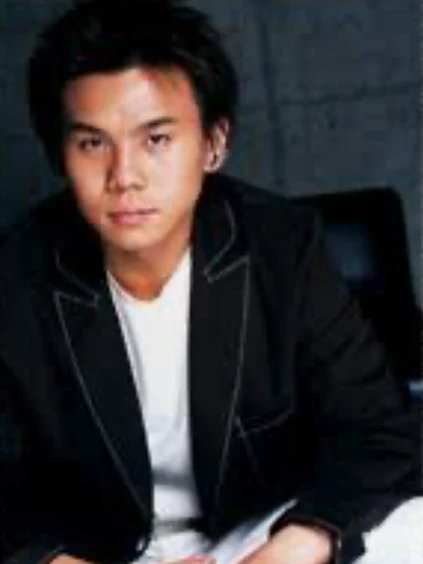
Mitsuhiro Matsuda
Japanese designer who founded NICOLE in 1967 and the MATSUDA label, known for romantic, historicist tailoring and for Matsuda eyewear.
Mitsuhiro Matsuda died on 17 May 2008, at 4.42am, of hepatocellular carcinoma, in a hospital in Minato-ku, Tokyo. He was 74. The Kyodo obituary carried by regional papers gives the time and the cause, and records that the funeral was held privately by his family. Dates circulating in resale listings that place his death in March 2008 are wrong. (Shikoku Shimbun / Kyodo; Kotobank)
He is the least-remembered member of the generation that took Japanese fashion abroad. Rei Kawakubo, Yohji Yamamoto and Issey Miyake are remembered because their work argued with the idea of a garment; Matsuda's did not. He made romantic, historicist, densely detailed clothes — Edwardian collars, embroidered knitwear, English tailoring recut for women — and a reputation built on refinement is harder to summarise than one built on rupture. Contemporary reference works described him as someone who trod "the fine line between sophistication and adventure," drawing on Burne-Jones paintings, Moroccan embroideries and Miles Davis in the same breath. (Contemporary Fashion, via Encyclopedia.com)
From Waseda to Sukiyabashi
Matsuda was born in Tokyo on 2 April 1934. He graduated from Waseda University in 1958, then entered Bunka Fashion College, taking a fashion design qualification in 1961. His year at Bunka is the celebrated one: he studied in the design course alongside Kenzo Takada and Junko Koshino, the cohort Japanese writers still call the school's "flower class." He then worked as a ready-to-wear designer at the retailer Sanai. (Shikoku Shimbun / Kyodo; Contemporary Fashion; Fashion Headline)
In the mid-1960s he travelled to Paris with Takada by ship. Takada stayed; Matsuda returned to Tokyo. That divergence set the shape of his career — an international designer whose base never moved from Japan. Two years after the trip, in March 1967, he opened a boutique called NICOLE in the Sukiyabashi Hankyu store, which the company treats as its founding. A directly operated boutique in Aoyama followed in November 1968, and Nicole Co., Ltd. was incorporated in October 1971 with Matsuda as representative director. (NICOLE; digital-zasshi)
English-language reference works usually give 1971 as the founding date, because that is when the company was registered; the brand and the first shop predate it by four years. Both figures are correct about different things, and a listing that dates a garment from "the founding" needs to say which one it means. (Contemporary Fashion; NICOLE)
One designer, many labels
Nicole grew by division rather than by diffusion. MONSIEUR NICOLE launched in March 1974, MADAME NICOLE in September 1976, ZELDA in November 1979 and NICOLE CLUB in November 1981. Reference sources add Chambre de Nicole in 1978. Each was a distinct commercial proposition sharing one design sensibility, and the company staffed them largely from Bunka graduates working under Matsuda — among them Mariko Kohga, who joined in 1974 and later had her own line, Hiromichi Nakano, who joined in 1972 at twenty-one after simply writing Matsuda a letter, and Yukio Kobayashi, who joined in 1976 on Monsieur Nicole. (NICOLE; Vintage Fashion Guild; Fashion Guide; Inter Belle)
The export name was not NICOLE but MATSUDA. MATSUDA U.S.A. INC. was established in January 1982; the New York boutique — the Madison Avenue shop most readers will have heard of — opened that March, and a Hong Kong company and a Central Hong Kong boutique followed in August and September of the same year. MATSUDA was shown at the New York collections from May 1983. A French subsidiary was set up in December 1986 and MATSUDA PARIS opened in September 1987. (NICOLE)
Matsuda also took part in the Paris collections, although surviving company histories do not identify the seasons. NICOLE's chronology instead fixes the expansion through its French subsidiary, established in December 1986, and the MATSUDA PARIS shop, opened the following September. (Shikoku Shimbun / Kyodo; NICOLE)
Why the work reads differently
Matsuda's clothes were built out of separates: silk blouses, elongated jackets, trousers, waistcoats and embroidered sweaters, pragmatic enough to be worn as a working wardrobe and romantic enough to look like costume in a photograph. He treated Anglo-American tailoring as source material to be examined with, in the phrase of one period assessment, a "critical, slightly adverse edge" — the tweeds and the tailoring are recognisable, the proportions and the surface are not. Vintage dealers describe the result as an understated New Romanticism, oversized and close to unisex, in which every component down to an individual button has been decided. (Contemporary Fashion; Gem)
That is also one reason he fell out of the international story. Deconstruction gave critics a thesis to write about; historicist refinement gave them a sample of fabric. Matsuda's clothes reward handling more readily than explanation, an advantage in a wardrobe and a disadvantage in a canon. (Contemporary Fashion; Gem)
It also matters that Matsuda's domestic reputation was built inside a phenomenon that did not travel. NICOLE was one of the houses of the DCブランド (DC burando) boom — "designer and character brand," the Japanese term for the designer-led labels that dominated Tokyo retail through the 1980s, sold through department-store floors and their own boutiques to a young domestic customer. Trade histories place TD6 and the early Tokyo collections squarely in that period. A designer whose commercial base was a Japanese boom, rather than a Paris show calendar, left a smaller trace in the English-language record even while his shops were open on Madison Avenue. (Fashionsnap; NICOLE)
His own statements were about the wearer rather than the theory. Interviewed by Croissant in September 1978, he said he wanted women to be told not that they were "cute" but that they were "beautiful" or "wonderful" — and that this came from earning your own money and making your own choices rather than from the name on the label. (Croissant Online)
Building Tokyo a calendar
Matsuda's other work was institutional. He was one of the founders of TD6 (Tokyo Designer Six), the designers' group formed to establish Tokyo as a centre of fashion creation and credited with creating the city's first official fashion week; vintage-trade accounts date TD6 to 1974, while Japanese trade histories describe it as active without fixing the year. (Vintage Fashion Guild; Gem; Fashionsnap)
The better-documented step came a decade later. In July 1985 the 東京ファッション・デザイナー協議会 (Council of Fashion Designers, Tokyo — CFD) was established; the six founders were Rei Kawakubo, Matsuda, Issey Miyake, Hanae Mori, Kansai Yamamoto and Yohji Yamamoto, and Matsuda became one of its officers. The first Tokyo prêt-à-porter collection had opened that April, on the 16th. The Tokyo show calendar that later designers inherited is partly his administrative work. (Fashionsnap)
Eyewear, and the name after 2008
Most readers today meet Matsuda through spectacles rather than clothes. The eyewear grew out of the American business of the early 1980s, and frames have been produced in 鯖江 (Sabae), the Fukui town that makes most of Japan's spectacle frames, since 1989. Retailers disagree about when the line formally began — some date it to 1982 with the US expansion, others to 1989 — so treat a confident start year with suspicion. Two frames carried the name into general recognition: the 2809, worn by Sarah Connor in Terminator 2 (1991), and the M3023, worn by Tony Stark in Iron Man 3 (2013). (Dig-it; Glass Factory; Downtown)
The clothing and the eyewear separated during his lifetime. In the mid-1990s the womenswear labels were put under Yukio Kobayashi while Matsuda concentrated on eyewear, and the ready-to-wear wound down from there. After his death the eyewear name was relaunched in 2011 and is now run as a Japanese luxury brand for international markets, hand-made in Fukui. Nicole Co., Ltd. continues in Japan with the NICOLE CLUB and HIDEAWAYS labels, rebranding 179/WG as NICOLE CLUB in September 2023. (Vintage Fashion Guild; Downtown; NICOLE)
Reading and dating a Matsuda garment
Start with the label wording, because the house used several and they are not interchangeable. Matsuda and Matsuda Nicole of Tokyo are the export-facing names used on garments sold through New York, Hong Kong and Paris from 1982 onward. MONSIEUR NICOLE (from 1974) is menswear, MADAME NICOLE (from 1976) womenswear, and ZELDA (from 1979) and NICOLE CLUB (from 1981) are separate lines for the Japanese market. A NICOLE-only label is a domestic garment; a MATSUDA label usually is not. (NICOLE; Vintage Fashion Guild)
Japanese sellers mark pieces they believe Matsuda designed himself as 本人期 (honnin-ki) — literally "the person's own period." The term is useful shorthand and unreliable as evidence: no published label change marks the mid-1990s handover of the womenswear lines to Kobayashi, so honnin-ki is a seller's judgement about a garment, not a documented fact about a stamp. Ready-to-wear under his own direction is effectively an early-1970s to mid-1990s phenomenon, which is why surviving pieces are comparatively scarce. (Vintage Fashion Guild; Gem)
Finally, do not read the eyewear back onto the clothes. A frame marked MATSUDA may have been made at any point from the 1980s to this season, including post-2011 production and archive reissues of 1970s and 1980s designs, and none of that tells you anything about the date of a jacket carrying the same name. Judge a garment on its label wording, its construction and its fabric, and treat the founding dates — 1967 for the brand, 1971 for the company, 1982 for MATSUDA abroad — as boundaries rather than as a date code. (NICOLE; Dig-it)
References
- Kyodo News. "松田光弘氏死去/ファッションデザイナー." Shikoku Shimbun, 18 May 2008.
- "松田光弘(まつだ みつひろ)." デジタル版 日本人名大辞典+Plus, via Kotobank. Accessed 11 September 2026.
- NICOLE Co., Ltd. "HISTORY." Accessed 11 September 2026.
- "Matsuda, Mitsuhiro." Contemporary Fashion, 2nd ed., St. James Press, via Encyclopedia.com.
- Ranch Queen Vintage. "Matsuda." Vintage Fashion Guild Label Resource. Accessed 11 September 2026.
- "Mitsuhiro Matsuda, the Forgotten Master." Gem, 1 April 2025.
- "東京コレクションはどのようにして始まったのか?歴史と変革." Fashionsnap, 20 October 2017.
- 澁川祐子. "「美しい」とか「素晴らしい」とか、そういうほめ言葉を与えられる女性に." Croissant Online, quoting Croissant, 10 September 1978.
- "4月2日はニコル創業者・松田光弘の誕生日です。" Fashion Headline, 2 April.
- "松田光弘(NICOLE創業者)のプロフィール." digital-zasshi. Accessed 11 September 2026.
- "東京コレクションの創設者・松田光弘氏が手掛ける「マツダ アイウェア」." Dig-it, 19 February 2024.
- "MATSUDA(マツダ)とは?|創設者・歴史・名作モデル・日本製の魅力." Downtown. Accessed 11 September 2026.
- "MATSUDA BRAND HISTORY." Glass Factory. Accessed 11 September 2026.
- "ニコル(松田光弘創業)出身のデザイナー情報." Fashion Guide. Accessed 11 September 2026.
- "中野裕通 Vol.2「原宿にいたい」一心で「ニコル」に入社." Inter Belle. Accessed 11 September 2026.
- Born
- April 2, 1934
- Died
- May 17, 2008
- Native name
- 松田光弘
- Education
- Waseda University (1958)Bunka Fashion College, Fashion design (1961)
Selected works
No results found
Try adjusting your filters or search terms.