
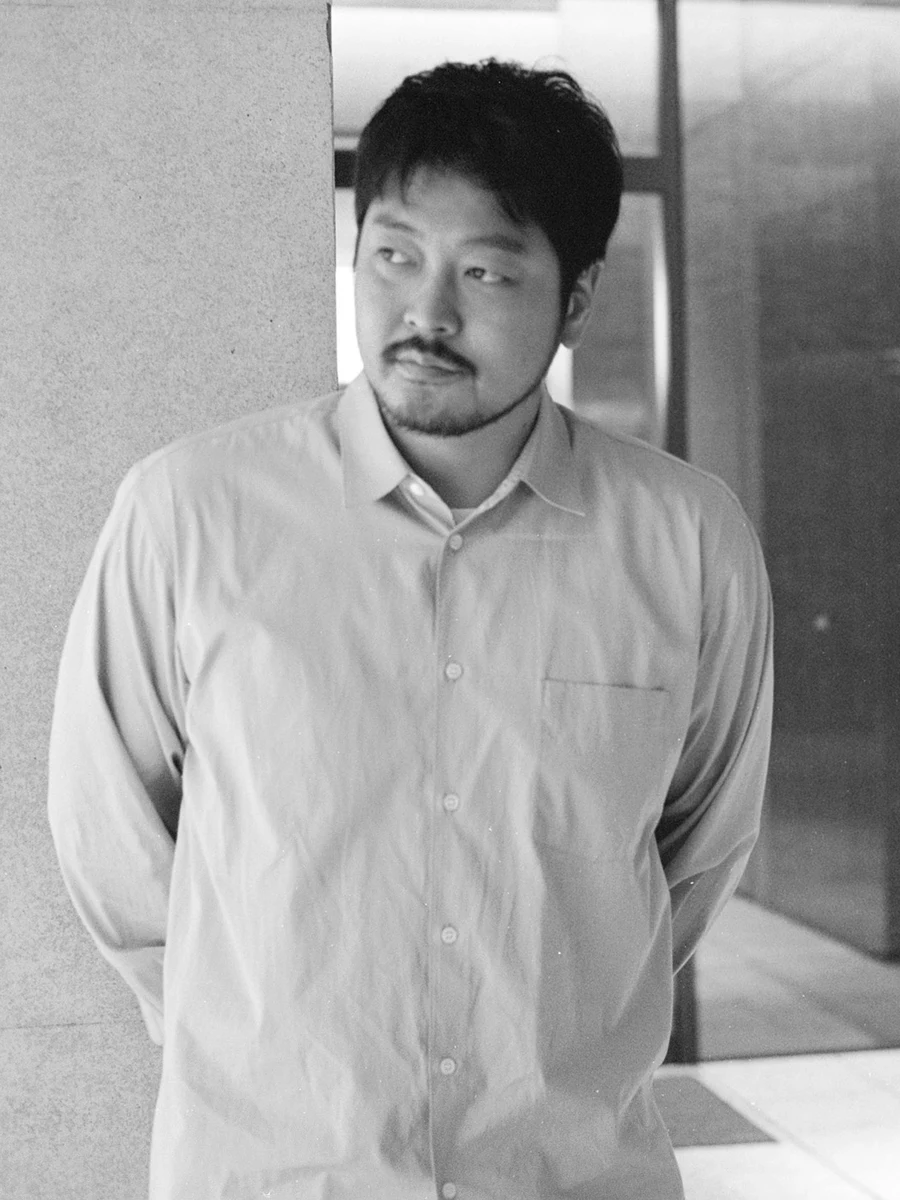
Soshi Otsuki
Japanese designer and SOSHIOTSUKI founder who recasts Shōwa-era salaryman tailoring as soft, emotionally charged contemporary menswear.
Soshi Otsuki founded SOSHIOTSUKI in 2015, but the label most people now recognise took shape almost a decade later. From Spring/Summer 2025 he narrowed its centre of gravity to the Japanese salaryman suit—especially the broad, soft tailoring associated with the late Shōwa and bubble-economy years. That sharper identity preceded his 2025 LVMH Prize grand prix, which made him the third Japanese designer to win the award. (Vogue Japan; LVMH Japan)
Calling the work “Japanese Armani” catches only its surface. Otsuki admires the ease and authority of 1980s Giorgio Armani, but he is equally interested in the imperfect Japanese imitations that followed: suits absorbed through magazines, department stores, offices and fathers' wardrobes. His tailoring holds admiration and embarrassment together. It is not a reconstruction of Italian luxury; it is a study of how aspiration changes a borrowed form.
Bunka, Coconogacco and an early label
Otsuki was born in Chiba Prefecture in 1990. He graduated from Bunka Fashion College's menswear course in 2011 and, while enrolled, also attended Coconogacco, the independent school founded by Yoshikazu Yamagata. Bunka supplied technical discipline; Coconogacco asked students to build a personal reason for making clothes rather than chase an accepted image of professional polish. (Vogue Japan; FASHIONSNAP)
He launched SOSHIOTSUKI with Autumn/Winter 2015. The early collections approached Japanese dress more directly through kimono structure, Buddhist clerical robes, mourning clothes, mizuhiki knots and chrysanthemum imagery. In 2016, only a year after launch, he reached the LVMH Prize shortlist and was its youngest Japanese nominee; he presented in Paris the following year. (GQ Japan; Vogue Japan)
That recognition did not immediately settle the business or the design. Otsuki won professional support from the Tokyo New Designer Fashion Grand Prix in 2019, established a company in 2021 and received the Tokyo Fashion Award in 2024. He later spoke about looking back at his own shows and feeling that the result had drifted from what he had originally wanted. The Spring/Summer 2025 reorientation was therefore less a sudden invention than an edit: removing broad symbols of “Japan” until one lived and emotionally specific form remained. (Vogue Japan; THEM Magazine)
The salaryman suit as memory
The decisive reference was his father's wardrobe. Otsuki turned one lapel outward and found that the exposed underside changed the jacket into something resembling a frock coat. That observation became the inside-lapel jacket, a signature that feels strange without requiring added ornament. The gesture is modest enough to be believable as something a wearer discovered accidentally, yet it rewrites the jacket's line from neck to hem. (Vogue Japan; GQ Japan)
Other changes work with the remembered proportions of Japan's late 1980s and early 1990s. Gorge lines sit low; lapels spread; shoulders and sleeves soften; pockets and cuffs grow slightly too large; wide trousers fall far enough to puddle above the shoe. Fusing placed around an inner pocket can hold shape without giving the entire jacket a rigid chest. A shirt front may be cut and draped so that it reads like a necktie, turning office uniform into one continuous construction. (Vogue Japan; Fashion Post)
Otsuki calls part of this approach “designing without designing.” It does not mean an absence of decisions. It means resisting the urge to display skill through unnecessary novelty and altering a traditional form only where the alteration earns its place. The designer has also described an “aspiration system”: because he did not inherit the codes of European luxury as natural authority, his distance from them becomes material he is free to misuse. (Vogue Japan; THEM Magazine)
This makes the suits emotional without relying on costume. For Japanese viewers of Otsuki's generation, the broad silhouette may recall a father leaving for work, television dramas, corporate portraits or the remains of bubble-era confidence. For someone without those memories, it still operates as soft, slightly dislocated tailoring. The local reference deepens the garment but does not have to be decoded before it can be worn.
Winning the LVMH Prize
Otsuki returned to the LVMH Prize in 2025, nine years after his first shortlist, and won the grand prize on 3 September. The award included €400,000 and a year of mentorship from LVMH specialists. The jury recognised a body of work that had become more specific, not more internationally generic: the collection's strength depended on a Japanese history of wearing and misreading the Western business suit. (Vogue Japan; LVMH Japan)
Spring/Summer 2026 continued through the bubble years. A reversed pocket created a deliberate crease and a place for the hand, turning habitual gesture into patternmaking. Otsuki's references expanded beyond the office while keeping that silhouette as an anchor: masculine display, dated ideas of success and the tenderness of borrowed clothes could coexist in one suit. (Vogue Japan; GQ Japan)
The December 2025 Zara collaboration, A Sense of Togetherness, was his first project spanning womenswear, menswear and childrenswear, with an item for dogs as well. The scale could easily have dissolved the label's identity; instead, it tested whether the soft proportions and family-memory premise could survive mass distribution and multiple bodies. (Vogue Japan; Vogue Japan)
From Tokyo to Florence and Paris
In January 2026 SOSHIOTSUKI appeared as a guest designer at Pitti Uomo in Florence, presenting Autumn/Winter 2026–27 in the label's first overseas runway show. The setting mattered because Otsuki's work has a running conversation with Italian tailoring, but the show arrived from a specifically Japanese route through that tradition. (WWDJAPAN; Fashion Post)
The label then joined the official Paris schedule with a first show on 27 June 2026 for Spring/Summer 2027. Titled The Persistence of Memory, it imagined nostalgia for a resort that Otsuki had never known. Jackets and trousers appeared loosened, melted or partially undone; the familiar salaryman was displaced into holiday memory. Shoes developed with Asics kept the collection connected to contemporary Japanese manufacture rather than treating Paris as an escape from it. (Vogue Japan; FASHIONSNAP)
By September 2026 Otsuki was also serving as a judge for the So-en Award, an important Japanese student-fashion competition. It is a small but telling reversal: fifteen years after leaving Bunka, he had moved from a student shaped by Japanese fashion education to someone helping evaluate its next entrants. (So-en; Bunka Fashion College)
Reading SOSHIOTSUKI
The label does not offer a public universal season-code guide, so dating should begin with the full care tag and style number, then be checked against official collection images. Early pieces may feature kimono-derived wraps, religious-dress references or explicit Japanese emblems. From Spring/Summer 2025, the most reliable clues are tailored: the inside-out lapel, low gorge, enlarged cuff, soft shoulder, draped necktie shirt and very long, wide trouser.
Those clues also prevent the recent work from being reduced to oversizing. Proportion is only one layer. Turn the jacket over and inspect how the lapel has been built; look inside for local fusing and unusual pocket construction; follow whether a shirt's “tie” is applied or cut from the body. Otsuki's argument lives in these quiet decisions. The suit looks inherited because it is culturally inherited, but its pattern is new.
References
- Hiroaki Nagahata and Reona Kondo. “ソウシオオツキ・大月壮士が語る、『デザインをしない』ことで生まれる新たなスーツ.” Vogue Japan, 5 September 2026.
- GQ Japan. “大月壮士が再構築する、日本のスーツ.” 4 September 2025.
- GQ Japan. “新世代デザイナー、大月壮士.” 14 September 2023.
- Megumi Otake, Yaka Matsumoto and Sakura Karugane. “大月壮士──『日本人のエモーショナルな部分を表現してみたくなった』.” Vogue Japan, 1 December 2025.
- LVMH Japan. “2025年度LVMHプライズ:受賞者発表.” 3 September 2025.
- Vogue Japan. “LVMHプライズ2025、ソウシオオツキの大月壮士がグランプリを受賞.” 4 September 2025.
- THEM Magazine. “Interview with Soshi Otsuki.” Accessed September 2026.
- FASHIONSNAP. “『ここのがっこう』が育てるもの.” Accessed September 2026.
- Fashion Post. “大月壮士の現在地.” January 2026.
- Vogue Japan. “SOSHIOTSUKIとZARAによるA Sense of Togetherness.” December 2025.
- WWDJAPAN. “ソウシオオツキがピッティ・ウオモで海外初のショー.” January 2026.
- Vogue Japan. “ソウシオオツキ 2027年春夏メンズウェア.” 27 June 2026.
- FASHIONSNAP. “SOSHIOTSUKI 2027年春夏コレクション.” June 2026.
- So-en. “第100回装苑賞、新審査員に大月壮士.” 24 August 2026.
- Bunka Fashion College. “卒業生・大月壮士.” Accessed September 2026.
- Native name
- 大月壮士
- Education
- Bunka Fashion College, Menswear (2011)Coconogacco
- Awards
- Tokyo New Designer Fashion Grand Prix, Professional Division, 2019Tokyo Fashion Award, 2024LVMH Prize for Young Fashion Designers, 2025
Selected works
No results found
Try adjusting your filters or search terms.