
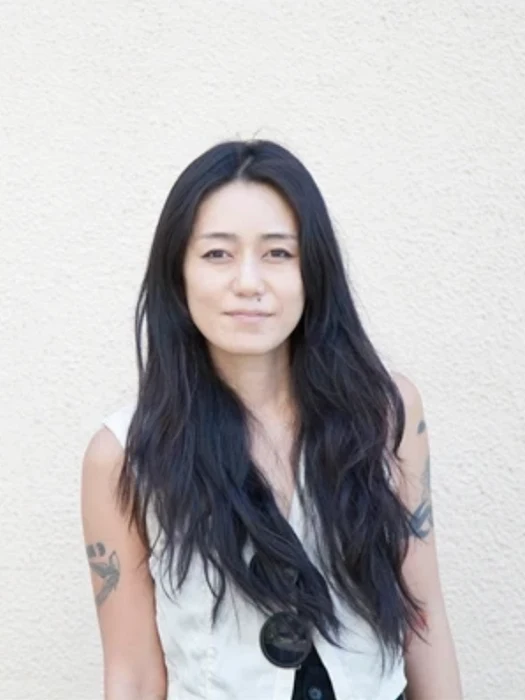
Limi Yamamoto
Japanese designer and founder of LIMI feu, the label she has run apart from her father Yohji Yamamoto's company since 2006.
Limi Yamamoto (山本里美) is the founder and designer of LIMI feu, the Tokyo house she has run under her own name since renaming it from Y's bis LIMI in 2002. She is not a junior voice inside her father's studio: LIMI feu keeps its own design and pattern room, and since 2006 has traded as a separate company, incorporated with Yohji Yamamoto as chairman rather than as creative director. (Fashion Press) The two houses are easy to conflate — she is his daughter, both work chiefly in black, and both have shown in Paris — but design authorship, and since 2006 the corporate structure, are hers. (fashion-guide.jp)
She has also described their methods as running in opposite directions. Where Yohji Yamamoto designs toward a predetermined idea of how a woman should look, Yamamoto works from her own body outward — wearing and testing a piece herself, adjusting it to how it feels to move in, and only then deciding who it is for. She has called her father "カリスマであり、異次元の人" (a charismatic figure, a person from another dimension), language that names the relationship while keeping a clear distance from it. (fashion-hr.com)
From Fukuoka to the pattern room
Yamamoto was born in Fukuoka Prefecture in 1974; no exact birth date has been published. She studied at Bunka Fashion College in Tokyo, which her father had attended a generation earlier, and joined Yohji Yamamoto Inc. after graduating in 1996. She then trained as a patternmaker in the Y's Atelier for about two years before her October 1999 appointment as a designer, although accounts do not detail the remainder of the three-year interval. (Fashion Press; digital-zasshi; GSC RINKAN)
Patternmaking is the stage between a sketch and a finished garment: the patternmaker works out how flat pieces of cloth take on volume and movement around a body. Yamamoto's apprenticeship shows in how concretely she describes her process — less as image-making than as a problem tested on a body, including her own. (fashion-hr.com)
In October 1999, Y's — the Yohji Yamamoto group's mainline womenswear label — appointed her designer of a new collection, Y's bis LIMI, which she presented for the first time at the Autumn/Winter 2000 Tokyo Collections. (GSC RINKAN) From Autumn/Winter 2002 the line was renamed LIMI feu — her own name joined to the French word for fire — dropping the Y's bis prefix along with the sense that it belonged to someone else's brand. Garments and collection material from the two seasons before the rename carry the Y's bis LIMI name, not LIMI feu; the wardatrobe guide to Yohji Yamamoto's lines covers where LIMI feu sits alongside Y's, Y-3, Ground Y and the company's other labels. (Fashion Press)
A design method run in reverse
Yamamoto has said that ideas for a collection do not come from searching for them; something catches her attention, sits unresolved, and resurfaces later — often because someone else independently draws her back to it — at which point she recognises it as ready to become clothing. Sustaining a label over decades, she has said, comes down to a designer's "unwavering thoughts and consistent vision" rather than a hunt for novelty each season. (Fashion Press)
She has named the women she imagines wearing LIMI feu as a specific type rather than a market segment: figures such as the photographer Sarah Moon, the choreographer Pina Bausch and the musician Fiona Apple, women who "carve their own paths at their own pace" and carry a quality she calls slightly divergent from the mainstream. Dressed in the label's black, structured, often voluminous pieces, she has said, that quality becomes visible as "inner harshness and intensity" rather than being smoothed over. (Fashion Press) A recent house description of the collection concept, issued for the Autumn/Winter 2026–27 range, keeps the same idea in brand language: designs built around atmosphere, proportion and wearability, avoiding decoration or exaggeration, and deliberately leaving blank space for the wearer's own character to occupy the clothes. (Yohji Yamamoto Inc. press release)
Building a company of her own
LIMI feu opened its first standalone shop in Daikanyama, Tokyo, in December 2003, on a site Yamamoto is reported to have chosen herself, and added TRACE, a secondary, lower-priced line, in 2004. (GSC RINKAN) In September 2006 the label was carved out of Yohji Yamamoto Inc. into its own company, with Yohji Yamamoto taking the chairman's seat rather than a design role and Yamamoto herself sitting on the board as designer; Japanese trade reporting frames this as part of a push toward overseas growth. (Fashion Press)
That growth arrived the following year. LIMI feu made its Paris ready-to-wear debut in autumn 2007, for Spring/Summer 2008, and within two seasons the brand was stocked at more than fifty retailers internationally and had expanded into a children's line. (digital-zasshi; Fashion Press; AFPBB News) In June 2008 she received the FEC Award for Designer of the Year in its newly created domestic category — an award her father had also won — and used the moment to draw a line under comparison rather than lean on it: "overseas journalists try to find what makes me different from my father," she said, adding that she wanted the industry to recognise "the pride of eight years" of independent work and that she had no intention of resting on the award. She also noted that the response from customers who actually wore the clothes had arrived faster, and felt more genuine, than the response from the press. (AFPBB News)
Choosing a smaller scale
LIMI feu's Paris presence did not become permanent. According to one Japanese profile, the label kept a regular Paris runway slot for around five years before stepping back to irregular, exhibition-style presentations in Japan instead; that specific claim rests on a single source and has not been corroborated elsewhere, so it should be read as one account rather than a settled fact. (digital-zasshi) What is better documented is that seasonal retail collections have continued without interruption: LIMI feu added the PRODUCT 0 sub-line in 2017, and collaborated with Windandsea, Dickies and Lee between 2020 and 2022, and the house was still releasing seasonal collections as designed by Yamamoto as of the Autumn/Winter 2026–27 range, which reached stores from 10 July 2026. (Fashion Press; Yohji Yamamoto Inc. press release)
Yamamoto has connected the deliberately contained scale to her method as much as to circumstance, saying she wants to keep producing clothing at a size she can personally oversee, so the people who work for her can be supported by it. Read against the 2008 Paris expansion, the later retreat to a smaller footprint looks less like a step back than a return to the working method she describes: judging a garment on her own body first, at a pace she controls. (GSC RINKAN)
Taken together, the two decades run in an unusual shape for a family label: an apprenticeship inside her father's company, a debut collection that still carried his brand's name on the door, a rename that put her own name on it instead, then a corporate split that made the separation legal as well as creative. Each step moved authorship further from Yohji Yamamoto rather than closer, which is the opposite of how a "daughter of" story is usually expected to run. (Fashion Press; fashion-guide.jp)
Labels, dating and how to read the work
The clearest dating marker in LIMI feu's own history is the 2002 rename. Anything carrying the Y's bis LIMI name predates Autumn/Winter 2002 and belongs to the brand's first two seasons; applying the LIMI feu name to that early run is a retroactive label, not an accurate one for the period. From Autumn/Winter 2002 onward, "LIMI feu" is the correct mainline name to look for on a tag. (GSC RINKAN)
Below the mainline sit distinct, separately priced sub-lines that should not be read as LIMI feu proper: TRACE, launched in 2004 at a lower price point, and PRODUCT 0, added in 2017. A piece from either carries its own line name and is not interchangeable with mainline LIMI feu when dating or valuing it. (Fashion Press) The 2006 change of corporate structure — from a line inside Yohji Yamamoto Inc. to the separately incorporated company that designs LIMI feu today — is chiefly a provenance detail rather than something visible on a garment's tag, but it matters for anyone tracing the business behind a piece, since it marks the point at which LIMI feu stopped being administratively part of its parent company even though Yohji Yamamoto remained its chairman. (Fashion Press)
Because the two houses share a surname, a palette and, for a period, a Paris runway calendar, resale listings sometimes fold LIMI feu into “Yohji Yamamoto.” They are not a single designer's output: the design authorship, and since 2006 the company structure, belong to Limi Yamamoto. The fuller relationship to Y's, Y-3, Ground Y and the rest of the group is set out in the wardatrobe guide to Yohji Yamamoto's lines. (Fashion Press)
References
- Fashion Press. "リミフゥ : LIMI feu." Accessed September 2026.
- Fashion Press. "リミ フゥ デザイナー・山本里美にインタビュー — 服を通して希望を、"自分らしく"前を向きたい人へ." Fashion Press.
- GSC RINKAN. "リミフゥの歴史." RINKAN.
- GSC RINKAN. "リミフゥのこれまでとこれから." RINKAN.
- AFPBB News. "<第51回 FEC アワード>インタビュー:山本里美、デザイナー・オブ・ザ・イヤー受賞について語る." 2 June 2008.
- Fashion HR. "デザイナーの親族が立ち上げたブランド【前編】." Fashion HR.
- fashion-guide.jp. "YOHJI YAMAMOTOとLIMI Feuのターゲット年齢層や歴史の違い比較." fashion-guide.jp.
- digital-zasshi. "山本里美(LIMI Feu)さんの経歴/プロフィール." digital-zasshi.
- Yohji Yamamoto Inc. "LIMI feu 2026-27秋冬コレクションを7月10日(金)より展開開始." PR TIMES, 2 July 2026.
- Wikidata. "Limi Feu (Q6549402)." Accessed September 2026.
- Native name
- 山本里美
- Education
- Bunka Fashion College (1996)
- Awards
- FEC Award, Designer of the Year (domestic category), 2008
Selected works
No results found
Try adjusting your filters or search terms.